


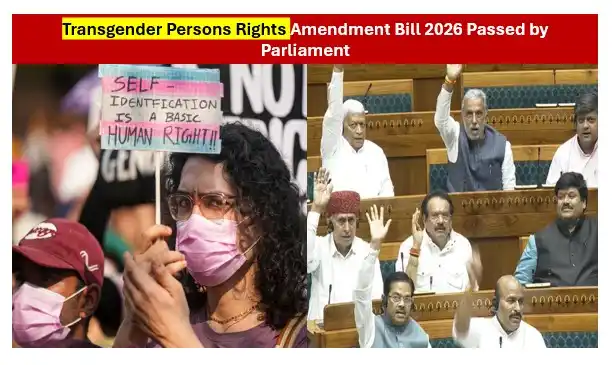
The bill on transgender persons (protection of rights) Amendment Bill, 2026, has been officially approved by the Indian Parliament, and this is one of the most significant (and controversial) changes in the Federal social legislation in recent years. The Rajya Sabha voted in favor, by voice vote after it was cleared by the Lok Sabha earlier this week.
The government is celebrating the move as a step in the right direction to bring administrative sanity and a system of welfare delivery to the real beneficiaries, but the Bill has sparked a tsunami of criticism among human rights activists and opponents leaders. The controversy has at its core a conflict between two worlds: one hard biologicalist and the other soft personality.
Redefining Identity: Self perception to Biology
The most essential alteration that is brought about by the 2026 Amendment is the change in the definition of a transgender person under Indian law. In the Act of 2019, a degree of self-perceived gender identity was also permitted which was later confirmed by the Supreme Court in the landmark NALSA vs. Union of India in 2014.
The new Bill, in its turn, turns on its head in the direction of medicalization. It clearly makes it known that a transgender individual will not and will never have included those with other sexual orientations and self-perceived sexual identities.
you may also like:
- Women Empowerment Gains Momentum
- Karnataka Moves to Crack Down on Honour Killings
- PM Modi speaks on Middle East War for the first time
The main changes in the definition include:
- Biological Focus: The law has now come to largely appreciate individuals who have variances that are intersex or congenitally different in sex characteristics (chromosomes, hormones, or genitalia).
- Socio-Cultural Inclusion: It does not ignore traditional communities like Kiner, Hijra, Aravani, and Jogta, but rather introduces a new word that many activists consider offensive and colonial, namely: eunuch.
- Elimination of Self-Determination: The clause that enabled a person to declare his/her gender by the way he/she feels (self-perception) has been scrapped. The government says that the old definition was too vague to an extent that welfare schemes had the possibility of being abused.
The Emergence of “Clinical Gatekeeping” The Medical Board
With the 2019 Act, a certificate of identity was an administrative procedure largely done with the District Magistrate (DM). The Amendment of 2026 insert an additional test of scrutiny which most people in society call dehumanizing.
An official known as the authority has been appointed to scrutinize applicants and they are called the Medical Board and led by a Chief Medical Officer (CMO) or a Deputy CMO. Identity certificates will now be issued by the District Magistrate by a formal recommendation of this board.
It is an outright attack on the dignity and privacy of the individual to compel him to stand before a board of doctors in order to establish what he is, which was the argument put forward by AAP MP Swati Maliwal in the Rajya Sabha debate.
He was refuted by the Social Justice Minister Virendra Kumar, who said that such a definition is necessary to make sure that the massive payoffs of government programs are not drained away by those who do not encounter the same degree of extreme and oppressive biological discrimination.
Grades of Punishment: a Two-sided Sword?
Among the rather complicated facets of the Bill, the reorganization of the section of Offences and Penalties should be mentioned. The government has also come up with graded punishments with the intended purpose of showing the extent of harm.
- Protecting Against Coercion: The Bill creates a new classification of criminal offense of forcing an individual to accept a transgender identity by mutilation, surgery, or even hormonal treatment.
- In adults: 10-year life imprisonment and a fine of 2 lakh.
- In case of children: Life imprisonment and a fine of 5 lakh rupees as minimum fine.
- Fighting Exploitation: Forcing a transgender individual into bonded labor or begging would now results in the sentence of 5-10 years (to 14 years in case of a child).
- General Abuse: Physically, sexually or emotionally abused and the general abuse continues at least six months, and up to two years.
Although the stricter penalties are to safeguard vulnerable individuals, opponents are concerned that the forced identity provisions might be abused to attack supportive families or physicians who help minors in their gender process and consider it as inducement.
