


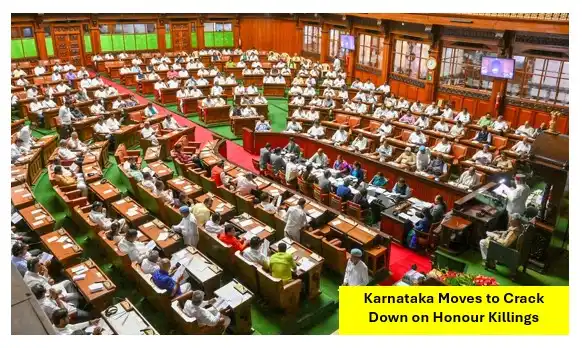
Karnataka’s Assembly passed several Bills to counter what is commonly termed Honour Killing; thus making strides towards addressing crimes borne out of Stigma and Family Pressures. The purpose of these bills is to offer certain legal protections (allowing good protections) to individuals (in particular young couples) who are threatened because of their choice of partners that go against Society or Family.
What does the bill propose?
As per the newly approved legislation, punishments for participants in Honour Crimes will be made severe. Honour Killing will be further defined as appearing in the law more clearly and Honour Killing will now be treated under different legal categories than Homicide.
Provision includes:
- Life in Prison or Death (in extreme cases) will be appropriate for anyone engaging in Honour Killing.
- Accountability for all participants will exist (conspirators [Family Members and Community Groups] will also face legal action).
- Safe Houses and Police Protection for couples who are in danger.
read more: PM Modi speaks on Middle East War for the first time
Focus on Prevention and Protection
In addition to punishment, a large effort will be placed on preventing Honour Crime. Authorities will be given the authority to intervene when an Honour Crime is reported and is a credible threat; District Delegates or Delegated Individuals may monitor vulnerable situations to protect individuals in a timely manner.
In addition, the law provides for special cells and helplines dedicated to providing assistance to persons allegedly subjected to coercion or violence as a result of either a caste-based, religion-based or independently chosen marriage.
read more: A Pledge by PM Modi to protect all citizens
Challenges with Deep-Seated Social Issues
The history of honour killings is associated with traditional caste-based systems, patriarchal values, and rigid social norms. Victims are routinely subjected to violence when they marry out of their caste or religion, and/or when they act contrary to established norms.
Karnataka intends to address these impediments through a well-defined legislative framework, and provide a timely reminder to those who perpetrate violence in the name of ‘honour’ that they will be punished.
read more: Govt amends National Highways Fee Rules 2026
Political and Social Responses
The response to this initiative has been positive, with all groups advocating a strengthening of the law specifically aimed at honour-based violence expressing their support for this legislative initiative. Many view this as a positive step towards aligning legislative activities with the constitutional mandates of equality and personal freedom.
However, there remain criticisms surrounding the need for effective implementation of this law. Many argue that simply having laws will not eliminate such behaviours without parallel efforts being made with respect to education, awareness, and social reform.
The Road Ahead
With only some final documents remaining to be processed, these Bills will eventually become LAW by the Assembly approving them.
If Discretionary Authority is exercised effectively and properly enforced; they could be utilized as a model for other states with similar challenges.
The biggest challenge will be to ensure all women feel comfortable to come forth as victims; to have law enforcement respond immediately upon receipt of reports; and for the community as a whole to begin to eliminate those types of traditions that create the culture of violence against women.
These Legislative Acts represent the Government of Karnataka’s commitment to supporting and protecting individuals and combating honour related violence, but the degree to which the passage of these Bills effects change depends on political will and the further evolution of society as a whole.
