


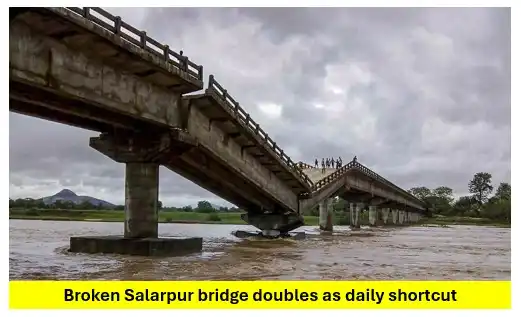
On the silent, dusty fringes of the area, where Noida’s urban sprawl gives way to Salarpur’s rustic pace, is a symbol of structural breakdown and human despair. The Salarpur Bridge, a concrete artery meant to link communities, has been broken for months. But if you show up at 8:00 a.m., you won’t find a scene of abandoned devastation. What you won’t see, however, is the particularly choreographed dance of danger: bicyclists precariously balancing their bikes on narrow slivers of pavement; office workers clutching at their bags as they pick their way zigzag through jagged gaps; schoolchildren merrily hopping across loops of exposed rebar.
What was to be abandoned infrastructure has been redubbed unofficially. To the thousands of people who live in Salarpur and nearby sectors, this broken bridge is more than a ruin — it is a high-stakes short cut that spares them four kilometers of brutal traffic. But with structural integrity crumbling, time will tell: how long can convenience trump the cost of a life?
The Science of a Shortcut: Why Your Brain Prefers It-offsetof
It’s scary, to an outsider. A large section of the bridge has sunk unevenly, leaving a “step” that demands an actual climb. Railing that was once protective has rusted or been worn away, leaving nothing between a commuter and a 15-foot drop into stagnant muck and debris.
The Geometry of Necessity
The main reason for this collective insanity is straightforward: The Alternative.
The Long Way Around: To get around the broken bridge legally, residents have to detour onto highly congested arterial highways. During rush hours, this adds 30 to 45 minutes to what should be a five-minute trip.
The Fuel Factor: In an age of volatile fuel costs, a daily four-kilometer detour is a financial drag on hundreds of delivery riders and laborers who live in the neighborhood.
Public Transport Voids E-rickshaws and autos are not willing to go the long route for a regular fare, which means those without private vehicles have no option but to walk across [across the broken spine of the bridge].
The sentiment on the question of manual scavenging is best encapsulated by one local resident, Rajesh, a factory worker: “We know it’s broken. We watch as the cracks expand week by week. But we’ve not been provided a road by the government, and the boss doesn’t give a damn if the bridge is down — he only wants to know if I’m running late.” So, we climb.”
An All Human Perspective: Tightrope Walkers Everyday
That bridge has also accrued its own unofficial “traffic rules.” There is an unstated protocol to traversing a ruin. “When a group is coming from the Salarpur side with bulky cycles, the commuters from Sector side wait at stable pillar.
The Groups at Risk
The Student Hustle: And then there are the school kids you see, easily the most gut-wrenching of all. They move among debris in neat clothes with fenders-fine precision that no child should be forced to develop. They treat the yawning cavities as if it were a game of playground hopscotch, not realising that a loose stone on their flip-flopped feet could change their lives forever.
The Delivery Marathon: Swiggy and Zomato riders are some of the most common “bridge-jumpers.” For them, time is quite literally money. With thermal bag slung on their backs, they heave the bikes across the smaller fractures. It is a physical act of strength and balance that more closely resembles an obstacle course than a commute.
The Old and Infirm: To elderly residents, the bridge is a barrier. The young can jump and climb, the old are confined to isolation or costly detours, a stark reminder of yet another social divide borne by snapped infrastructure.
Conclusion: A Slow-Motion Disaster
The broken Salarpur bridge is another testament to the Indian commuter’s resourcefulness, but it is also a stinging indictment of urban planning gone awry. It should not have to take a tragedy — a fallen child or an inhibition of the span — for the “shortcut” to be made whole again as what it still is: a safe, workable highway.
Until the first bulldozer comes into to start laying a new road, any day now, anyway, the people of Salarpur will walk along their concrete tightrope and back again. They do it by finessing their lives against the minutes saved, in the hope that one day won’t be the day that the bridge decides its had enough.
