


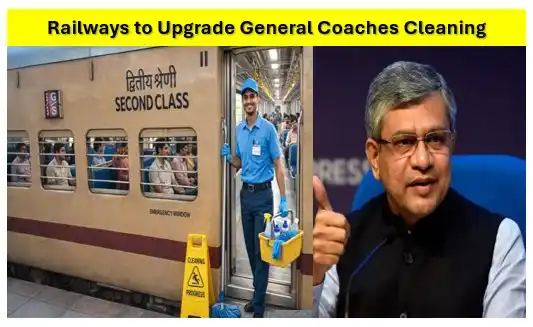
An invisible, sharp line has separated Indian train platforms for decades. On one hand, the reserved AC coaches — cool and quiet with regular attendants. On the other hand, there are the regular sections — cramped and shabby, generally ignored by cleaning staff as a train hurtles through the night. That line was effectively erased this week as Union Railway Minister Ashwini Vaishnaw made it official.
As part of the ambitious “52 Reforms in 52 Weeks” plan for 2026, and with the goal of achieving Passenger satisfaction — Rail Minister unveiled the very first one where they aim to revamp On-Board Passenger Services outright! The most radical change? The general coaches would no more be the “forgotten” carriages of the Indian Railways. In an effort to make hygiene democratic, their coaches will now be treated to the same professional, high-quality cleaning as trains for premium travellers.
The absorbent pad penetrates with ease across the floor, whereas the dirt and grime are scooped up to be discarded by simple vacuuming.
Traditionally, Indian Railways adopted the “clean-train-station” (CTS) model. Only at some big stations, for which there were special cleaning teams, did trains suffer a thorough clean. If a toilet went out of service or a dustbin overflowed between these points, passengers would have to endure.
The 2026 Reform eliminates this static model with an ongoing cleaning process
Full Trip Attendance: Service will be cleaned from the originating to destination station.
Vague Combative Integration: General Boogies taggedjusten same could be the fastest vehicles to censor it. The mandate is clear: Every coach, no matter the fare it commands, will be held to the same cleanliness standard.
Integrated Service Teams: Some new “integrated model” where multi-skilled personnel will perform cleaning, linen (in sleeper coaches) and “petty repairs” together.
How the Tech-Enabled Monitoring Works:
- High-Res Capture: Skilled evaluators will photograph toilets, sinks and aircraft interiors with high resolution cameras on a frequent basis.
- AI Analysis: These images are taken into an AI system which analyzes the cleanliness levels as compared to “Gold Standards.”
- Real-Time Alerts: If the AI identifies garbage, stains, dry basins etc., instant alerts are sent to the train service provider.
- Heavy Penalties: With the new Quality-cum-Cost-Based (QCBS) contracts, service providers will have to pay a heavy price if the AI logs repeated failures making poor-quality low-cost routine” contractors a thing of the past.
52-Week Timeline: Radical Reworking
The “52 Reforms” proposal is structured governance at the graduate level. Rather than one-onerous announcement, the Ministry has pledged to make one major systemic change every single week in 2026.
Take It From The Top: Single-Digit Accidents or Bust
Building on the 52-week plan is the ”zero-tolerance” policy for any accidents. The Minister noted an impressive reduction of 90 per cent in consequential train accidents—from 135 ten years back down to only 11 in 2025-26.
For 2026, the objective is to get this down into the single digits.” This will be done by aggressively adopting Kavach 4.0 (the Indian ATP) and predictive maintenance tools. By deploying sensors and AI that will help foresee when a track or a wheel could fail before actually doing so, the railways is moving away from “reactive” to “proactive” safety.
Humanizing the Rails: Training and Skill
It’s people, not technology that are the ultimate drivers of success. Many of them, among the 52 reforms, will be about upskilling the workforce.
Simulator Training: Loco Pilots will learn high-speed signaling such as AR/VR.
Sensitisation Training: “Hospitality and empathy” training is imparted to on-board staff, especially those who have been recently posted in general coaches, so that they can cater with patience and care to the millions of travellers who use its services every day.
In conclusion: Commit to Joe for More than One Year
This is not a “magic wand” fix, Railway Minister Ashwini Vaishnaw was candid about the timeline. The new cleaning system will be implemented on 80 long-distance trains (4 or 5 for each zone) in the next six months. The installation on the entire fleet of Indian Railways would be completed in three years.
However, the intent is unmistakable. By making the general coach at 1-reform-2026 the priority, the government is also sending out signals that it is changing its priorities. It is a vow that you do not have to be in the Vande Bharat or AC sleeper for ‘modernization’; it is the boon of any citizen walking with a ticket and a dream onto an Indian train.
