


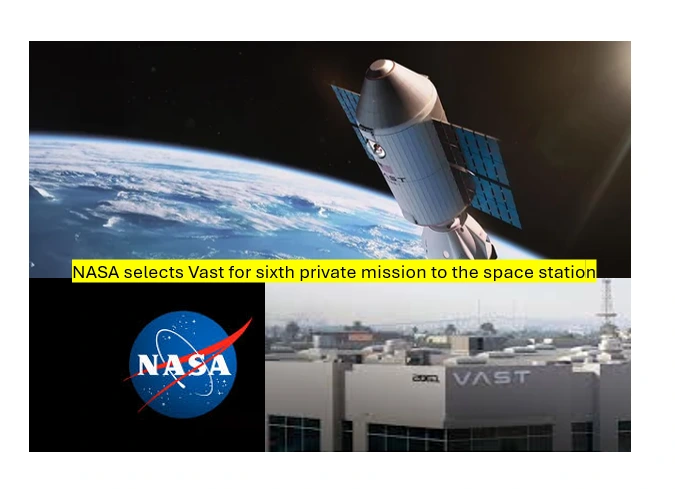
The “commercialization” of Low Earth Orbit (LEO) just advanced by a huge measure. NASA selected the California startup, Vast to lead the sixth private astronaut mission (PAM) to the International Space Station (ISS), it said February 11, 2026.
Slated for launch by no earlier than summer 2027, the reassignment is a historic milestone in private spaceflight. For the first five missions, private ISS visits were an effective monopoly of Houston-based Axiom Space. By giving the sixth order to Vast, NASA is sending a signal that the race to construct a new generation of space stations has become a multihorse marathon.
A Plan for the Post-ISS Times
The International Space Station is reaching the end of an illustrious career, set to retire in 2030. NASA’s broader approach is to prevent a “space station gap” by allowing private businesses to build their own platforms.
Training for Haven-1 and Haven-2
For Vast, this mission is more than a 14-day journey; it’s an important “dress rehearsal.” Vast is planning on developing Haven-1, the world’s first commercial space station when it launches in 2027.
Operational Lessons: Through controlling a mission to the ISS, Vast’s mission control and ground crews will learn from real-life experience in docking techniques, management of life support systems and crew scheduling.
The Transition: This mission is a link to Haven-2, Vast’s proposed replacement of the ISS and one that the company hopes will ultimately supplant the orbiting laboratory altogether.
The Isaacman Influence
Jared Isaacman, a veteran of private spaceflight who is now the administrator of NASA, stressed that these missions are about American leadership. “Each new entrant has a specialty,” and Vast’s contribution to the elite club of commercial partners is no different, said Isaacman.
NASA shares how night at Mars looks like! – Rare pictures revealed
Mission Details: 14 Days of High-Stakes Science
Though the crew for the sixth mission has yet to be announced, its flight parameters are already beginning to take shape.
A Science-First Portfolio
NASA-sanctioned private missions like these are moving away from early “space tourism” flights and more toward professional research. Vast has already put out a call for proposals, with the 14-day stay dedicated/examining:
- Protein Crystallization Microgravity Profile Developing medicines in space.
- Human Bio-monitoring: Employing Vast’s health-condition monitoring panels to monitor how the human body acclimatises and adjusts to space.
- Cold Storage Returns: In an unusual “barter” arrangement, NASA will offer Vast in-orbit goods like cargo storage space, while NASA will hitch a ride on Vast’s return to carry sensitive scientific samples that need to be kept frozen during transit and can cost upward of $3 million to bring back aboard the International Space Station.
NASA Approves iPhones for Spaceflight After Years of Restrictions
Conclusion: The Prologue to Haven
Max Haot, Vast’s chief executive, described the selection as a “vindicative moment” for the company. Armed with more than a billion dollars in private capital and the fact that its Haven Demo satellite has successfully reached orbit, Vast’s no longer a “Space underdog.”
With the ISS itself currently in the last four years of operation, Vast’s sixth mission is critical for failure or success going forward. If a private company can pull it off crewed mission and leverage what they learn into an independent station then the dream of people living long-term, profitably and privately in space will be one step closer to reality.
