


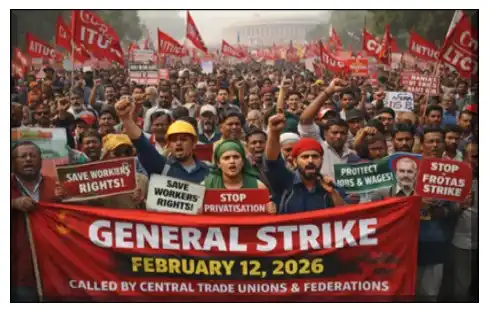
On Thursday, February 12, 2026, a general strike organized by a collective of 10 central trade unions along with supporting labour and farmers’ groups has been scheduled in a nationwide action. It will be one of the largest mobilizations of workers in years, with millions expected to take part throughout India.
Trade unions, including large federations such as INTUC, AITUC, HMS, CITU, AIUTUC, TUCC, SEWA, AICCTU, LPF and UTUC have given notice of their intention to participate in the strike.
Estimated Scope of Participation
Union leaders expect more than 30 crore (300 million) workers from the formal and informal sectors to participate in the strike across the country.
At least 600 districts are expected to experience some level of disruption due to the strike, much more than during past national protests.
Farmers’ organizations, led by the Samyukta Kisan Morcha (SKM), have publicly committed to supporting the strike and mobilising rural participation on the same day.
Some specific groups, such as the BSNL Employees Union, have issued strike notices, outlining the demands of their particular sector along with the larger union demands.
What Are We Demanding?
The strike is in response to a nationwide package of government initiatives that trade union leaders say are “anti-worker, anti-farmer and pro-corporate” in nature. The broad demands include:
Labour & Employment Demands
The Central Government of India The Central Government of India’s New Code on Labour, which unions state are diluting worker protection and increasing precarious jobs, has repealed the four codes.
There have been significant changes in the public sector which have rejected contractors and the privatisation of publicly owned enterprises.
The right to work, wages, and the roll-back of policies that are viewed as undermining workers’ collective bargaining rights will be strengthened.
Unions representing farmers and allied agricultural workers are pushing for the restoration of MGNREGA rural employment guarantees. Union representatives state that the MGNREGA rural employment guarantees are the backbone of rural agricultural employment and should be restored.
The withdrawal of other bills, including the Seed Bill Amendment and the Electricity Bill Amendment, and the passing of the Viksit Bharat Guarantee for Rozgar and Ajeevika Mission (Gramin) Act, will also be requested.
Opposition to the India-US interim trade deal will also be widespread. Farmer unions claim that the deal will open up domestic markets to cheaper, imported goods, resulting in reduced incomes for farmers throughout the country.
Many left-leaning parties and other regional political groups have openly supported this strike, including the CPI, the CPM, the All India Left PCB and the Dhania Party. These political parties call on their supporters to participate in this strike as a means of promoting workers’ rights.
Impact on Daily Life
Although the overall impact of this strike will be known only on strike day, many sectors of the economy will be directly impacted:
Public Transport and Services:
The availability of public transport, especially local trains, buses and metro services, throughout the majority of the country, is likely to be disrupted as employees join protests.
- Banks and Financial Services: The trade unions for the banks have also called for a strike and will therefore be taking industrial action on the 12th of February, which may lead to disruption of services in their branches.
- Government Offices and Schools: Government office workers are expected to be working with reduced staff as some states are closing or observing a holiday for their schools and universities, in order to support their strike action.
- Urban and Rural Workforce: The urban blue-collar workers and rural labour groups will participate in the strike so cities and villages will all be feeling the impact of the action taken.
- Transport disruptions: Social media users from states such as Kerala have indicated that there will be major disruptions in travel and services; predictions are for almost all services to come to a complete halt if enough workers participate in the industrial action.
- Government Response: To date the Central Government has not pulled back any of the current Labour Codes or policies as they continue to implement the Labour Framework which they say simplifies and modernises the labour laws.
Some State Governments are preparing contingency plans for providing essential services to the public on the 12th of February and encouraging discussions with unions, however, the unions have refused to negotiate at all and will take full measures for the action taken against the industries or application of the laws.
What Happens Next?
On Thursday, February 12, 2026, there will be a nationwide general strike (and at the same time, farmers’ protests) that will occur throughout India.
The labour unions have indicated that they will evaluate the effectiveness of the strike and will continue protesting depending upon how successful the strike was.
This strike represents the largest and most significant mobilization of labour and agriculture in India in years and has highlighted the underlying issues of labour reform, agricultural policy and trade agreements.
