


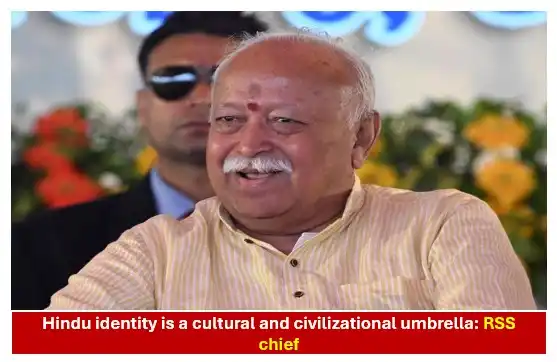
In a landmark speech that effectively launches the diminishing to the centenary of the Rashtriya Swayamsevak Sangh (RSS), Sarsanghchalak Mohan Bhagwat has articulated an ensuring which moves identity based on “Hinduness” from the religious plane to particular state mindedness area. During his speech in Mumbai on February 7 (2026) he said “We don’t use the word Hindu as opposed to anything… We see it is something connected with culture and beyond that the civilization also… It has an expansive connotation used by every inhabitant of Bharat including Muslims, Christians..”.
His comments, made as part of the “100 Years of the Sangh Journey” lecture series, are an attempt to change a national narrative. By stating that “Hindu” is an adjective and not a noun, Bhagwat is laying the groundwork for a discussion about what it means to be Indian in the 21st century—based on bonds of family and culture rather than necessarily common styles of worship.
The Identity “Adjective”: Why Words Count
At the heart of Bhagwat’s speech was a linguistic and ontological difference. In his opinion, using “Hindu” as a noun relegates it to one community or religion. Yet, if we treat it as an adjective, it can describe a mode of existence and recognition rather than that which can only emerge for the purposes of ideological justification within one cluster of modern political boundaries.
He maintained that the identity Hindu is the cornerstone of Bharatiyata (Indianness). This broad definition has the result of Hindu being a civilisational catch-all term which includes anyone who is proud of the heritage of Bharat, respects its past and contributes to its glory, irrespective of whether he prays at a mandir (temple), masjid (mosque) or church.
Read also:
- EAM Jaishankar Highlights Need for Global Cooperation
- Tarun Chugh appointed as BJP’s central
- Supreme Court’s statement to Whatsapp
The Supports / Pillars of this Civilizational Umbrella:
- Cultural progeny: There is a shared biological and cultural origin of all the sons of this soil, this does not mean that unity is based on superior or inferior Vanaprastha, which they have sought to impose.
- Culture of Acceptance: An historical tradition of not only tolerating but actively respecting varied approaches to the truth.
- There is wisdom in sacrifice: An exhortation for citizens to labor with “selfless purpose” in whatever they do, to build the country.
- Protection in Diversions: With the truth that Hindutva is, if anything, at all a political guarantor of safety for all practicing any variety of religion – as its DNA is overwhelmingly plural.
Reclaiming History: Lessons from Partition
Among the more sombre moments of Bhagwat’s speech was his oblique discussion of India’s history, especially that of 1947 Partition. He said the country got divided because we had forgotten ‘Hindu bhav’ (the Hindu sentiment of unity).”
He believed that the social fabric started coming apart when the people of the subcontinent lost sight of their shared civilizational roots and became aware only of themselves as distinct entities.
“We never disrespect anyone’s faith. No, that is not Hindu What kind of a person is anyone to harm a seed? But we must have dialogue. We must remind ourselves of the unity we have, rather than attempting to build it anew.”
