


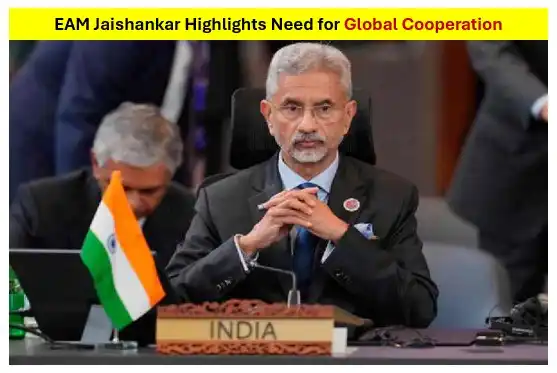
In a world in which the fuel of an entire nation passes from oil wells to mineral mines, India has sent out its message as loud and clear. Addressing the first ever Critical Minerals Ministerial in Washington D.C. on February 4, 2026, External Affairs Minister Dr. S. Jaishankar made a forceful statement: the age of “excessive concentration” should come to an end.
As the great scramble for lithium, cobalt and rare earth elements intensifies around the world, Jaishankar’s appearance at this 50-nation summit notes that India has finally changed its corners on resource diplomacy. It was not just a meeting about mining; it was a high-stakes conversation about economic sovereignty, national security and the future of the clean-energy transition.
The Short: Why Critical Minerals Are the “New Oil”
To see why this ministerial meeting is significant, we need to understand what’s at stake here. Critical minerals — which include everything from the lithium in your smartphone to the neodymium in a fighter jet’s engine — are the backbone of 21st-century technology.
The problem? Many of these minerals are now dominated by a few players. “This excessive concentration” — in which one country or two countries dominate the mining and processing of a resource that is vital to advanced technology “is not an easy problem to solve,” but it leads to a “strategic chokehold that we can’t be comfortable with for much longer,” Jaishankar said.
De- Risking the Future: The Indian Approach
Jaishankar’s speech was all about something called “de-risking. In diplomatic language, what it means is the world has to stop relying on China for its minerals so much. But for India, de-risking isn’t just about diversifying away from one source; it’s about forging a dynamic multi-layered domestic and international ecosystem.
The National Critical Minerals Mission
Jaishankar flagged India’s Atmanirbhar Bharat campaign, the focus on critical materials and the National Critical Minerals Mission This isn’t just a mission of piling holes into the earth, but an end-to-end structure that includes:
- Exploration: India’s un-tapped geological potential on map.
- Processing: From raw ore to high-value refining.
- Recycling: Creating “urban mining” to extract minerals from electronic trash.
Dedicated Rare Earth Corridors
The establishment of Dedicated Rare Earth Corridors in states like Odisha, Kerala, Andhra Pradesh and Tamil Nadu is an interesting highlight of the 2026 strategy. These azimuths are supposed to be mines archipelago’s industrial nodes, where the pickaxe meets production line. It is of course poised to be a world leader in REPMs the actual “engines” of the green revolution—by organizing both these research entities and processing plants together.
US offers Venezuelan oil to India as Russian crude imports fall
The FORGE Initiative: An OPEC for Minerals – Globally?
Among the important takeaways from the ministerial was India’s official endorsement of the FORGE initiative. Led by the US with support from more than 50 partners, FORGE is being seen as a possible “trading zone,” or even as a “mineral bloc.”
What makes FORGE different?
- Stable Price: Unlike most other markets that have been subject to manipulation, FORGE attempts to design a price-stable mechanism to reduce the fear of people losing money in seconds.
- Financial Muscle: With up to $100 billion in lending authority, it offers the money required for “friendly” countries to begin their own mining and refining projects.
- Strategic Acquisition and Resourcing: The proposal promotes build-out of reserve like system (like SPR) for mitigation against supply side shock.
Humanizing the High-Stakes Diplomacy
On the sidelines of the formal speeches, the ministerial was an extravaganza of “sideline diplomacy.” Jaishankar’s schedule in Washington was a masterclass in forging a “mineral-tight” alliance. He met with:
- Marco Rubio : To sign deals on bilateral exploration and mining.
- Anita Anand: Preparing the ground for Uranium and mineral deals prior PM Mark Carney’s India visit.
- Peers in Peru, Italy and the Netherlands: to make sure that India’s mineral chain supply is as diversely geographical as possible.
These conferences are the tangible result of “human-centric” diplomacy — forming a bond between leaders so that when a crisis arrives, those phone lines will continue to remain open and supply lines intact.
The Path to 2047: ‘Resilience’ Must Be Our Way of Life
To most members of the public, this ministerial sounds like some abstract policy. But whether or not these talks succeed, indeed, will determine the cost of your next electric car, how secure is the national power grid and just how strong — or vulnerable — U.S. defenses.
