


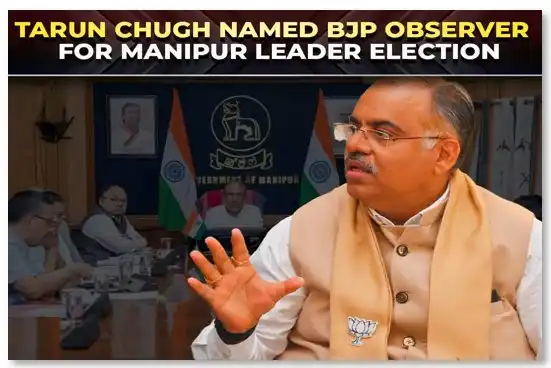
Manipur’s political terrain is poised at a precarious juncture right now. The wheels of democracy have begun to roll once more, almost after a year of administrative silence during President’s Rule. A significant step towards reetaerliniK a popular.set govenuueol, the BJP Parliamentary Board has authorized the appointment of Tarun Chugh, National General Secretary of BJP as Central Observer for election 0f leader,tneBJP Legislature Party in Manipur.
This is not a pro forma appointment; it is an arduous mission to navigate one of the most subtle, complex political and social environments that modern Indian history has seen. With the present spell of central rule in Manipur set to end on February 13, 2026, all eyes are now on New Delhi where the fate of it leadership is being worked out.
Tarun Chugh’s Mission: Beyond Being a Spectator
High-pressure political assignments are nothing new for Tarun Chugh. A Punjab native with a yeomen’s background in RSS, Chugh is known as an effective “trouble-shooter” for the party. Yet his job in Manipur could prove to be his trickiest yet.
In his role as Central Observer, the following are responsibilities of Chugh:
- Consensus Builder: There are murmurs of a bubbling discontentment and divergent aspirations between 37 BJP’s MLAs and Chugh wants to find an acceptable face for both the “valley” as well as the “hills.”
- Consolidating Allies : The BJP should continue its alliance with the National People’ Party (NPP) and Naga People’s Front (NPF) for a strong participatory government at Manipur.
- Plowing through Ethno-Sensitivities: Most importantly perhaps, he has to manage this without further exacerbating ethno-Armageddon between the dominant Meitei and Kuki-Zo communities.
The choice to make someone as fiesty a leader as Chugh indicates that the BJP is not in a mood to endorse “stop-gap” arrangements and instead wants leaders who can reach out for long-term reconciliation.
The Context: A Year of “Suspended Animation”
Just to know how heavy this week’s meetings in New Delhi are, you have to rewind to events early in 2025. Then-Chief Minister N. Biren Singh stepped down on February 9 2025, in the wake of a months-long wave of ethnic violence unprecedented for decades, which had kicked off back in May 2023. A President’s Rule was in place by 13 February, suspending Manipur Legislative Assembly having strength of 60 members.
It is being ruled by the Centre (under Governor’s Rule) for last twelve months. While the level of violence has significantly declined, in part because of a substantial security presence and many peace efforts, the vacuum within Palestinian politics was still a source of dispute. The determination to form a government now is born out of the intent to re-establish governance in Kerala while technically staying within the legal framework by not actually crossing the expiry date of president’s rule.
The Delhi Parleys: A House in Divided!
The national capital has been the focus of Manipur politics in the past 48 hours. Nearly all BJP MLAs, as well as leaders of the NPP and NPF, were called to New Delhi. There is a sense of excitement and anxiety in the air at Manipur Bhavan and at the BJP headquarters.
The Leadership Contenders
Although the party has not yet divulged anything, there are a few names that have been doing the rounds as a probable candidate for the post of Chief Minister:
- N. Biren Singh: The former CM continues to be a strong force even in the valley, his return is however a sticky point with Kuki-Zo legislators.
- Th. Satyabrata Singh: The present Assembly Speaker is looked upon as a moderate and non-partisan figure.
- Y. Khemchand Singh: A senior minister of the party and a veteran member.
- A New Face: There is widespread speculation that the high command may opt for a “dark horse” — an untainted leader who has had nothing to do with the recent controversies in order to signal a new beginning.
The Kuki-Zo Factor
The position of the 10 Kuki-Zo MLAs (7 from the BJP) is one of the largest challenges for Tarun Chugh. A number of these lawmakers have voiced reservations over being a part of a new government without an agreement on their demands for administrative autonomy (a “Separate Administration”). Whether Chugh can stitch these members into the new government will indicate if it can make an honest claim to be representational of Manipur.
Conclusion
With the sun going down over the Manipur hills, over Imphal’s busy streets, all eyes have been on the meetings in New Delhi. The induction of Tarun Chugh as the Central Observer is the clearest sign yet that “the suspended animation” of Manipur’s democracy is nearing an end. Whether the transition comes with true peace or more political positioning has yet to be decided, but the game is on.
The next few days will determine not only the fate of a party but the future of a state that has waited far too long for its own voice to return.
