


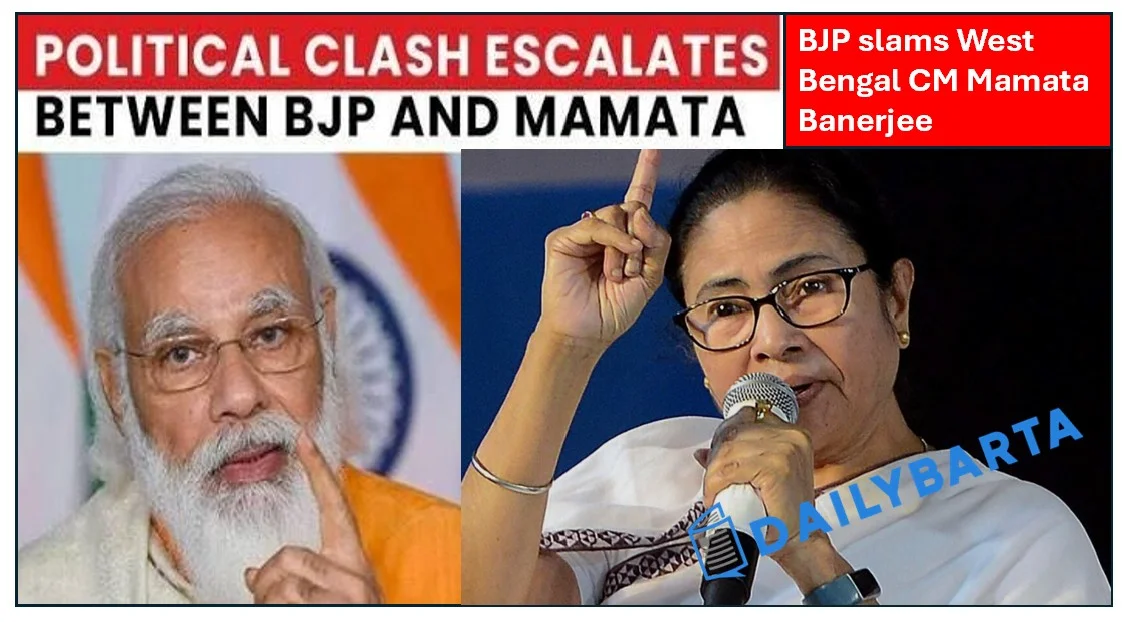
A latest build-up of political tensions before the 2026 West Bengal Assembly elections, the Bharatiya Janata Party (BJP) reacted strongly to the intimidation-style comment allegedly leveled by West Bengal Chief Minister Mamata Banerjee against Union Home Minister Amit Shah, who is presently on a visit to the state.
At a press conference held at Bhubaneswar, national spokesperson of the BJP, Sambit Patra, criticized Banerjee’s outburst at Bankura district. Patra alleged that what the Chief Minister actually said is that Shah is “lucky that he is able to go out of the hotel safely because if he wants, we won’t allow him to go out of the hotel.” “Mamata Banerjee has threatened the Home Minister of India with words that cannot even be imagined. Patra said that they cannot even step out of the hotel if they wish. He further explained that the CM has actually threatened the Union Home minister.
“This is not just an insult leveled against Shah, but it is a threat to the entire population of the country,” added Patra and highlighted the alleged lawlessness in the state of Bengal under the leadership of the TMC.
Patra went further, saying the remark was not just directed at Shah but was “a threat to the entire population of the country,” reflecting an alleged atmosphere of lawlessness in Bengal under the Trinamool Congress (TMC). Patra alleged that 300 party activists have been martyred and approximately 3,000 have been displaced because of violence by TMC supporters, which is strongly denied by the ruling party.
Mamata Banerjee says that AI deleted 54 lakh names from the Bengal voter list.
Establishing the Political Context: The Overall Criticism of the BJP
The spat comes against the backdrop of a heating up of the political showdown in West Bengal. Union Home Minister Amit Shah, who is currently on a multi-day tour of the state, has escalated his attacks against the Mamata Banerjee-led government. Shah, in a press conference in Kolkata, held the TMC government responsible for creating a climate of fear, corruption, and misgovernance, and said the infiltration of infiltrators coming into the country from neighboring Bangladesh is a national issue, not a regional issue, and will be dealt with accordingly if the BJP comes to power.
Shah also criticized the state government for its implementation of federal schemes and termed West Bengal as a “haven for infiltrators,” and that social welfare services were plagued by corruption. Speaking in a related context, Shah forecast a possibly two-thirds majority for the BJP in the 2026 elections, campaigning on a radical programme, lambasting the TMC for sabotaging development and for not allocating land for the construction of a fence on the borders of Bangladesh.
TMC’s Response and Political Conflict
The TMC vehemently denied all the charges brought by the BJP, terming them politically tinged offensive maneuvers to deflect focus from important governance matters, particularly the Special Intensive Revision (SIR) of electoral rolls and charges of Disenfranchisement. Both Mamata Banerjee and leaders of the party have stated that people from disadvantaged groups have had their electoral rights endangered by the SIR process, which they assert has seen the deletion of millions of names from voter rolls in a perceived centralized revenge.
Banerjee has also retaliated against Shah’s statements on the issue of infiltrators, wondering why there is no fuss raised over other bordering states, when it is apparently a problem only with Bengal. She has brought up the instances of Pahalgam and Delhi to disprove the allegation that it is only Bengal which has an issue with infiltrators and has politicized this issue by BJP to win over votes.
Through her speech, Banerjee has cited mythical personalities like Duryodhan and Dushasan to present the BJP leadership as villains, when they claim that the Centre has plans to unsettle the present government in the state, a notion the BJP finds baseless.
Political Scenarios Before the Upcoming Elections in 2026
In this episode, the rising political rhetoric being witnessed in the state of West Bengal has come to the fore, as political parties step up their campaign activities before the upcoming assembly elections, which are to be held in April 2026. In the BJP, criticism regarding law and order, entry, and threats to national leaders becomes a crucial strategy to raise questions about the TMC’s rule and gain the confidence of the masses. For the TMC, resistance to what it termed a centralized assault on state autonomy and indiscriminate political attacks has remained central to its electoral messaging.
As both sides dig in, the clash is likely to persist, with increased rhetoric and mobilization efforts to frame the narrative in one of India’s most politically significant battleground states.
