


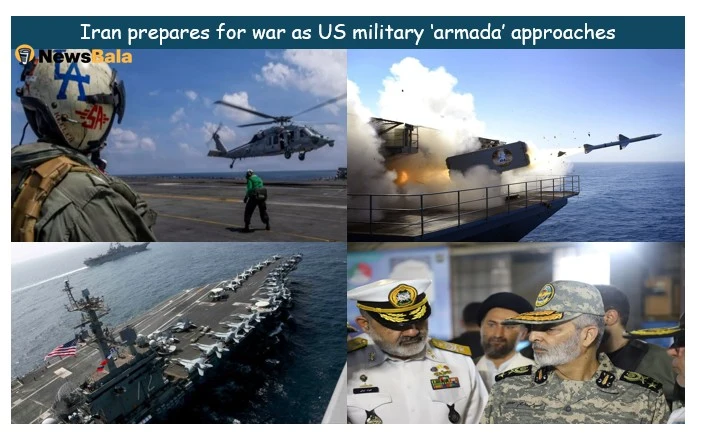
The waters of the usually lively Strait of Hormuz, the world’s highway for both energy and silence this week. By late January 2026, the Middle East’s geopolitical temperature is no longer “boiling”: it is simmering to a boil in preparation for high intensity warfare. After months of tit for tat proxy clashes and unsuccessful back-channel diplomacy, the United States has dispatched what military officials describe as a “Naval Armada”—three massive carrier strike groups and an amphibious ready group—now cruising into the waters off of Iran.
In Tehran, the response has been part grim determination, part desperate scrambling. Iran is no longer talking the language of strategic patience; it’s getting ready for war. From the fortified silos of Iran’s Islamic Revolutionary Guard Corps (IRGC) to streets and corridors in a country already suffering under the ruins of sanctioned isolation, there is a feeling of a nation on edge for an existential storm.
- The “Steel Wall”: The US Navy Construction of naval vessels was quite dynamic in the US.
The scope of the American deployment marks a level not seen since the end of the Cold War. From the USS Gerald R. Ford and the USS Abraham Lincoln, which lead the naval task force that includes an array of guided-missile destroyers as well as nuclear-powered attack submarines and those specially-designed “mine-countermeasure” vessels.
This is not just a “freedom of navigation” gesture. Washington, of course, has dubbed this “armada” a direct rejoinder to intelligence indicating that Iran’s Revolutionary Guard is close to achieving the ability to shut down the Strait of Hormuz — with the (frankly autarkic) intention of immediately slashing 20% of the world’s oil supply and driving global economy into deep recession.
Iran’s War Prep in Three Pillars:
- The Drone Swarm: Thousands of Shahed and Mohajer loitering munitions have been transferred to camouflaged launch sites on the southern coast.
- The “Silent” Subs: Iran’s small fleet of Ghadir-class midget submarines, which are said to be nearly impossible to track in the shallow, noisy waters of the gulf, have apparently left their docks.
- The Proxy Network: Iran’s “Axis of Resistance” from the Levant to the Gulf of Aden has been put on notice -with designs to start a limited naval engagement into a multi-front regional firestorm Noticed
The Iranian leadership has justified this buildup not in terms of aggression, but as a “Sacred Defense” against neo-colonialism. State media has been awash with footage of missile tests and subterranean “missile cities,” designed to reassure a fearful domestic audience that is increasingly worried about the possibility of all-out war.
Iran president tells Saudi crown prince that US threats cause instability
The Human Toll: A Country in the Darkness
Beneath the satellite imagery of carrier decks and missile batteries is the human story, one of deep ambiguity. For 88 million Iranians, the “drums of war” are not a metaphor; they are what it sounds like when the future collapses.
The Iranian rial has plunged to all-time lows ahead of the conflict and “panic buying” in Tehran and Isfahan have emptied shelves. There is, however, a double-edged nature to the Iranian street. Whilst many are tired of the regime’s confrontationalist foreign policy, others have been energised by a deep sense of national pride and a history of intervention from overseas.
The Domino Effect Across the Region: Israel, Saudi Arabia and More
The approach of the US armada is reverberating in regional capitals. With fears that an opening Gulf salvo could result in a massive rocket barrage from Hezbollah on Israel’s northern border, the IDF is currently in its highest state of preparedness since 1973.
At the same time, the Saudis and Emiratis are in a bind. But while they are wary of Iran’s regional ambition, they are equally terrified by a “hot war” in which their own desalination plants and oil refineries might be targeted by Iranian cruise missiles. And the UAE has whispered “de-escalation” as the US uses its bases — a balancing act that likely would become untenable after the first shot is fired.
Conclusion: The Diplomacy’s Last Hour
With the US carrier strike groups working within reaching distance, the diplomatic window of opportunity is fast closing to a sliver. The “armada” is a machine of maximum pressure, but history tells us that when two sides are this well armed and this suspicious, the flimsiest spark — an errant drone, a jumpy sonar operator, a misinterpreted radio message — can ignite the whole bush.
Iran is ready for war because it believes that it has been left with nothing but “resistance” as the last coin of the realm. Rather than going with flowers and chocolates, the US is coming in with an armada because it only believes that armed apocalypse can restrain a regional hegemon from overturning the world order.
We are now in the “Grey Zone” — a mode of conflict that is below war. What occurs in the next 72 hours is almost certain to shape Middle East security for at least the next quarter-century.
