


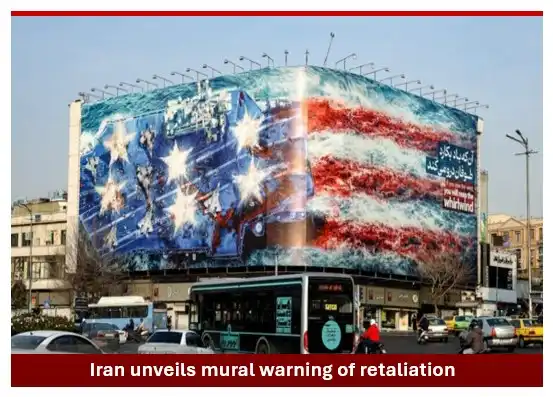
Above the historic Enghelab (Revolution) Square in downtown Tehran, a striking new image recently appeared on a giant billboard. Revealed: Sunday, Jan. 25, 2026; the mural is not just a work state art; it’s a stark and direct visual ultimatum to America. Showcasing the bird’s-eye view of a flaming American aircraft carrier with ruined fighter jets and bloodied decks, it features a chilling biblical and proverbial warning in both Farsi and English.
This aggressive show of psychological warfare couldn’t come at a worse time when the Middle East is teetering on the edge. As a “massive fleet” centred on the USS Abraham Lincoln heads to the Gulf and U.S. President Donald Trump warns of military action “just in case”, the mural provides a dark endpoint to weeks of ratcheting tensions, domestic unrest inside Iran, and a return to “maximum pressure” rhetoric that has shaped the past year.
A Symbolic Site of National Defiance: Enghelab Square
Enghelab Square has long been the Iranian state’s gallery of choice for political messaging. Its murals are swapped out to match the regime’s foreign policy du jour, but this installation has been particularly in-your-face. The imagery — graphically depicting exploding planes and a trail of blood creating the stripes of the American flag — is designed to convey strength to a domestic audience while also signaling in Washington that any such strike would be met with asymmetric, and potentially catastrophic, retaliation.
The presentation came days after the commander of Iran’s paramilitary Revolutionary Guard issued a threat against the United States, which on Friday killed one of its most powerful generals, Qasem Soleimani, in a drone strike as he visited Baghdad. This is more than posturing — it is a defensive posture from a regime that increasingly feels cornered, both by foreign military build-up and unprecedented domestic challenges.
The Protests and the Trigger: Why Tensions Flared
The current crisis is not something that happened in a vacuum. It is the final straw in a harsh winter for the Islamic Republic. Iran has been hit by waves of protest since late December 2025 after the rial and living standards collapsed. What started as an economic grievance quickly became a direct assault on the theocracy.
The Human Toll of the Crackdown
Deaths: Sunday, the Human Rights Activists News Agency (HRANA) reported that the number of deaths had soared to more than 5,400, making this the deadliest unrest Iran has seen since the 1979 Revolution.
Detentions: Over 40,000 have been detained.
The ‘Blackout’ of the Internet: For more than two weeks, Iran imposed its broadest internet shutdown in history – part of efforts to quash the flow of information and videos documenting the crackdown.
It is precisely this internal situation that underlies President Trump’s threat of military intervention. He has publicly promised “very strong action” if Tehran undertakes mass executions of detainees or persists in murdering peaceful protesters. He was more blase at a base in Florida on Thursday, saying any future U.S. strike could make past confrontations “look like peanuts.”
A Region Prepares for the Worst: The Military Chessboard
As the mural of hoisted in Tehran, the physical pieces of war were already coming into play. Air Force F-15E Strike Eagles have increased their presence in the Middle East, according to U.S. Central Command. Meanwhile the UK’s ministry of defence said it was sending Typhoon fighter jets to Qatar “in a defensive capacity”.
The anxiety about getting it wrong is real. Sources in Iran have confirmed to me that Supreme Leader Ali Khamenei has moved to a secure underground complex, with the day-to-day management of the leader’s office being taken over by his third son Masoud. This bunker-mentality approach to ruling indicates that the Iranian regime believes it could soon face a “decapitation strike” or pinpoint attack on its nuclear installations.
“And we have a very powerful fleet heading to the region,” Trump said Thursday, continuing, “We’ll see what happens … We have one of the most powerful ships in the world.
But for the Iranian leadership, this “whirlwind” mural is their way of signaling that they don’t intend to wait and see. By targeting American bases in nearby countries like Saudi Arabia, the U.A.E. and Turkey, Tehran is trying to use regional diplomacy as a way to shield itself from missiles.
The Diplomatic Deadlock: How to Break the Impasse?
Feelings behind the fiery rhetoric and violent murals aside, back-channel signals are still quite mixed. Despite Iranian Foreign Minister Abbas Araghchi alleging that there is “no plan” for mass executions, the U.S. government has its doubts. The U.N. Security Council and the international community will sit down this week to address the human rights conditions in Iran—which Tehran is certain is merely a harbinger of Western intervention.
The mural at Enghelab Square is an in-vivid-color reminder that the now of diplomacy in 2026 does not consist only of communiqués but what Ayatollah Khomeini liked to call (while exploding rockets), “the language of missiles” and the knack of intimidation. For the millions of Iranians trapped between a repressive regime and the peril of foreign war, the message on the wall is a chilling sign of how close to the brink of a conflagration this region has come.
As we enter the last week of January, the Gulf looks on. Will the “wind” sowed by decades of enmity at last be reaped in the “whirlwind” for which both these sides now appear to be gearing up?
