


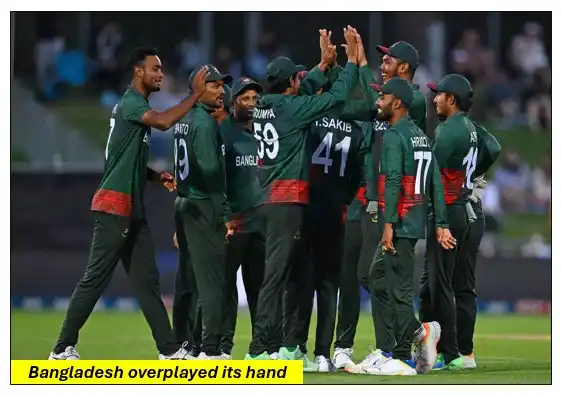
The cricketing fraternity was shocked in January 2026 when Bangladesh Cricket Board (BCB) announced its decision of withdrawing from the upcoming ICC Men’s T20 World Cup. The board has termed “security concerns” and ICC’s refusal to shift matches to Sri Lanka as the major obstacles, but the decision has come under intense domestic criticism.
Former BCB General Secretary and former CEO of the Asian Cricket Council (ACC) – Syed Ashraful Haque has been fronting it. In a damning critique of the scenario, Haque said that both the BCB and interim government have “acted too soon”, claiming that this decision will threaten to cut off Bangladesh from world cricket for years and decades.
How the Dominoes Fell: From IPL Snubs to World Cup Boycotts
To appreciate the seriousness of the current crisis, it is necessary to trace back its chain reaction with unusual speed issues that emerged in early January. The row erupted not on the international stage, but in the Indian Premier League (IPL).
GrudgesApperently, standoff rose between the two boards after the BCCI allegedly asked the Kolkata Knight Riders (KKR), a franchise of their league 2026, to do away Bangladeshi Pacer Mustafizur Rahman from the roaster. The BCCI insisted the move was a cricketing decision but officials in Dhaka took it as a snub. Days later, the Bangladesh government banned telecasting of IPL matches across the country calling it a “public interest”.
What ensued was high-stakes brinkmanship:
- The Request: Bangladesh asked the ICC to relocate its Group C games — in Kolkata and Mumbai — to co-hosts Sri Lanka.
- The ICC Response: Based on its own security audits, the ICC found no credible or verifiable threat against the Bangladesh team in India and rejected the venue change.
- The Ultimatum: The ICC delivered a 24-hour notice for the BCB to confirm participation. When the confirmation did not come, the governing body swiftly announced that it was replacing Bangladesh with Scotland.
Why Does Syed Ashraf Choose to Provide a Questionable Agenda as His Critique?
Syed Ashraful Haque was not shy of words when it came to the fallout. Speaking to a few media companies, he described BCB’s position as a “mockery” of sports management. He is concerned that the board has looked like a ‘subservient’ arm of the interim government rather than an independent sports body.
Robbing Players of a Once-in-a-Lifetime Opportunity
The moment that brought the most emotion from Haque concerned the athletes. By withdrawing due to political friction, the board has essentially “broken” the dreams of an entire generation of cricketers like captain Litton Das and his soldiers who will now have to watch the tournament from home.
The Fallacy of Security Concerns
Haque contrasted both the ICC tournament and domestic leagues, noting the absurdity of security reasoning for an ICC event. He said ICC events have the best and most stringent levels of Federal and State security, while the IPL and bilateral cricket in India between the boards, ends up with a lack of effective security. Bangladesh may end up as a potential “troublemaker” or “trouble monger” internationally, if such assurances are dismissed.
Diplomatic Miscalculation
He cautioned any future host nation may now think twice before inviting or hosting Bangladesh for fear the team could withdraw at the last minute over non-sporting reasons.
Scotland Ride to the Rescue: The New Group C Spotlight
Where Bangladesh has stood down, Scotland has stepped up. Sitting 14th in the T20I rankings coming into the tournament, Scotland were also the highest ranked side not to qualify naturally. They will now fulfil a Bangladesh schedule in Group C that also features England, the West Indies as well as Italy and Nepal.
And the ICC’s swiftness in moving on suggests test matches will have zero tolerance for political games of their own when it comes to scheduling events. For Scotland, it is an opportunity to play in the big league and for the ICC, it could be a measure taken to protect the “sanctity of tournament schedule.”
Long-term Consequences for Bangladesh Cricket
Bangladesh’s absence from the 2026 T20 World Cup by no means amounts to being denied a shot at winning a trophy for only the fourth time this millennium. It bears heavy financial and reputational censure.
- FINANCIAL LOSS: Millions to be lost in participation fees, prize money and global sponsorship revenue for the BCB.
- Slide in Ranking: In the absence of World Cup matches, Bangladesh’s T20I ranking is set to drop and will make it even tougher to earn future qualifications.
- Internal unrest: There are also early whispers questioning the administration from players with at least a few senior cricketers having second thoughts about their national team future under the present regime.
Quitting of a BCB director, soon after the announcement about Scotland tour, also exposes cracks in the board.
Conclusion An Exercise in Sport Autonomy
The 2026 T20 World Cup pullout will probably become a cautionary tale about what happens when geopolitical tensions are permitted to define the terms of engagement in sports. As warned by Syed Ashraful Haque, the “destructive aftermath” will linger on for years.
In a multipolar world, autonomy is usually the best protection a sporting body has. By not being able to keep the lines drawn between cabinet office and cricket pitch, the BCB has not only snubbed itself out of one top drawer global event but taken its fans through a heartbreak that should never be about bat or ball.
