


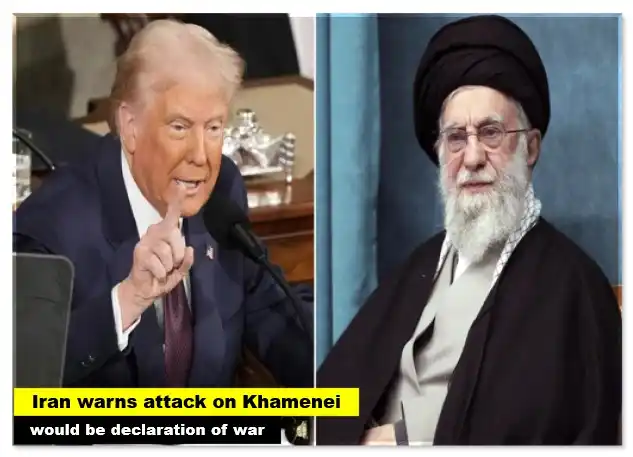
In a major increase in a rhetoric which has reverberated across international diplomatic circles, “Any military operation against the Supreme Leader’s (Khamenei) palace would offer supporters of this war with reason to attack and they will see our permission as guarantee for realizing their goals, if ever they dared make such a move” Reuters reported Iranian President Masoud Pezeshkian declared in no uncertain terms yesterday that any ground invasion or targeted missile strike on Ayatollah Khamenei would be sauce for the gander; and taken as an official declaration of “all-out war” by the Iranian people.
The statement, posted on social media and carried by state-run news organizations Sunday January 18, 2026, opens a precipitous new phase in the steadily deteriorating relations between Tehran and Washington. It comes in direct retaliation for increasingly confrontational rhetoric from the United States, where President Donald Trump had just said it was “time for new leadership in Iran”.
A Nation on the Brink: Background to the Warning
The warning was issued as Iran faces its most serious domestic challenge in decades. Popular protests which began in late December 2025 as a result of economic frustration, high inflation and the free falling value currency has since developed into a broad anti-government protest. The response of the regime has been a near-total blackout on the internet and violent suppression that human rights groups say has taken thousands of lives.
The Iranian leadership has been able to paper it over when turning to external enemies, with the gravity of a nation facing attack uniting its squabbling factions. By presenting an attack on the Supreme Leader — who has the last word on all matters in Iran’s theocracy — as an attack on all Iranians, the presidency is moving to unify nationalist sentiment and warn off foreign powers from intervening.
The Trump Factor and ‘Maximum Pressure’ 2.0
Friction between the two countries has grown since the White House revived “maximum pressure” tactics. The U.S. military had been ready to strike Iranian targets in early January, but the plans were stalled at the last minute, recent reports said.
Iran’s leadership has rushed to cast masquerade-size blame on Washington for the country’s current predicament. In a defiant Friday sermon, Khamenei himself called President Trump a “criminal” and claimed the US had fomented domestic unrest with “the military support of these [so-called] rioters.” This war of words in in itself — has effectively ensured there is no hope at the moment looking into the future for deescalation, and both sides seem to be getting closer to a point of no return.
Regional Implications, and the Ghost of June 2025
The current friction is stained with memories of the “Twelve-Day War” in June 2025, a short but furious conflict between Israel and the United States that ended with damage to Iran’s nuclear infrastructure and exposure of military weaknesses. Though the system held, Iran’s hard-liners have never tamped down their racist panic about the mustard gas and conditioning that they received from Saddam Hussein in their seven-year war with him.
And the newly created Defense Council in Tehran has suggested the potential for pre-emptive action. Iran’s response would not depend on the identity of the attackers, they said, and “if there is real evidence that it is a tangible threat, we will avoid details.” The phrase “all-out war” therefore could prove to be more than just a reactive policy; it could become an immediate trigger for Iranian military mobilization throughout the region.
U.S. President warns of 25% tariff on countries doing business with Iran
Key Takeaways from the Crisis
Key elements of the current impasse are:
- Existential Red Lines: The Supreme Leader’s safety is now openly connected to the commencement of regional war.
- Domestic Repression: The regime is laying the groundwork for a harsh crackdown on internal dissent under the guise of foreign “interference.”
- Economic Warfare: The Stranglehold of sanctions are the number one cause of Iranian suffering, which the regime directly uses to inflame anti-Western sentiment.
- De-escalation that Failed: Attempts to calm the crisis outside of public view by diplomats have been shattered, and the personal tenor of what was said between Trump and Khamenei has left a diplomatic vacuum.
The Path Forward: Diplomacy or Deterrents?
While the “uneasy calm” in Tehran and Isfahan persists, the world waits anxiously. The statement of the Iranian government has, in effect, made the Supreme Leader a human “tripwire” for large scale war. The focus for Washington is to stand with the Iranian people in their demand for change without inciting a war that could escalate across the Middle East.
To Tehran, the bet is whether this hawkish “all-out war” talk will serve as a deterrent to strike — or an excuse for further international isolation. With the internet back on and the world watching, over the next few weeks we will see whether this is a war of words or something far more ruinous.
