


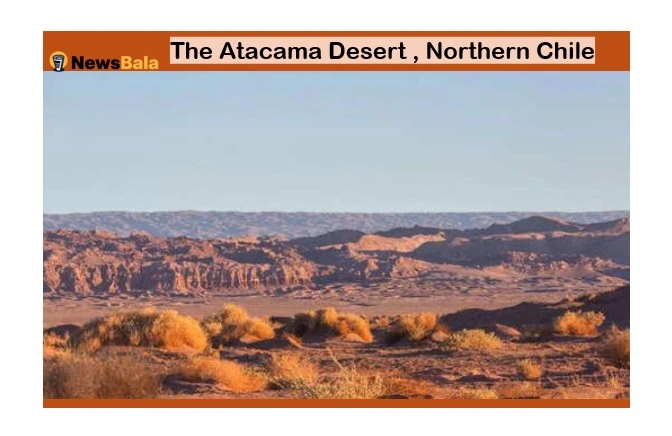
The Atacama Desert in northern Chile maintains one of the worst weather records on Earth. There hasn’t been any measured rain in some parts of this huge desert for almost 400 years, making it one of the driest places ever recorded. Researchers studying the climate say that from the late 1500s to the early 1970s, some places didn’t get any rain, as shown by weather stations.
The Atacama Desert has become a center of science and environmental interest because it doesn’t rain there frequently. The Atacama has been the driest non-polar desert in the world for hundreds of years. This is because, unlike most deserts, it never rains there.
Extreme dryness is caused by geography
The Atacama doesn’t receive much rain because of a unique mix of geographical and weather forces. For the most part, the Andes Mountains block the humid air from the Amazon jungle to the east. In the west, the cold Humboldt Current that flows along the Pacific coast keeps the air from getting cloudy and rainy.
The strong rain-shadow effect caused by these conditions means that clouds lose their water before they reach the desert. Because of this, rain clouds rarely form over the Atacama, and when they do, there is little to no rain. This phenomenon makes the area much drier than many other deserts around the world.
How Life Could Go On Without Rain
Even though the Atacama Desert is very harsh, some types of life can survive there. Instead of rain, the area gets wet from ocean fog, which is called camanchaca. This fog forms over the Pacific Ocean and brings small amounts of water to plants, insects, and germs before it hits land.
Some plants have evolved to take in water straight from the air, and some animals get their food from plants that require fog to live. Microorganisms that live below the surface have also changed to be able to live with less water. These survival strategies enable life to thrive in previously deemed unsafe areas.
It rarely rains, and the desert blooms
The Atacama had a long dry spell that ended in 1971, when parts of the desert got some rare rain. The Atacama Desert Bloom is a beautiful natural event that happens when it rains. Dormant seeds, buried for years, suddenly emerge, covering the desert floor with bright flowers.
These blooms only happen when the weather isn’t normal, and they might only last a few weeks. They are beautiful, but they don’t always show up and are difficult to locate. Their rarity makes them a strong reminder of how life waits calmly below the desert surface for the right conditions to appear.
Value in science and interest around the world
Because it is so dry, the Atacama Desert is an important place for scientists to do research. Its weather and dirt are a lot like those on Mars, which is why space agencies use it to test exploring gear and do research. Scientists also study how microbes stay alive in such harsh conditions, which helps us understand the limits of life on Earth and beyond.
The area is also important for archaeology. There is evidence that people lived in and around the desert thousands of years ago, coming up with creative ways to stay alive since it didn’t rain much. These results show that people can adapt to harsh settings.
Scientists, tourists, and environmentalists from all over the world still come to the Atacama Desert. Researchers use the salt flats, dry riverbeds, and rough terrain as living laboratories to study climate change.
The Atacama Desert is still a strong example of how different the climates on Earth can be. It has been dry for hundreds of years, but there are occasional bursts of life there. It is also very important for science around the world.
