


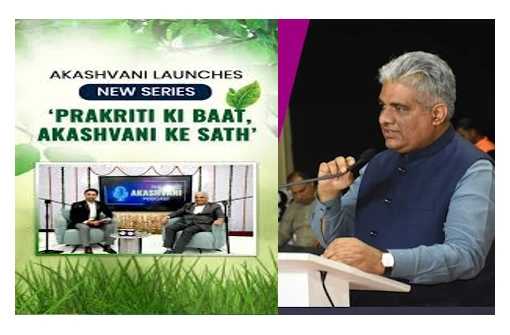
The crackle of a radio tuning in to Akashvani (All India Radio) has been the heartbeat of Indian homes for decades. It has told the story of a nation’s birth, its agricultural revolutions and its technological leaps. Now, as the world finds itself at an ecological juncture and India’s national broadcaster is moving back to them I see us coming full circle. ‘Prakriti ki Baat’ and the birth of a new narrative: Trigger-happy Akashvani One week through the inspiring new series, akashvani is transcending its role as news-reporter and nurturing a national dialogue on our collective survival and prosperity.
This is not just another government broadcast. The voices in the people share their best green stories that tell us how India is taking gigantic leaps to save nature, generate renewable energy and live a sustainable life.
A Voice for the Earth: The Heart of ‘Prakriti ki Baat’
In an age of “doomscrolling” and climate anxiety, ‘Prakriti ki Baat’ (Conversations with Nature) comes as a whiff of fresh, Himalayan air. The show is predicated upon the straightforward yet resonant premise of celebrating what is working. Amid global news screaming about the planet being laid waste, this series highlights the quiet revolving unseen in India’s backyards and forests and quirky inventors’ labs.
The initiative hopes to bring complex policy-making closer to the general citizen. Be it the sprawl of solar parks in Rajasthan’s deserts, or the regeneration of ancient mangroves across Sundarbans — the series is an attempt to channelise such feats into tales of human endurance and community glory.
Why Radio Still Matters in the Climate Fight
You may wonder: in a world of 4K streaming and snap reels, why the airwaves? The answer lies in accessibility. Radio is perhaps the most democratic medium in India. It is heard by the farmer in a distant village in Bihar and the commuter caught in Bengaluru’s traffic. In making Akashvani the vehicle to carry this message across — it ensures that the ethos of environmental stewardship is not simply an “urban elite” conversation but a movement at the grassroots.
200 Parrots Die Of Food Poisoning In Madhya Pradesh’s Khargone District
Disassembling The Pillars: Series Contents
‘Prakriti ki Baat’ is built on a tight structure and covers the multi-facets of India’s green journey. The episode is a deep dive into the themes that shape our modern ecological self.
Energy Independence and the Solar Revolution
India’s pledge to reach Net Zero by 2070 is a huge step. The series looks at how we went from being a coal-reliant country to one of the global leaders in solar and wind energy. Auditors get an insider view of the International Solar Alliance and how “One Sun, One World, One Grid” isn’t just a slogan – it’s a blueprint for global energy security.
The Tiger With a Gun for Hire Wild Life Conservation and the Return of the Big Cats
Here are my favorite installments on India from the series: One of the most eagerly awaited parts of the series looks at India’s successes in biodiversity. From the unbroken thread of tigers stretching out from an era in which humans remained hexed and awe-struck to the momentous reintroduction of Cheetahs, the series speaks with forest rangers, biologists as well as local tribal witnesses who are our last line of defense for our wildlife.
Tiger Death In Madhya Pradesh Pushes Year’s Toll To Highest Since 1973
Lifestyle for Environment (LiFE)
Drawing its inspiration from the global Mission LiFE movement, ‘Prakriti ki Baat’ stresses that environmentalism is not just about mega dams or our jungles; it’s also about the human being. The series also demonstrates how wisdom that much of the world has abandoned as being “past its sell by date”—the circular economy, minimum waste, plant based diets—are actually he most cutting-edge and forward-thinking forms of sustainable living there are.
A Closed Chapter of Akashvani
‘Prakriti ki Baat’, an attempt by Akashvani News to turn “environmental news” into festivities. It shows that the story of our planet is the greatest story we’ll ever tell. As the theme music disappears and we hear the narrator’s words about a greener tomorrow, and how it’s our “last refuge,” this is a reminder that we have no ownership of this planet: The Earth doesn’t belong to you; you belong to the Earth.
When you tune in, you aren’t just tuning in to a broadcast — you’re joining a movement. Let’s listen, learn and do — for the generations who one day will tune in to hear us describe how we saved their world.
