


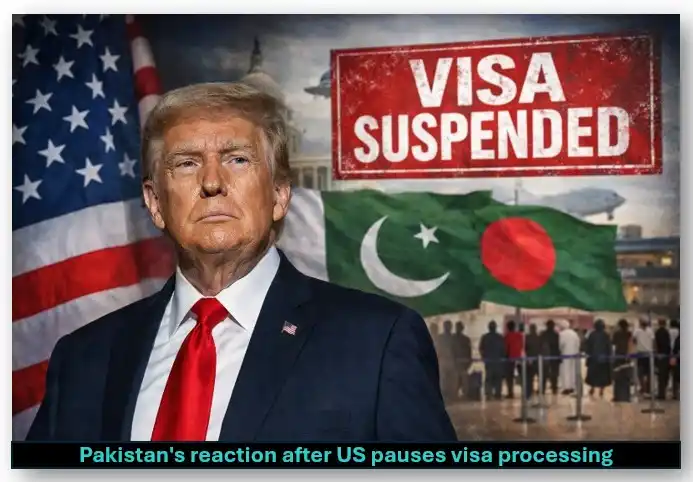
The US State Department has issued a temporary halt to processing immigrant visas for people from 75 countries, including Pakistan, starting January 21, 2026. This is part of a wider initiative by the Trump government to make immigration policy stricter and limit the entry of foreign immigrants labeled “likely to become a public charge,” meaning those anticipating public assistance, though non-immigrant visas (for tourism or business travel, for instance) are not reportedly involved in this restriction.
The pause in visas is indefinite until such a time when the U.S. government reassesses its immigration policies and procedures in addressing concerns it has raised with regard to welfare benefit use and enforcement.
One of the countries affected by these developments is Pakistan. It has also shown diplomatic responses to the developments. Below is a detailed discussion about the responses by the Pakistani government.
Official Pakistani Government Response: Tone of Cautious Optimism
The Pakistan Foreign Office has adopted a cautious optimism in response to the U.S. decision, adopting a rather measured tone. Instead of an outright condemnation of the move, Islamabad focused on dialogue and emphasized that this is a suspension expected to be temporary, part of an internal review of policy.
At a news briefing in Islamabad, FO Spokesperson Tahir Hussain Andrabi said that Pakistan has taken note of the US announcement and is in constant contact with US authorities to seek clarification and details. He explained that Islamabad looks at the suspension as an internal process for review and not as a permanent change.
Andrabi also hoped that routine immigrant visa processing will be resumed soon and said he was confident that diplomatic engagement will remove the uncertainties. This approach reflects Islamabad’s priority of managing the situation without flaring up and minimizing negative effects on Pakistani citizens who have pending plans for a visa.
Engagement and Dialogue with Washington
Pakistan has once again declared it is closely following the trends and keeping open their channels of communication with the Government of the United States of America.
This tone of engagement underlines Islamabad’s diplomatic approach: instead of a sharp statement or an act of retaliation, Pakistan indicates cooperation and patience while it tries to safeguard the interests of its citizens.
Domestic Concerns and Public Sentiment
Impact on Pakistani Nationals While the government’s official response is cautious and diplomatic, there is growing public concern, especially amongst those with whom the policy will directly impact. Thousands of Pakistanis who apply every year for immigrant visas — whether due to family reunification, employment, or education — now are kept at crossroads with uncertainty and a potential delay in their travel plans.
As a result of the sudden immigration ban, there are concerns from potential immigrants, students, and professionals. Many families’ long-awaited plans to move to or meet in the United States are currently in a state of limbo regarding when such plans will resume. Such a situation has created debate on social networks, with most people expressing their frustration at the immigration policy lack of clear communication on its cessation. (Anticipating social thread reactions of most users).
Opinions of Experts and Criticism of Policies
Certain South Asia policy analysts have raised questions about Pakistan’s inclusion on this list of affected countries. They claim that Pakistani nationals who immigrate to America possess highly developed skills and are highly wealthy. In other words, such people are less likely to access welfare benefits. Interestingly, this is one of the very reasons for which Washington imposed this measure. Islamabad may raise these aspects through diplomatic talks with Washington.
Some argue that grouping Pakistan along with other countries having such vastly different socio-economic settings may not be in line with the data that the public-charge provision purportedly seeks to capture. Indeed, this specific issue contributes to the broader domestic dialogue in Pakistan as it seeks to balance relationships between the U.S. and protecting domestic interests.
Larger Diplomatic Implications – Maintaining a Stable Bilateral Relationship
Pakistan’s reaction, focusing on hope, dialogue, and partnership, seems to be an effort to maintain stable relations with the United States. Pakistan’s policy seems to be aimed at avoiding irritation and reacting in kind to statements, despite supporting people from Pakistan who are affected by this policy. Indeed, this policy fits into Pakistan’s broader policy aim of keeping a constructive engagement with major powers, regardless of any disagreements over certain issues.
No Escalation or Retaliatory Measures
In particular, it should be noted that Islamabad has not responded positively to these developments by taking a retaliatory or threatening approach. On the contrary, Pakistani officials have been concentrating on diplomatic Engagement and hopeful statements rather than escalating a conflict with Washington.
Pakistan is also expected to continue their diplomatic efforts to seek clarity on the visa halt and obtain timelines to reinstate normal processing, especially when they realize its ramifications for their nationals.
The following are key areas of uncertainty: How long this reprieve might continue, how specific cases will be treated, and whether Pakistan might be able to obtain an exception in priority matters such as family reunion and labor matters.
As things stand, it seems that Islamabad’s approach to this crisis has been one of guarded optimism, taking into account the possible consequences for common Pakistani citizens, whilst attempting to maintain overall bilateral relations.
