


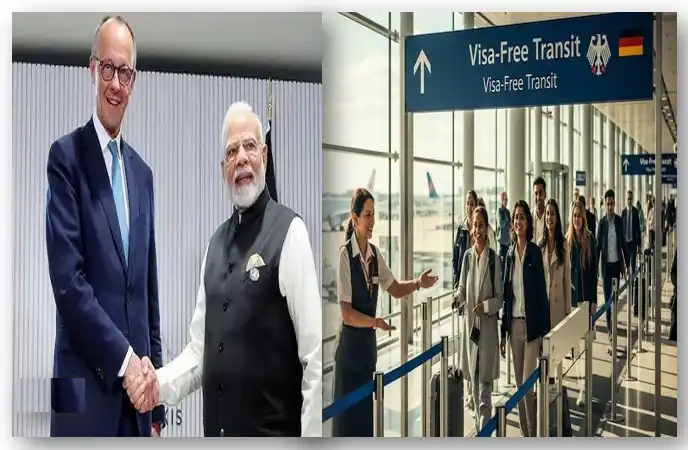
Indian passport holders can now travel to other countries through German airports without a visa. This makes it easy for Indians to travel between countries. The choice was made public after Prime Minister Narendra Modi and German Chancellor Friedrich Merz talked about it at their meeting in Ahmedabad.
Indian tourists who are used to having to fill out forms even for short stops at airports will find Germany’s latest move a quiet but welcome relief. A new rule that lets people change planes through some of Europe’s biggest hubs without a visa has made this much easier.
What’s New
Indian passport users will no longer need a Schengen Airport Transit visa, which is also called a Type A Schengen visa or a transit visa, when going through airports in Germany.
This rule applies to people going to a non-Schengen destination but linking through German hubs like Frankfurt and Munich.
The choice was made public during German Chancellor Friedrich Merz’s first official trip to India, which took place on January 12 and 13, 2026. Prime Minister Narendra Modi hosted the visit, which was mostly about improving strategic and economic links. The main topics of discussion were defence, trade, electronics, and mobility. The visa-free travel service was sold as a result of the larger talks that would be good for people.
What’s Different
Indian tourists who change planes in German airports will no longer need a transit visa. While they wait for their next trip, they can stay in the foreign layover area. This gets rid of the need for extra forms and cuts down on the time travellers have to wait.
The building is only for getting to and from the airport. Tourists from India will still need a legal visa to visit Germany or travel within the Schengen area.
Are you planning to fly from Navi Mumbai International Airport soon?
What Does A Transit Visa Really Mean?
A transit visa is not the same as a work or tourist visa. The only people who can use it are tourists who are just going through a country.
The Schengen Airport Transit visa lets people from certain countries change flights at an airport while staying in the international transit area and not going through border control.
In the Schengen area, you needed a transit visa at all European airports, even if you only went through passport control and never left the airport, picked up your bags or left the building. This was the case at all German airports as well. If you don’t have that ticket, you might not be able to board the plane at the airport.
Adults had to pay a fee of about €90 (Rs 9,471) and send in papers, photos, confirmed tickets, trip insurance, and other things. It could take up to 15 days to process, and it could take longer during busy travel times.
A lot of Indians thought this was unfair, especially since they weren’t even going into Germany.
Over the years, there have been reports of people being stopped in the middle of their trip because they did not have a passage ticket.
Usually, tourists were not allowed to board at the first airport because flight staff noticed that they were missing a document. People who got to Europe without the right ticket were sometimes put on planes back right away.
Because things weren’t clear, travelling through Germany or any of the other Schengen countries was risky, even when trips were cheaper or easier.
This is why Germany and Europe made transit harder
The Schengen system sets the rules for transit in Europe, but each country decides which people need an airport transit card. There were only 20 countries on that list from Germany. They were India, Afghanistan, Bangladesh, the Democratic Republic of the Congo, Eritrea, Ethiopia, Ghana, Iran, Iraq, Nigeria, Pakistan, Somalia, and Sri Lanka. Some countries get something called “transit privilege.”
Indian travellers going from Delhi to New York through Frankfurt or from Mumbai to London through Munich had to apply for a Type A visa ahead of time, get the “transit privilege,” or even get on their flight at the first stop.
Who Will Gain?
Indian students, workers, tourists, and people who travel around the world a lot and use German airports as hubs should benefit from the change. The easier rules for passage should also make it easier for airlines and tourism companies to move people.
Part of India and Germany’s growing ties
People see the move to let people travel between India and Germany without a visa as a step towards improving their relationship. Both countries are working to improve their trade, technology, education, and movement, with making travel easy being a big part of this.
