


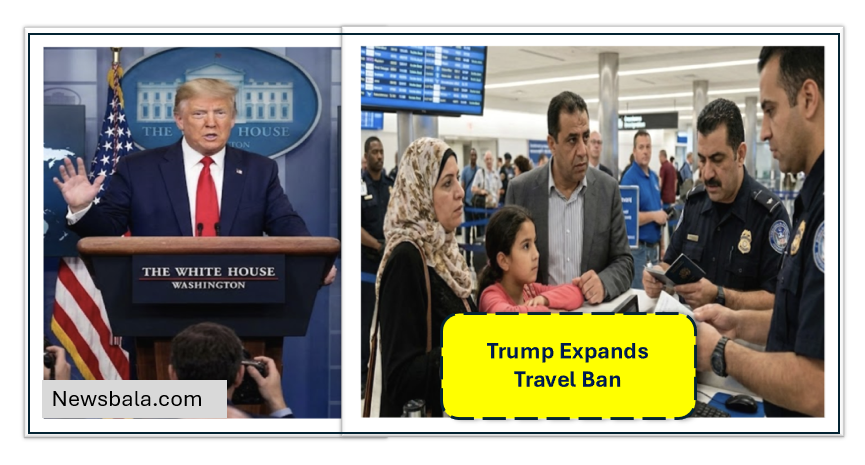
U.S. President Donald Trump substantially expanded the travel ban initiated by his administration, including five additional countries in the list of countries, the representatives of which are not allowed to enter the United States, and introduced new limitations on numerous countries. The broadened policy, announced on Tuesday, is among the most comprehensive changes to U.S. entry policies this year and will take effect on January 1, 2026, according to officials.
New Countries Added to Full Travel Ban List
In the new declaration, the citizens of Burkina Faso, Mali, Niger, South Sudan, and Syria can now be subjected to complete restrictions on travel into the United States in the tourist and immigration sector. The administration also expanded the ban on people who travelled using travel documents issued by the Palestinian Authority, on the basis of national security and vetting issues. These nations are added to a list that already contained some countries that were previously the target of travel restrictions by the U.S.
Authorities claimed that the extended ban affects entry under the vast majority of visa types. However, exemptions still exist for the lawful permanent residents, persons possessing active visas, and taking part in some recognised U.S. interests like diplomats and athletes, among others, the admission of which is in the national interest.
read more:
- Hyderabad Set to Get the World’s First Donald Trump Avenue
- 3 US lawmakers move to end Trump’s 50% tariffs on India
- US Lawmakers Push to End Trump-Era Tariffs on India
- Trump Pushes New Big Beautiful Bill
Partial Restrictions Imposed on Many More Nations
In addition to the five countries that have been banned, the administration has also enforced partial travel restrictions to other countries. These policies restrict specific types of immigration – especially non-immigrant and short-term visas – to the citizens of approximately 15 other countries. They are Angola, Antigua and Barbuda, Benin, Cote IV, Dominica, Gabon, The Gambia, Malawi, Mauritania, Nigeria, Senegal, Tanzania and Tonga, Zambia, and Zimbabwe. The Trump officials say that the lax vetting procedures, the rate of overstays of visas, and the lack of cooperation on law-enforcement data by these nations expose security weaknesses that warrant greater scrutiny.
Security Justifications and Controversy
The policy has been justified by the white house officials as a necessary measure to protect the American citizens and to ensure that people who cannot be vetted appropriately are not allowed to access the country. They have mentioned issues of untrustworthy civil records, absence of information-sharing with American authorities, and internal instability in some of the afflicted countries as some of the leading causes of the expansion.
Critics, however, complain that the measures are not right as they depend on nationality to target a whole population instead of measuring individual threats. The travel ban has been criticized by human rights and refugee advocacy groups as discriminatory and likely to create tense relations between the US and other affected nations. The legal issues are likely to arise, with critics arguing that the increased restrictions reflect previous unpopular immigration policies and will disproportionately affect some families, students, and valid travellers.
Context and Next Steps
The relocation is in the backdrop of increased domestic insecurities and management of immigration, mostly due to high-profile crimes by foreigners. The broader travel ban virtually doubles the number of countries restricted from travel to and from the U.S. this year, highlighting the aggressive travel policy.
The new restrictions will be applied on January 1, and the U.S. State Department is expected to come up with further instructions on exceptions and procedures. The analysts report that the policy change may have an effect on international travel, international mobility, and the U.S. diplomatic relations, particularly with the countries where the new ban now covers citizens.
