


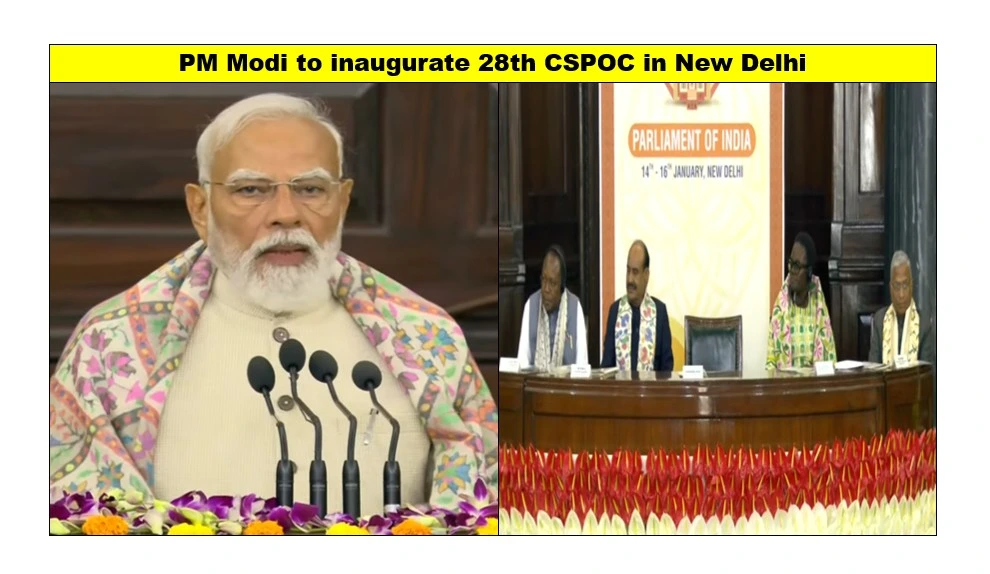
The rare winter sun descended over the Capital on the evening of Thursday, 15th January, 2026 and Rangmanch, or Central Hall as it was historically known in Samvidhan Sadan (the old Parliament House), emerged as the nerve-centre of parliamentary diplomacy across borders. The 28th Conference of Speakers and Presiding Officers of the Commonwealth (CSPOC)-2019, a landmark event that witnessed the participation of parliamentary heads from around the world, was officially opened by Prime Minister Narendra Modi.
This is not just another diplomatic summit. For India, it is a time to flaunt its title as the “Mother of Democracy” before a fraternity of 53 countries. The forum – featuring 61 Speakers and Presiding Officers from 42 Commonwealth Member States as well a number of semi-autonomous parliaments, makes CSPOC the single largest Assembly in its 57 year history.
Modernizing the “Temple of Democracy”
The main message of this year’s conference is indicative of the swift change in technology that we are experiencing across all spheres of life: Artificial Intelligence (AI) and Digital Transformation. In his keynote speech, PM Modi stressed that democracy should not lose its human face in the digital age if it is to remain relevant.
Those conversations are poised to address a question that every modern lawmaker is trying to answer: How can AI be applied to make parliaments more efficient without sacrificing proper oversight and transparency, which citizens have come to demand?
“Innovation drives modern governance, but we must also ensure that technology is the enabler and don’t become traps,” said the Prime Minister pointing out India’s own digital journey—from paperless legislative processes to employing technology in last-mile delivery of services as an example.
The conference is that “Green Revolution” in governance. The four-day virtual 28th CSPOC is being presided by Lok Sabha Speaker Om Birla and he informed that the whole of 28th CSPOC is going digital. From coordinates on a special app to web-based information sharing, the event is completely paper-free—raising the bar for green diplomatic summits.
PM Modi Likely To Inaugurate India’s First Hydrogen-Powered Train
The Paradox of Social Media: Lawmakers Affected
Beyond AI, a significant portion of the three-day conversations center around the double-edged sword of social media. The Speakers are looking at the effect of digital platforms on MPs lives and work, in an era where memes less measured than a parliamentary debate can set national discourse when they go viral.
The agenda items include:
- Equalising Public Interaction: Bridging gap between voters and representatives through Social media.
- Fighting the Fake Wars: How to Keep House, Dignity and Responding to “Fake News” in viral days.
- Mental Health and Wellbeing: Recognising the unimaginable pressure MPs are under in a 24/7 online world.
India as com “Vishwamitra” of the Global South
The hosting of the CSPOC after a hiatus of 16 years (2010 was the last time), is a diplomatic and strategic stride for India. It endorses the nation’s status as a bridge between the developed West and the developing countries in the Global South.
The high-profile participation of leaders such as Dr. Tulia Ackson, President, Inter-Parliamentary Union (IPU) and Sir Lindsay Hoyle, Speaker of the UK House of Commons, highlights the international significance held by the Delhi conscious meet. Traditional powers like the UK and Canada will be there, but huge attention is being dedicated to small island states and African countries that hold values of India’s parliamentary system.
Pakistan and Bangladesh are the only two Saarc members which have been left out in the meeting, with Pakistan yet to receive an invite and Bangladesh is without a Speaker after general elections. Despite regional disparities such as these, the mood in ND is to forge solidarity and breathe life into democratic structures.
India’s Reform Express Picks Up Speed- PM Modi Focusses on GDP Growth
Why It Matters for the Average American?
Though high-level summits can seem far-removed from the daily lives of ordinary people, the effects of the CSPOC are immediately palpable. The “Delhi Declaration” at the conclusion of this conference will present a roadmap for longer-term parliamentary inclusiveness.
In talking about “Innovative strategies to deepen public understanding of Parliament,” the leaders are identifying ways to engage citizens — especially young people — in the legislative process outside simply casting a vote every five years. It is also increasingly a story of making the “Temple of Democracy” available for those it serves.
When the conference closes on 16 January, Speaker Om Birla will officially pass the Chair of the CSPOC to Sir Lindsay Hoyle from the UK. But the legacy of this Delhi meet — on AI, sustainability and digital accountability — is likely to shape the agenda for Commonwealth parliaments over the next decade.
