


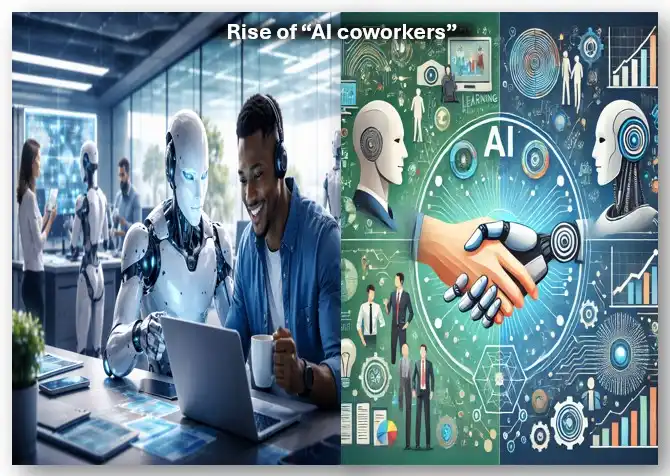
In recent years, artificial intelligence has transitioned from a background productivities aid to a more ‘coworker-like’ solution. This is because artificial intelligence can now help with the writing of emails, data analysis tasks, coding tasks, marketing campaign design, and also engage in meetings through a messaging interface. According to tech experts, these artificial intelligence tools act as ‘digital coworkers’ who work with humans. However, with more enthusiasm has also emerged the fear: Is the reality of artificial intelligence coworkers catching up with the promise, or has the enthusiasm led to a reality mismatch?
What Do We Mean by “AI Coworkers”?
“AI colleague” generally refers to highly advanced artificial intelligence—sometimes powered by large language models or machine learning—that can carry out tasks on their own and respond to humans in a conversational manner. In contrast to other types of software, these models have the ability to learn and make sophisticated decisions.
Examples would be coding assistants powered by AI, which propose and debug code, AI analysts who brief on complicated datasets, and AI agents who manage schedules, engage in customer support, and write reports. Here, it’s hardly the issue of automation alone, but also of human and AI collaboration direction and execution.
The Hype: Why AI Coworkers Sound Revolutionary
1. Vast Productivity Advances
The proponents claim that having AI work partners would significantly improve work productivity because they could work on routine yet time-consuming tasks. More time would be allotted for heavy responsibilities like planning, creativity, and building business relationships.
2. Always-On, Scalable
“AI does not get tired, go on vacations, or require a traditional onboarding process,” says Edward Wickersham, executive vice president and COO at OSI Systems, Inc. “After deployment, they can scale immediately across teams and geos,” which benefits worldwide companies.
3. Democratization of Expertise
Coworkers that work along with AI promise to bring about greater access to specialized knowledge. A non-technical person in an organization can utilize an AI to work on data analysis. A junior developer can also depend on an AI assistant in order to deal with complicated code.
The Reality Check: Current Limitations
1. Reliability and Accuracy Problems
Although they possess formidable abilities, AI partners are not infallible. At times, they may be incompetent in subtle yet important ways. For instance, they could provide credible though false data.
2. Lack of True Understanding
Such computer programs lack human-level understanding and judgment, nor can they be held accountable. These programs identify pattern recognition versus meaning, which can be a concern in situations involving human ethics and complex interactions. These computer programs may be conveniently referred to as “coworkers.”
3. Integration Challenges
Implementing AI colleagues is no simple matter, where software can just be installed in an organization, unlike current practices where data quality, integration, employee education, and workflow change are seen as concerns in implementing software solutions, while creating inefficiencies rather than efficiency in software implementation, as in implementing AI solutions.
Employment Effect: Augmentation Rather Than Replacement
Job replacement has been one of the biggest concerns regarding AI workmates. Although certain jobs, especially those revolving around repetitive tasks, may face this threat, more often than not, jobs have been augmented and not replaced.
Technology-induced jobs, like artificial intelligence assistants, usually modify job processes rather than make the job obsolete altogether. New occupations arising from technology include, but are not limited to, AI trainers, workflow designers, and human-computer-interaction designers. Workers, on the other hand, also require new skill sets like prompt designing, critical assessment, and judgment.
Cultural and Psychological Aspects
- Trust and Acceptance: For AI co-workers to work properly, employees must be able to trust them—but not uncritically. It is tough to find the right balance between trust and distrust. Excessive distrust may result in mistakes; insufficient distrust may counteract the advantage.
- Identity and Meaning at Work: Employment goes beyond the issue of increased productivity because it can also influence who an individual is and give his or her life meaning. There are some workers who can feel intimidated or diminished by the presence of AI workers, particularly when it comes to the aspects relating to knowledge or creativity. There could be lack of transparency.
Additionally, there may be worries concerning surveillance, data privacy, and power imbalance when AI teammates are employed to closely monitor the performance of human employees.
The Road Ahead: From Novelty to Normalization
In the short-term future, artificial intelligence co-workers could become a regular phenomenon in the workplace, in the same way that email or cloud computing became in the past. The key drivers of success in this new technology would be more in the control of humans than the technology itself.
The hype reveres AI co-workers as nearly human partners about to change work overnight. The fact is that they are powerful tools that, if properly incorporated, could improve human ability, but they are not substitutes for human judgment, creativity, or accountability.
Conclusion: Beyond the Buzzword
Artificial intelligence coworkers signal the real change in the way work is done, but the term itself can be very confusing. They are neither tools nor coworkers. They fall under the “new category of collaborative technologies,” which enhance human work with associated risks and responsibilities.
The gap between hype and reality is, therefore, critical to understanding. Organizations that delve into the realm of AI colleagues with their eyes open, rather than their hearts, will reap more benefits.
