


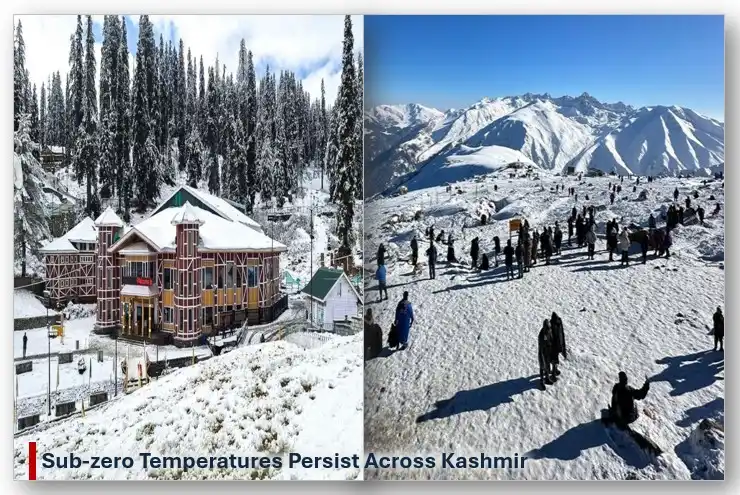
Quiet, cold winter has arrived in Kashmir Valley this winter of 2026. January may be well on its way, but blue skies by day and bitter, brain-freezing cold at night continue to paint a divinely mixed palette. In towns and villages everywhere, from the narrow lanes of Srinagar to the high alpine meadows of Gulmarg, sub-zero temperatures have been a constant companion that is trying even for Kashmir’s legendary resilience.
At present, the Valley is in the midst of Chillai Kalan, a traditional 40-day harshest period of winter that started on December 21 and would end on January 31. This year, however, the Grand Forty has lived up to its name as the mercury has regularly plunged low into negative territory, turning every day’s existence into a delicate dance of survival.
The Midnight Freeze : Srinagar and Beyond
In the summer capital, Srinagar, the nights have been especially dreary. Tuesday morning, the mercury dropped to a minimum of -2.4°C, slightly warmer than the season’s lowest temperature so far (-6.0°C), recorded earlier this week. While this may be only a slight increase, the evidence of cold conditions are apparent everywhere.
And some of the fringes of the famous Dal Lake have begun to freeze over, albeit with a sheer translucent ice. Boatmen — locally known as shikarawalas — are breaking the frozen crust with their oars to quickly slice through water. And outside the capital, the numbers paint an even chillier picture:
- Shopian in south Kashmir was one of the coldest inhabited places at -5.2° C.
- Pulwama (-6.5°C) was among the centers of a persistent cold wave.
- Temperatures in Pahalgam and Gulmarg, the famous tourist resorts remained around -3.4°C while these tourist spots looked like frosty, snow covered postcards.
- The Dry Chill:A Winter Devoid of its White Garment
The most distinctive feature about the winter of 2026 is deep on snow cover in the plains. Although there have been fleeting dustings in the high country, the valley floor is decidedly dry. For many people, this “dry cold” is also harder to take than a snowy one. With the insulation of the snow gone, and more radiational cooling, the frost continues down further in top soil and through water systems.
There are telephone poles, power lines and a single well that occasionally freezes during the winter to leave residents with no water in the morning unless they thawed their service pipes with blowtorches or kettles. Farmers and apple growers are especially worried; the absence of snow means the “recharge cycle” for the region’s glaciers and groundwater is undergoing a severe disruption. The Valley’s aquifer is the snow which in its absence portends the doom of water shortages this summer.
The Rhythm of Resilience: Pherans and Kangris II
Despite the hurdles of bureaucracy and body, life in Kashmir adjusts with a grace that is ancient. The Pheran A traditional long woolen cloak, the pheran has been adopted as universal uniform for people of all age groups. Slung inside these gowns is the Kangri – a small earthen fire-pot woven with wicker, around which they also weave themselves like vespertilian bits of straw.
In the mornings, the scent of Noon Chai (salty pink tea) drifts from bakeries and houses as a needful means of heating and communing. The spirit of the Valley is not diminished, even as these sub-freezing temperatures have contributed to an increase in seasonal illnesses and a power grid under stress. The markets might open a bit later and close at the sun’s first descent behind the mountains, yet the hum of life goes on.
Winter Rains And Freezing Temperatures Compound Misery In Gaza
Outlook: Are the Clouds Coming?
The Meteorological Department has predicted that the dry spell will continue for a few more days, but they believe there might be a change in weather conditions towards the end of the month. One such “Western Disturbance” is forecast to arrive mid-next week (January 20) and could deliver the long awaited snowfall to the desiccated plains.
Until such time, the people of Kashmir shall continue to be ruled by the “King of Cold.” With the frost still etching designs on windowpanes and the Jhelum River meandering lazily across the heart of the city, it’s now a waiting game – patiently and stoically — for those first flakes to turn that wintry dry into an artist’s canvas.
