


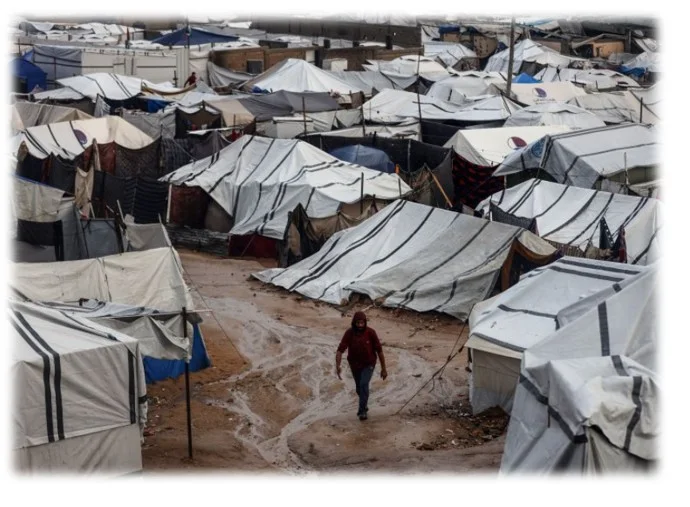
As December 2025 comes to an end, the Gaza Strip battles a formidable new enemy:
a brutal winter storm that has transformed an already dire humanitarian situation
into a bitter struggle to stay alive. Now, for the almost two million people displaced
by two years of conflict in northwestern Syria, torrential rains and near-freezing
temperatures have turned makeshift camps into waterlogged quagmires, ripping
through the flimsy fabric of tents never designed to weather a Mediterranean
winter.
A strong low pressure area – named ‘Storm Byron’ earlier in the month, and followed
by a so-called polar low over the weekend – has seen 50 to 70 km/h winds coupled
with heavy rain battering much of the country. The toll has been devastating, local
health officials report that at least 18 people, including several newborns and young
children, have died of hypothermia and exposure since the cold snap began.
A Landscape of Mud and Water
It’s a quiet, shivering chaos in Khan Younis’ sprawl and the central camps of Deir al-
Balah. Families that have sheltered for months in structures fashioned from scraps of
wood and bedsheets now rouse themselves to find all their few possessions floating
on muddy water, ankle-deep.
For many, the fight is not only against wet but slippery conditions, but also with the
buildings themselves, which are rickety and structurally unsound. The Palestinian
Civil Defense has also received more than 5,000 calls for help this week only.
Buildings in residential areas, already weakened from years of bombardment,
are beginning to fall under the weight of the water and from force of the winds. A
woman died in Gaza City on Sunday, December 28 when a partially-collapsed home
crumbled under pressure from the storm.
English“We drowned last night,” says Majdoleen Tarabein, a mother uprooted from
Rafah. “The tent flew away. The mattresses are wet.” “We don’t have any
dry clothes for the kids. Water is where there is no more place to hide from water.”
The Desperate Need for Shelter
The vastness of the “shelter gap” is staggering. International aid organizations have
been pressing to get winterization kits into the hands of those who need them, but
the volume of need is far more than what comes through crossings these days.
Tents and Homes : Local operations rooms say 200,000 prefabricated homes are
needed to replace the feeble tents being used in Gaza at present.
The threat to the coast: surges raising waves are pouring in from the sea along Al-
Rasheed Coastal Street, submerging thousands of shelters by the waterside and
pushing families further back into already crowded places.
WASH Crisis The rain is not only cold it’s a threat to health. Flooded sewerage
systems and uncollected solid waste (more than 1,300 tons per day because of fuel
shortages) have heightened the risk of waterborne diseases among children already
weakened by malnutrition.
Even after a ceasefire formally went into effect in October 2025, humanitarian
officials say the restrictions on “dual-use” materials are costing lives, sometimes in
dire circumstances where the same timber and metal sought to reinforce shelters is
also banned. UNRWA said some supplies were coming in, but “they are not at the
scale required” to forestall a winter disaster.
Winter Pollution and Your Gut: Essential Lifestyle Changes to Stay Healthy
Health Risks: The Silent Killer
Though the rain is doing the visible damage, at night — when temperatures drop to
between 8 degrees and 10 degrees Celsius (46°F-50°F) — it’s a quiet killer. For a
baby born in a tent without heating, these are fatal temperatures. Medical teams
working in the handful of still-operating hospitals have noticed an increase in
respiratory infections along with cases of severe hypothermia.
The lack of fuel is still a major constraint. Without it, families cannot heat water or
cook, nor can hospitals keep the even temperature required for incubators and
emergency wards. UNICEF has recently called for global funding of $7 billion, much
of it aimed at the 73 million children in conflict zones like Gaza who are making
“impossible choices” between staying dry and eating.
Amid Freezing Winter, Army Intensifies Ops In J&K Against Terror
A Forecast of Uncertainty
With the end of year drawing closer, the Palestinian meteorological department said
the low-pressure system would continue. More thunderstorms and even hail are
scheduled to inflict Monday and Tuesday for parts of the north.
The patience of the people in Gaza are being pushed to its farthest limit. They have
no permanent housing: They “shiver from cold and fear” as one resident put it.
There is no doubt that as the Syrian winter sets in, there will be further calls for
increased provision of prefabricated homes and winter supplies, with governments
from across the international community emphasising that weather-related deaths
are entirely preventable if only the political will to permit aid at scale were to appear.
For now, the people of Gaza wait — not for a shift in the political scene but just for
the rain to end.
