


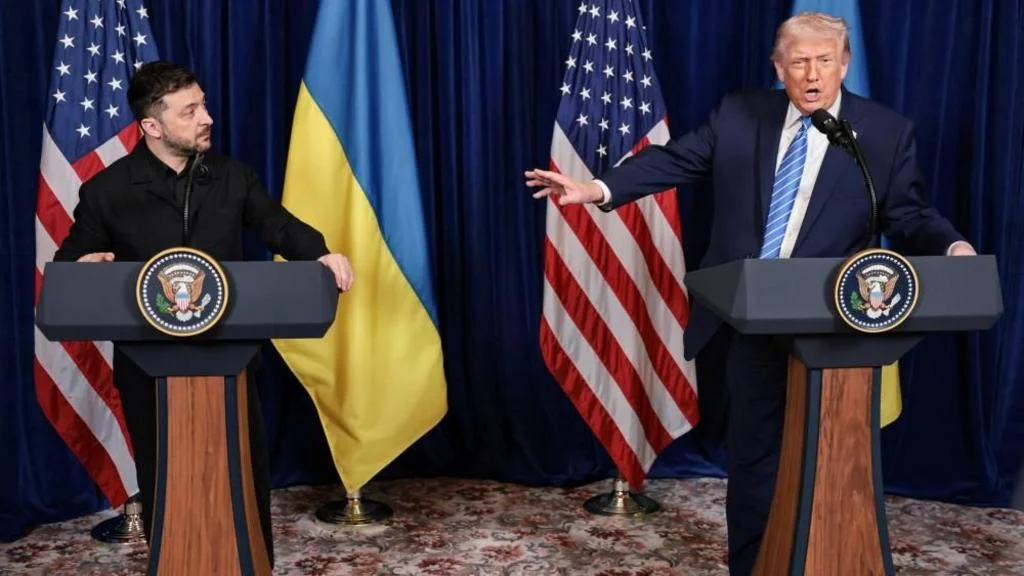
High-level peace talks between the United States president, Donald Trump, and Ukrainian president Volodymyr Zelensky have given cautious optimism when they happened in Florida, where they said that there has been significant progress in terms of ending the war between Russia and Ukraine, which has lasted almost four years. But, as President Trump said, there are still one or two quite prickly matters keeping a complete breakthrough at bay, all of which have to do with the question of territory and the future of the Eastern regions of Ukraine.
Significant Progress in Peace Framework
In an interview with reporters at Mar-a-Lago, the two leaders said that their talks were great and substantive. Zelensky disclosed that almost 90 percent of a 20-point peace plan had been mutually agreed upon, and Trump stated that security guarantees to Ukraine were 95 percent complete. Giving another round of talks, Zelensky says that American and Ukrainian negotiating teams will meet again next week and work on the issues that have not been fully discussed, and improve the structure of the peace roadmap.
Zelensky stressed that the dialogue needs continuous operation, and he is thankful that the diplomatic momentum has been created during the past weeks. He once again stated Ukraine’s willingness to negotiate in good faith and ensure that the final agreement would respect Ukraine’s security, sovereignty, and long-term stability.
The Main Controversy: The situation in Donbas
Although there is a general agreement on most of the provisions, Trump admitted that the most challenging problem is territorial issues, especially in regard to the Donbas region. Donetsk and Luhansk regions, which are now called Donbas, have been the center of the conflict since Russia invaded the area in its entirety in February 2022. At the moment, about 75 percent of Donetsk and almost the entire Luhansk is controlled by Moscow.
Trump noted that a reference to converting Donbas into a demilitarized buffer zone is yet to be resolved. Russia is also said to demand that Ukraine retreat to the limited territories it still has. In contrast, Kyiv has responded with the proposal of transforming some parts of Donbas into a safe, free economic zone, patrolled and governed by Ukrainian troops.
U.S. President has changed his mindset on matters of compromising territories several times in the last several months, at times, suggesting that Ukraine could still have occupied territories back under its control before reversing his position. Trump added that the territorial dilemma was a very tough issue, but it would be solved as well after the talks.
Security Assurances and Foreign Intervention
Trump also said that agreements on the long-term security of Ukraine are in the offing. Still, he did not insist on whether it would engage troop placements or direct military assistance of the U.S. He suggested that someday the U.S. and Russia (jointly with Ukraine) might have trilateral talks. Still, at the appropriate moment, he pointed out that he wanted to establish a durable and enforceable peace mechanism.
The meeting came soon after Trump had a personal dialogue with the Russian President Vladimir Putin. Little information about the discussion was revealed, but Trump alleged that Putin wished that Ukraine would succeed. On the other hand Moscow had declined to concede to a ceasefire that would allow Ukrainian referendums on disputed areas. In the meantime, Russian foreign policy consultant Yuri Ushakov affirmed that Trump had made the call, and that the two leaders had agreed that a temporary ceasefire in its present version could only possibly make the conflict last longer, and not end.
Europe Backs Negotiations further
After the talks with Florida, Zelensky gave briefings to European allies. European Commission President Ursula von der Leyen applauded the achievements of their diplomatic actions. It emphasized that Ukraine must get ironclad security guarantees by day one under whatever settlement is achieved. French President Emmanuel Macron also declared the next month’s Paris conference of allied countries to discuss the solidification of the security commitments to Ukraine, and it is necessary to guarantee the peace and stability of the region.
Also, Zelensky hinted that Ukrainian officials may visit Washington in January for additional consultations, perhaps with European leaders, to align expectations and positions and enter potentially decisive negotiation phases.
Read also
- Russian Strikes Damage Neutral Turkish Vessels in Ukrainian Ports
- Russia escalates attacks on key Ukrainian region of Odesa
- Ukraine Says Drones Hit Russia’s Largest Gas Processing Plant
- 3 US lawmakers move to end Trump’s 50% tariffs on India
- Trump expands travel ban, adding five more countries
War Yet Lingers on, But Diplomacy Prospers
Although negotiations are picking up pace, the war on the ground persists, with Russia still controlling some 20 percent of Ukrainian territory. Humanitarian cost is still enormous, and the geopolitics are out of this world. Trump admitted that in case of the negotiations going really badly or halting, the war may linger on, and this highlights how immediate and delicate the diplomatic window has become.
However, the rhetoric of both Washington and Kyiv indicates unparalleled progress towards an eventual compromise despite the lack of resolution to the various disagreements. As the world grows more demanding, the upcoming weeks should be the time that will reveal whether diplomacy will finally bear some fruit and peace can be attained, or whether Ukraine will be able to enter another year of devastating war.
