


At a time when more and more attention is being paid to the carbon footprint of our digital habits, a shocking new study has refocused the spotlight on another resource — one that’s significantly more tactile water.
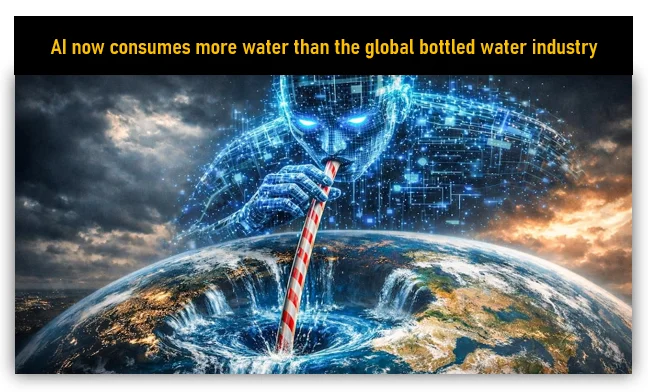
The world appears to have hit a cold hard wall in the form of an obscure academic paper by Dutch scholar Alex de Vries-Gao, which brings home new research published in December 2025 other than by journal Patterns. From ground zero, water used for artificial intelligence systems is projected to exceed the volume of bottled H2O all people worldwide drink in annually by end-2025.
The Scale: AI vs. The Bottled Water Industry
The figures that the study, which was led by the founder of Digiconomist, produced are hard to ignore. As tech giants like OpenAI, Google and especially Microsoft rush to put more powerful models in the field, the “thirst” in infrastructure that powers them has ballooned.
The room: By 2025, the AI sector could consumers between 312.5 billion and 765 billion litters of water.
The Comparison: Consider the global bottled water industry (the source of drinking for billions): it uses about 446 billion litters per year.
The “Drop” in the Bucket: On an individual basis, university researchers at California-Riverside had earlier calculated that just chatting with an AI bot (which they pegged as roughly 10 to 50 back-and-forths) “drinks” some 500ml of water — about the size of a conventional plastic water bottle.
Why Does AI Use So Much Water?
AI resides in gigantic data centers the size of warehouses filled with high-performance GPUs (Graphics Processing Units) that create lots of heat.
Direct Cooling (Scope 1): Data centers use evaporative cooling to avoid melting or hardware failure. This requires the use of freshwater to take on heat and then return it back to the air as vapor.
Scope 2 Power Generation (Indirect): This is the “invisible” expense. All of the electricity that AI swallows is generated in power plants, which consume billions of litters of water to cool and keep steam-driven turbines lubricated.
The Supply Chain (Scope 3): Making just one microchip—the “brain” of A.I.—demands “ultrapure” water to scour wafers clean and cool machinery, making the total industry footprint all the more bloated.
A Local Crisis in a Global Business
The researchers caution that the environmental effects are not equally shared. More than half of the world’s large data centers are in areas facing high or extremely high water stress, including parts of India, China and the American Southwest (like Arizona and Georgia).
In these places, A.I.’s “thirst” is now starting to clash directly with those of local agriculture and municipal drinking supplies. For reference, a 100MW data center can go through as much water as 80,000 people – and some communities are seeing their utility prices climb and local wells dry up as a result.
Industry Fails to Deliver: Will we see Water Positive by 2030?
Tech giants are not ignoring this research. Companies like Google and Microsoft have committed to becoming “Water Positive” by 2030, meaning that they will return more water to the environment than they consume.
The Challenge: As demands for AI power are projected to triple, while we maintain our current pace by 2028, experts caution that such sustainability promises are only getting harder to keep.
Potential solutions: Some scientists suggest “Federated Carbon Intelligence” that schedules AI training during cooler night hours in order to reduce evaporation, in the same way you wouldn’t water your lawn at noon.
Conclusion
The next time you shoot a query off to a virtual assistant so it can summarize a document, or an image, think about how the “cloud” comes with a very real, and somewhat liquid cost. The 2025 data is a wake-up call for transparency — and although we can measure the speed of AI model, we are only just starting to understand its real cost to the planet.
