


The mid-latitudes — from the north of the United States to central Europe — have been treated this late in 2025 to a celestial show that typically only unfolds above frozen Arctic tundras. The night sky has been turning into flickering canvases of shimmery emerald green and dark, electric purple.
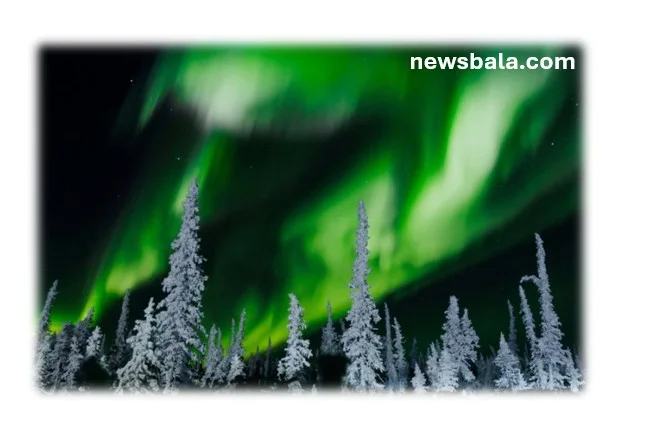
This is not just a good two weeks of clear skies; it’s simply what happens when the Sun is as “angry” as it’s been, and a neat example of atmospheric chemistry magic. Here’s the science of why those lights are headed your way.
The “Solar Maximum” Peak
The solar gymnastics show was punctuated on the technical front with an auroral display because we are at Solar Maximum for Solar Cycle 25. The Sun follows an approximately 11 year cycle, from quiet (solar minimum) to violence ( solar maximum).
At this solar maximum, in 2025, the sun is peppered with sunspots and often “burps” large clouds of plasma called Coronal Mass Ejections (CMEs). When all of these billions of tons of charged particles hit Earth’s magnetic field, they can set off Geomagnetic Storms. Those storms drive the “auroral oval” — the ring of light typically restricted near the poles — toward the equator, giving people at lower latitudes a chance to see it.
Why Green? (The Oxygen Effect)
Green is the more common color in any aurora, but during severe solar storms, it becomes strikingly vibrant. This is caused by solar electrons striking oxygen atoms in the atmosphere.
Where they happen: The impact events happen at approximately 100 km and 250 km above the Earth.
The Science: When oxygen atom is hit, it gets `excited.’ Once it cools back to its ground state, it gives off a photon of light at a particular wavelength (557.7 nm), which our eyes see as intense green.
Human Vision: We are most sensitive to green more than any other color, which is why even weak aurora shows up as green in our eyes or a camera’s lens.
Why Purple? (The Nitrogen Signature)
Green is the most common color, but “rare red or blue even occurs much higher in the atmosphere,” says Solomon.
These colors are the result of a particularly strong solar activity.
You need gas, and a lot of solar heat for that purple or violet. Nitrogen is what makes the aurora purple.
Altitude: Colors like these are produced at lower altitudes, often under 100 km, where the atmosphere is thicker and there’s more nitrogen.
The Science: It requires a high-energy solar storm to drive particles that deep into the atmosphere, where they can interact with nitrogen molecules. When ionized or excited, these molecules emit light in the blue and red wavelengths.
The Mix: These blue and red emissions mingle with the predominant green to produce the beautiful purplish-pink fringes often observed along the bottom edge of auroral curtains.
Why So Distant From the Poles?
Under “normal” circumstances, Earth’s magnetic field functions as a shield that channels these particles to the North and South Poles. But when, as in the case of a G4 or G5 (Extreme) Geomagnetic Storm, the solar wind “rumbles over” us with enough force, it overwhelms the magnetic guard.
That makes it possible for particles to travel into the atmosphere far to the south (in the case of the Northern Hemisphere) or north (in the case of the Southern Hemisphere). By 2025, a number of X-class solar flares are havin’ that kind of “push” – shoving the aurora south so it becomes visible perhaps as far towards the Mediterranean or decks in the southern U.S.
Read also
- This is what the science says Steve Smith black tape over his eyes
- Blue Origin Makes History with First Wheelchair User in Space
How to Catch the Next Show?
If you are outside the traditional “Aurora Zone,” your best bet is to keep a close eye on the Kp-index — a scale from 0 to 9 that rates geomagnetic activity. A Kp of 7 or more usually sends the lights to latitudes farther south.
Look North: In the Northern Hemisphere, turn your gaze to the northern horizon.
Escape Light Pollution: Run from city lights; the aurora at lower latitudes is usually dimmer and can be lost in background light.
Snap a Photo: Today’s smartphone cameras can often do a better job “seeing” the colors than humans. Try Night Mode, or a long exposure to see if there lurking in the shadows is a green and purple glow
