


A recent meeting in Amman between Prime Minister Narendra Modi and Jordan’s King Abdullah II bin Al Hussein was a strong reminder of a relationship that is not only old but increasingly strategic. Occurring amid celebration of 75 years of diplomatic relations between the two countries, the all-encompassing bilateral visit — first by an Indian head of government in 37 long years – was a momentous one as it took the relationship from just goodwill to concrete and comprehensive cooperation.
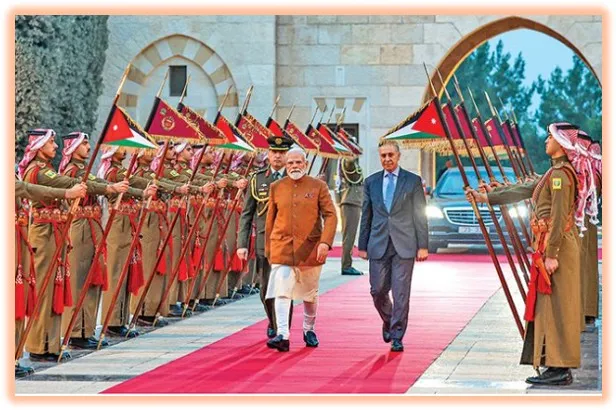
Meeting at the Husseiniya Palace, the talks were multi-dimensional and encompassed enhancing economic and technological ties, but placed it in a bedrock framework of shared regional and global security interests with counter-terrorism and the West Asia crisis being on top of the list.
A Common Ground on Global Security and Moderation
The heart of the two countries’ dialogue was global security and the necessity to fight extremism. The two leaders reiterated their strong condemnation of terrorism, radicalization and violent extremism in all its forms or manifestations. PM Modi also praised King Abdullah II’s leadership in promoting moderation, referring to their joint work on an Islamic heritage conference when the King visited India last year and their first meeting at the UN in 2015 which was dedicated to countering violent extremism.
Modi also recognised the strong and strategic message of Jordan against violence, saying the contribution of King Abdullah II is “extremely important not only in the Arab world but also at the global level”.
The two leaders also shared their views on the deteriorating situation in West Asia, including Gaza. PM Modi praised the active and positive role played by King Abdullah II in promoting peace and stability, with both agreeing on the need for peace to be restored in the region. This security and moderating factor convergence, is one of the key strategic foundations on which the relationship between India and Jordan now stands.
Forging New Economic and Digital Pathways
In addition to security, much of the visit was about putting fresh wind into trade relations. India is already Jordan’s third largest trading partners and PM Modi presented an ambitious eight-point vision to take the cooperation forward. The objective is plain: to double bilateral trade from the current figure of about $2.8 billion to $5 billion over the next five years.
In order to accomplish this, a number of priority areas were examined with the intention of fostering closer cooperation; accords were signed in several different forms (Memorandum of Understanding [MoU]):
Fertilizer and Agriculture: Jordan is one of the most important suppliers of phosphates and potash to India. to discuss increased Indian investment in Jordan for the supply of phosphatic fertilizers essential to India’s agriculture.
Digital Public Infrastructure (DPI) PM Modi suggested cooperation in alignment of Jordan’s digital payment system with India’s Unified Payments Interface (UPI). This also falls under a signed LoI to share India’s successful digital experiences in Jordan for its development.
Renewable Energy and Water Management: Acknowledging common challenges, both sides agreed to sign MoUs on Technical Cooperation between the two ministries in the field of new and renewable energy, their collaboration in water resources management and development for undertaking joint projects, and sharing expertise.
Strategic and Critical Minerals The necessity of the joint effort to develop our critical minerals assets was noted as a new vital area of focus in that it will be necessary for reindustrialization and technological futures.
The discussions also deepened people-to-people connections. Cultural Exchange Programme was renewed and a one of its kind twinning arrangement between Petra and Ellora, two world famous historical sites were signed which typify ancient and civilizational links between the two countries.
This historic engagement, commemorated on the backdrop of the completion of 75 years, has not only re-invigorated an ancient friendship between our two nations but has also effectively put forth a dynamic and multi sectoral road map to bolster each other’s growth, strategic resilience and regional peace in decades ahead.
