


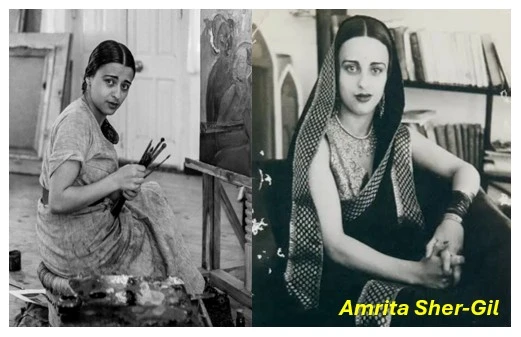
Amrita Sher-Gil is renowned as one of India’s finest painters even today. She was born in Budapest on January 30, 1913; her father was Umrao Singh Sher-Gil and was an educated man who made his living as a photographer. Her mother was Marie Antoinette Gottesmann, from a cultured family in Hungary. For much of her childhood, she lived between Europe and India, being nurtured within an affluent and intellectual atmosphere.
Early life
Even as a young child, Amrita demonstrated tremendous ability as an artist and developed musical and artistic expertise as a child and then continued studying at the École des Beaux-Arts in Paris. Having been exposed to both cultures while growing up, she had a significant influence on her artistic vision. Although raised in an affluent family, she felt a sense of isolation from others and was left wondering where her place was culturally.
Personal Challenges
One significant challenge for her was her mixed-race heritage- she was both Indian and European- yet was not fully embraced by either culture, leaving her unsure of what her own identity was. Her artwork often met with criticism for being ‘too modern’ and ‘too unconventional.’ The emotional struggles she experienced, including feelings of isolation and loneliness, were experienced throughout her life. Even though she found incredible success at such a young age, she never stopped searching for a deeper meaning to her work and for an artistic resolution.
you may also like:
- Clarence Ellis the Computer Scientist
- Tenzing Norgay the Man Who Climbed Over Clouds
- Dashrath Manjhi carved a road through a mountain alone
Career / Journey (Dialogue)
- Career – Starting
Amrita’s artistic career began when she was doing serious artwork in Paris in the 1920s. She had been influenced by the work of various European masters, including Paul Cezanne and Paul Gauguin. By the time she was nineteen years old, she had earned a reputation as an artist and had become one of the youngest people in history to be named as an Associate of the Grand Salon in Paris.
- Return to India
In 1934, Amrita returned to India and her direction as an artist changed as she was now inspired by the villages, women and the rural poor of India; and created a new philosophy for her artwork that would showcase the true experience of the lives of real people in India rather than emulate Western Art.
- Major Breakthrough
Amrita Sher-Gil’s artistic nature combined dynamic, dramatic works with a coherent visual aesthetic. Many of the artist’s pieces portray ordinary people, with a particular concentration on their dignity and strength; the artist utilized bold colour and simplified shapes and forms, thereby achieving a unique blending of both Indian and European modernist art forms.
Sher-Gil played an important role in developing modern Indian art; her paintings inspired and encouraged many Indian artists to create their own unique styles of artwork compared to their globally-influenced counterparts.
Achievements
- At the age of 19, Sher-Gil was awarded the title of Associate of the Grand Salon in Paris
- The first two works noted above are examples of numerous masterworks
- Amrita advocated for the promotion of modernism among Indian artists through her artwork
- India has declared her to be a national treasure, in addition to all of the works created by her and the National Gallery of Modern Art in New Delhi
Personality traits/characteristics
Amrita was bold/ assertive and demonstrated intelligence; she demonstrated an ability to articulate and challenge established norms and was empathetic to those who are suffering and struggling, as reflected in her artwork.
Amrita had a high degree of self-esteem and an equally strong desire to express herself artistically. She wrote, “I can only paint in India”, reflecting her sentiment towards her homeland, while having lived in Europe as a child.
Impact on Society
Amrita Sher Gil revolutionized the art of India by steering away from the decorative traditional style and directing her attention to themes of realism and expressive emotion. By illustrating the lives of Indian women and the underprivileged in rural villages, she gave dignity to a group of people who are often neglected in the world of fine art.
Her own artistry motivated many subsequent generations of modern Indian artists to explore new creative avenues, whilst maintaining their connection to traditional Indian culture and dealing with social truths.
Lesser Known Details/Statistics
- Sher-Gil spoke different languages, including Hungarian, French, and English.
- In addition to visual arts, she was interested in Music and Literary Arts.
- Many critics have compared her influence in Indian art to Frida Kahlo’s impact on Mexican Art.
- Sher-Gil produced over 170 works of art before her untimely death
Death
In 1938, Sher-Gil was married to her Hungarian cousin Victor Egan. Although she painted until her health failed, she passed away unexpectedly on December 5, 1941, in Lahore, Pakistan, at the young age of 28 years. The cause of her untimely death remains a mystery and has added intrigue to her life history. The art world was in shock upon hearing of her death, as many were convinced her some of her most important works would still have been created had she lived longer.
Legacy
Amrita Sher-Gil is widely regarded today as a trailblazer in modern Indian art. Her work adorns museum galleries and universities throughout the world; scholars and students alike study her art.
Timeline
- 1913 — Born in Budapest, Hungary
- 1929 — Studied art in Paris
- 1932 — Joined the Grand Salon
- 1934 — Returned to India
- 1937 — Painted Three Girls
- 1938 — Married Victor Egan
- 1941 — Died in Lahore at age 28
