


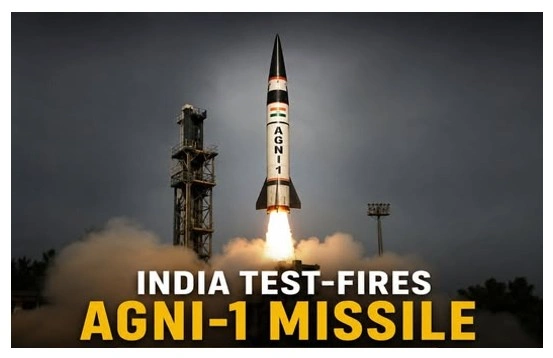
On Friday, India successfully conducted a launch of its Agni missile from the Integrated Test Range at the Odisha coast of India. The Indian military and the Strategic Forces Command supervised the launch. As stated by the Indian Ministry of Defence, the test validated all operational and technical parameters of Agni-1.
The successful launch of Agni-1 is another step towards India’s ongoing development of its strategic deterrent capabilities while modernising its arsenal. The test also comes at a time when large security challenges in the region are taking place.
Conducted off the Coast of Odisha
The test was conducted from the Integrated Test Range, which is a defence test range facility that has been established at the Chandipur along the Odisha coastline and is operated by the Defence Research and Development Organisation (DRDO). During the test, the missile successfully hit its target according to the predetermined path and completed its flight as expected.
The Strategic Forces Command (SFC), which oversees India’s nuclear missile capabilities, managed the test launch. Defence analysts say that periodic testing of missile systems is essential to maintaining operational readiness and reliability of a country’s strategic weapons systems.
read also: Gold factory discovered deep under the Pacific Ocean
About the Agni-1 Missile
The Agni-1 is an Indian developed ballistic missile with capabilities to carry both nuclear and conventional warheads. It has a strike range of 700 km, and it is designed for rapid deployment due to its high mobility.
The Agni missile system is a key element in India’s overall strategic deterrence plan. It can be used with both conventional and nuclear weapons. The Agni missile system also has a reputation of being highly accurate and flexible in its operational use.
The Agni missile system’s family of missiles includes short-range (<700 km) to long-range (>10,000 km) systems, which provide the Indian Armed Forces with a wide variety of different launches from which they can access targets across all operational ranges.
read also: 27 potential planets discovered with two suns
Raising India’s Strategic Preparedness
This successful test-firing demonstrates India’s increased confidence in establishing credible and effective deterrence postures. In addition, the timing of this test occurs during a period of rapid completion of various missile and defense systems by countries in India’s immediate vicinity.
According to Indian officials, the most recent test affirms the reliability/maintainability/readiness of India’s ballistic missile systems. Additionally, the test supports the empirical validation of enhancements through upgraded operational processes.
According to experts, the Agni missile program has been crucial in improving both India’s long-term strategic stability as well as its national security architecture.
read also: Super-Earth discovered day-time temperature is said to be 725°C
India’s Advanced Missile Capability Expanding
India conducted a successful flight test of an advanced Agni missile equipped with Multiple Independently Targetable Re-entry Vehicles (MIRVs) just weeks before the Agni-1 launch occurred recently in early October 2020. The testing was performed on 3 October from Dr APJ Abdul Kalam Island, located off the coast of Odisha, India.
The capability for the Agni missile (and others) to carry multiple weapons to several targets at one time (MIRV technology) is considered by defence experts to be a significant enhancement to missile capability because it enhances strike options, increases the ability to penetrate enemy anti-missile defence and provides the ability to provide fast-response capabilities.
Furthermore, it has been reported that this advanced Agni missile test involved multiple types of payloads that were targeted at targets ranging from the Indian Ocean to across a wide area of the globe.
Indigenous Defence Development is a Primary Focus
The defence research and development organisation (DRDO) drives the country’s missile development efforts while being supported by domestic defence industry. The nation has made a strong commitment over the past several years to develop indigenous strategic defence capabilities, which is part of the broader “Make in India” initiative.
Recent advancements such as loitering munitions, hypersonic weaponry, and precision guided ordnance illustrate India’s increasing application of technology to its military operations.
According to experts, ongoing funding of domestic/complementary missile technology will continue to bolster Indian defence readiness as well as reduce their reliance on foreign soldier technology.
Strategic Significance
The strategic significance of these advances is evidenced by the recent Agni-1 test illustrating India’s commitment to having a strong strategic deterrent in this rapidly changing global order. Analysts cite that frequent missile firings indicate operational readiness and help to instil confidence within the military regarding current deployment systems.
India is expected to continue to expand its missile capabilities through the addition of more sophisticated long-range systems and greater use of advanced technology as volatile regional security dynamics continue to evolve.
