


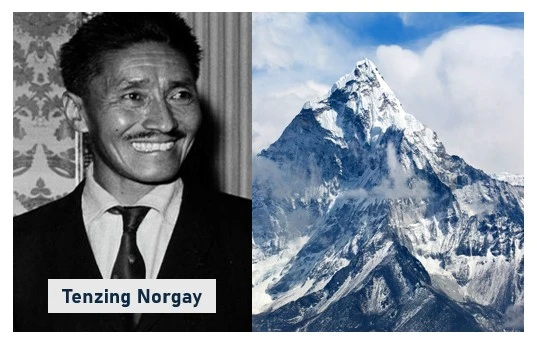
Tenzing Norgay was born on May 29, 1914, in the Himalayas near Mount Everest. Mountains would define his life and legacy. His Sherpa family lived in the Himalayas, where life was tough, solitary, and deeply connected to nature. Long winters, difficult terrain, and hard work were daily necessities.
It is said that a Buddhist monk named him Tenzing Norgay instead of Namgyal Wangdi. The name was spiritual, but no one could have predicted its fame.
Early life
Tenzing was raised with the Himalayas in view. Locals see Mount Everest as more than a mountain. It was holy. People feared and revered it. The peak was called Chomolungma, Goddess Mother of the World.
But young Tenzing saw more in the mountain. That calm curiosity changed mountaineering forever.
A Difficult Childhood That Built Extraordinary Strength
Growing up in the Himalayas demanded toughness. Tenzing was raised by poor Sherpas and learned the value of hard effort. Lack of amenities, smooth roads, and opportunity.
Mountains made people psychologically and physically fit. Kids went miles over tough terrain, carried huge loads, and survived the cold. Unknowingly, Tenzing was building character that would let him survive the worst conditions on Earth.
His interest in Himalayan adventures developed as he aged. British and European climbers sought guides and support crews for Everest climbs.
He liked these climbers’ tales.
Tenzing left home for Darjeeling, India, a Himalayan adventure base. He wanted to work and join an Everest climbing team.
you may also like:
- Dashrath Manjhi Carved a road through a mountain
- Radia Perlman the Woman Who Helped Build the Modern Internet
Entering the Dangerous World of Everest Expeditions
Tenzing’s first job was as a porter, carrying supplies to climbing parties across treacherous mountain trails. The work was brutally hard. The climbers faced avalanches, deep crevasses, snowstorms and freezing winds that could kill in minutes.
But soon Tenzing stood out.
He had extraordinary stamina, keen mountain instincts and remarkable composure when the pressure was on. Other climbers saw that he could be steady in a dangerous situation, when fear would overtake most people.
In 1935 he joined his first ever Everest expedition. In the next few years Tenzing took part in several Himalayan expeditions. Some proved disappointing. Others were close to winning before deadly weather drove teams back.
Each failed climb taught him something. He learned the speed at which the snow could change. He learned the responses of the human body at extreme altitudes. Most of all, he learned that Everest demands patience and respect.
By the early 1950s Tenzing Norgay had a reputation as one of the best high altitude climbers in the world.
The Mountain That Refused to Be Conquered
In the first part of the 20th century, Mount Everest was one of humanity’s biggest mysteries. Expedition after expedition failed to summit the mountain, despite climbers’ dreams.
Above 8,000 meters, oxygen levels drop severely. Climbers are breathless, fatigued rapidly, and even a slight mistake can kill. Many had died on Everest from cold, avalanches, and violent storms.
But climbers returned.
The 1952 Swiss expedition commanded by Raymond Lambert included Tenzing. Both men soared higher than most before them. Their chances of reaching the top were briefly high.
Summit had other plans.
Storms and weariness forced them to turn back nearly halfway.
Despite disappointment, Tenzing gained mountaineering fame after the trek. His strength, courage, and resolve were admired.
Most believed Tenzing Norgay would be present when Everest was conquered.
Famous Climb That Changed the World
A 1953 British expedition commanded by Colonel John Hunt planned to retry Everest. Edmund Hillary, a big, resolute New Zealand mountaineer, climbed.
While on the trip, Hillary and Tenzing developed trust and respect. Trust between climbers can save lives in Everest’s death zone.
The climb was exhausting. With heavy oxygen equipment, the team crossed perilous icefalls, ascended high slopes, and suffered frigid temperatures. A few steps higher up the mountain were physically demanding.
Tenzing Norgay and Edmund Hillary reached Earth’s highest point. Humans had never ascended Mount Everest before.
The feat stunned the world
Newspapers around the world hailed it as one of the great exploratory triumphs of the century. Instantly Tenzing was an international hero.
But he was modest even in that moment of fame. Later, when people argued about who had reached the summit first, Tenzing refused to make it a personal contest. He always stressed that the climb was a team effort.
Fame Awards and Worldwide Respect
Tenzing Norgay became one of the world’s most famous mountaineers after the Everest expedition. Wherever he went, crowds would gather to welcome him.
His achievement was recognised by governments and organisations with several prestigious awards.
- He was awarded the George Medal for bravery by Britain and the Order of the Star of Nepal by the King of Nepal.
- The Government of India awarded him the Padma Bhushan, one of the country’s highest civilian honours, in 1959.
- The Himalayan Mountaineering Institute was founded in Darjeeling in 1954 and Tenzing took up the post of Director of Field Training.
A Legacy Higher Than Everest
Tenzing Norgay passed away on May 9, 1986 in Darjeeling, India but his legacy continues to inspire millions all over the world.
His life story is one of incredible courage and perseverance. He rose from a humble Himalayan start to become one of the greatest mountaineers in history.
More importantly, he proved to the world that real greatness isn’t just about reaching great heights. It comes from humility, resilience and the courage to keep moving forward even when the path feels impossible.
Today, the name Tenzing Norgay is not only associated with the man who climbed Mount Everest, but with the spirit of determination.
