


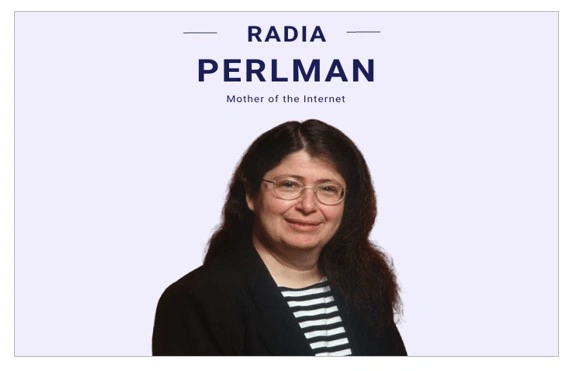
Radia Perlman, who is not a household name outside the tech world, is one of the most influential people in the history of computer networking. Her work is the silent foundation of how modern computer networks operate today.
Her most celebrated work is the design of the Spanning Tree Protocol which gave Ethernet networks stability and reliability. Constant failure and communication loops would have a difficult time in large scale networks without this kind of innovation. Perlman’s ideas solved some of the Internet’s biggest engineering problems, although many people contributed to the Internet’s development.
Early life and education
Radia Joy Perlman was born in Portsmouth, Virginia, United States in 1951. She was raised in a home where education and analytical thinking were part of the daily routine. Her father was an engineer for the U. S. government and her mother taught mathematics.
From an early age she had a natural interest in logic and problem solving. She liked puzzles and patterns and systems that took some careful thought. She was not like many children she was more interested in how things worked on the inside than on the outside.
In her childhood, engineering and computing weren’t typical career options for women. But at the same time, she was encouraged at home to pursue her interests without restrictions and this was an important factor that helped form her future.
you may also like:
- Bhimrao Ramji Ambedkar builder of the Indian Constitution
- Arunachalam Muruganantham revolutionized affordable sanitary pad
- Jagadish Chandra Bose a gem who is will be cherished forever
Education and Early Computing Interest
Perlman had studied mathematics at the Massachusetts Institute of Technology (MIT), one of the most prestigious technical institutions in the world. There, she gradually developed a keen interest in computer systems and programming.
Computers were still in their infancy. Back then machines were big and expensive and not nearly as accessible as now. Networking between computers was also a new and difficult field. For young researchers like Perlman, these limitations made the subject both challenging and exciting.
She went on to get her Master’s and PhD in computer science at MIT. Her academic studies were in distributed systems and network protocols, topics that would later be at the heart of her career.
The Problem of Early Computer Networks
In the early days of computer networking, engineers had a big problem. Networks needed several links between systems so data could still flow if one link failed. But this caused an unexpected problem.
With multiple paths, data packets could end up going in circles forever. These loops created congestion, duplicated data and sometimes complete system collapse. The problem grew worse as networks grew and harder to control
Many engineers worked on fixing this, but there was no stable and scalable solution. This challenge has become one of the main barriers in the construction of reliable Ethernet networks.
Spanning Tree Protocol
The breakthrough came in the 1980s, when Perlman was working at Digital Equipment Corporation or DEC. She developed the Spanning Tree Protocol (STP), a system for network devices to communicate and automatically configure themselves in a loop free structure.
Instead of having all links up all the time, STP intelligently disabled redundant links, but still had backup routes available. If the primary connection went down, the system could quickly bring up an alternate path.
This concept fundamentally changed the operation of Ethernet networks. It made them stable, scalable, able to handle complex environments without falling apart.
STP was later standardised by IEEE as an official industry standard and is still considered a fundamental networking concept today. Current versions of the protocol are still in use in
- Corporate networks
- Cloud infrastructure
- Universities
- Communications systems
In many ways it became one of the hidden building blocks of the modern internet.
Career Development and Work in Progress
After her triumph at DEC, Perlman stuck around big tech environments. She later joined Sun Microsystems working on networking and security systems. She has worked with Intel and other research groups.
In those jobs, she developed a very special skill which is the ability to strip very complex systems down without losing their effectiveness. Often her solutions were elegant, solving deep problems in a surprisingly straightforward way and engineers often appreciated her work.
Besides her engineering work, she also wrote influential textbooks on networking. One of her most famous works is Interconnections that is Bridges, Routers, Switches and Internetworking Protocols which is widely used in the computer science education.
Experience and Challenges in a Male Dominated Field
Perlman began her career at a time when women in engineering and computer science were very much in the minority. In many professional settings she was frequently one of the only women present.
She never made a career out of this challenge in the public eye, but she has said that gender imbalance in technology was a real problem. She focused less on recognition or barriers and more on her work and on solving technical problems.
She showed that success can change perceptions and open doors for more women to enter the computing and networking field.
Acknowledgement and Awards
Though not one to seek the limelight, Perlman ultimately earned recognition for her contributions. She was inducted into the National Inventors Hall of Fame and received multiple lifetime achievement awards in networking and computing.
She has also been honoured by such major organisations as the Association for Computing Machinery (ACM) and the Internet Society.
Yet, she is known for her humility and practicality in engineering despite these awards. She often stresses that technology should not be about complexity or prestige, but about reliability and usefulness.
Legacy and Influence
Radia Perlman’s impact is felt in nearly every digital interaction today, even if it goes unnoticed.
Whether it’s a video call, an online payment or a cloud service, every time data travels over a network, systems inspired by her work help ensure that communication is stable and efficient.
Her ideas helped turn networking from fragile experimental setups into robust global infrastructure. She also showed that some of the most important contributions in technology are made quietly, behind the scenes, not just through technical innovation.
Summary
Radia Perlman’s is not a story of public visibility or commercial fame, but of deep technical impact. Her invention of the Spanning Tree Protocol and her broader contributions to networking systems helped shape the foundation of the modern Internet.
Her work enabled networks to scale reliably across the globe, supporting everything from business systems to global communication platforms.
She notes that some of the most powerful innovations in computing history are not always visible, but they are felt every time the world remains connected.
