


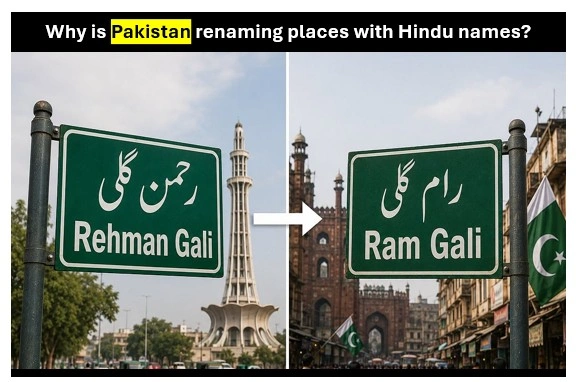
Prior to gaining independence from British rule in 1947, there existed a sizable Hindu, Sikh, and Jain population in Pakistan. At that time, nearly everyone who now resides in Pakistan lived in India.
More than seventy years after India’s division into two countries (including Pakistan), there has been a gradual re-emergence of many of the traditional names for roads, neighborhoods, and public buildings throughout Lahore, Pakistan under the current government.
This effort by the Government of Chief Minister Maryam Nawaz to re-instate traditional historical name places has brought attention to Pakistan from around South Asia. Many of the historic names being re-instated were associated with some element of Hinduism, Sikhism, or Jainism.
According to sources on the ground in Lahore, this project is part of a broader effort referred to as the “Lahore Heritage Areas Revival Project,” which requires financial resources and approval from the Provincial Government as well as the support of former Prime Minister Nawaz Sharif.
The individuals involved in the on-going restoration project have stated that they are not restoring these traditional historical names for any religious or political purpose, but rather to help preserve the unique cultural diversity of those who lived in Lahore prior to 1947.
Some examples of locations in Lahore that will be returned to their historical names are:
Many additional neighborhood, street, and other public areas will be restored to their pre-partition names, including such well-known neighborhoods and street names such as Lakshmi Chowk; Queen’s Road; Lawrence Road; and Ram Gali; etc., where the pre-partition names were changed to reflect either Islamic or Nationalist names after the founding of Pakistan.
Signs of the restoration of the names have already appeared in many areas of Lahore, indicating that the restoration effort is progressing.
read more: Pakistan sends 8000 soldiers to Saudi Arabia
Why Were the Names Changed Earlier?
Following Partition in 1947, millions of Muslims moved out of their homes in what became Pakistan and millions of Hindus and Sikhs moved out of their homes in the new nation of India. Over the decades following Partition many of the streets, neighbourhoods, and public monuments carrying the names of Hindus or Sikhs were renamed as Pakistan shaped its new national identity.
Some of these changes were gradual, while others were done very quickly during times of political Islamisation. For example, some reports indicate that the names of some of these places were changed in the 1990s during a period of increasing communal tension, including following the destruction of the Babri Masjid in India.
For instance, Jain Mandir Chowk may have become Babri Masjid Chowk at this time. These name changes eventually became part of the government’s official record of these places but, for many residents, the names they had always used continued to be used informally.
read more: China Draws 4 Red Lines Ahead of Trump’s Visit
Political Symbolism or Heritage Revival?
Officials in Pakistan have labelled this name change process as a heritage restoration initiative designed to restore a pluralistic past of the city of Lahore — which was made up of Muslims, Hindus, Sikhs, Jains, and Christians prior to the major demographic change that followed Partition.
Many supporters of the preservation of older names believe that this helps preserve the cultural memory and to provide continuity with the historical past. Many historians and local scholars have also expressed that Lahore’s identity cannot be separated from its pre-Partition heritage.
Critics of the Punjab government say that the recent decision reflects a different kind of symbolic gesture, one that projects a certain level of moderation, openness to cultural diversity, and an attempt to appear inclusive. However, many residents in Punjab argue that they never actually stopped using the old names, making the change more symbolic than revolutionary.
read more: Bangladesh seeks China’s support for Teesta River project
Reaction from Citizens of Punjab
Reactions on social media from citizens in both Pakistan & India about the name change have been very strong. Many Pakistanis are responding positively to the change, saying that it is a welcome sign towards acknowledging our collective South Asian history as shared. On the other hand, there are some citizens who remain skeptical about whether simply changing the names to something more South Asian will actually result in other larger concerns regarding the rights of minorities or preserving their cultures (heritage).
There have also been comparisons made within India about recent renaming efforts carried out by different State Governments – where State Governments have been renaming streets or buildings and removing name plates with the names of local gods and goddesses that were previously used – as opposed to Islamic names, or names of Imperial powers that were previously used (i.e., British Raj).
Bottom line
Thus, Lahore represents a grossly problematic and controversial debate occurring throughout South Asia about whether or not renaming places constitutes an act of cultural correction, a political symbolization for a particular kind of political purpose or whether this type of renaming is justified from the perspective of preserving history. For Pakistan, however, the restoration of the names Krishan Nagar and Jain Mandir Chowk are two examples of the only times in the history of Lahore where a public place has been acknowledged as having a diversity-rich history.
