


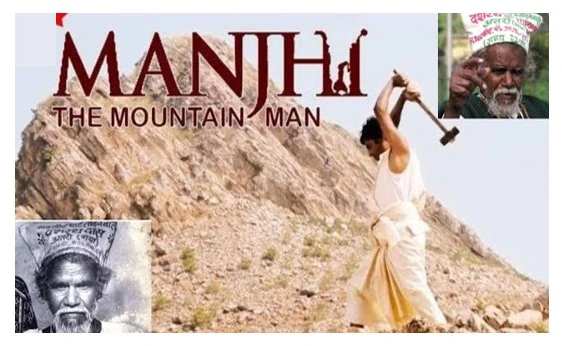
Dashrath Manjhi was born on 14 January 1934 in the small village of Gehlaur in Bihar, India. He hailed from a poor labour family of a socially backward community and his life since childhood was full of hardships.
Gehlaur was encircled by rocky hills and jagged country. The village had little development, bad roads, almost no medical facilities and very few avenues for education or employment. Most families lived as farmers and day workers. Hunger, poverty, struggle, these were everyday parts of life.
As a child, Dashrath had seen people walk long distances for basic needs. Often villagers had to cross dangerous mountain paths to reach nearby towns for food, work or medical help. In an emergency the situation deteriorated further.
Life taught him early to be tough
Like many poor villagers, Dashrath too had to leave home for some time in search of work. He worked in coal mines and in physically demanding jobs to make ends meet. He had little formal education but he had extraordinary mental toughness.
But at the time no one could have guessed that this humble worker would one day become famous all over India as the Mountain Man.
A Love Story That Changed His Life Forever
One of the most important chapters in Dashrath Manjhi’s life began after he married a woman named Falguni Devi.
The couple was poor but closely bonded. Falguni would help Dashrath often in his long hours of work to earn a living. It was a simple life, but like most country families, they found pleasure in small things.
And then came the tragedy. One day, as the popular stories go, Falguni was taking food to Dashrath who was working on the other side of the mountain. She slipped on the rocky path and fell badly and was seriously injured.
The nearest hospital was miles away. The mountain was in the way of the towns closest by and the villagers had to go a long, tiring way around it.
By the time medical help arrived, it was too late and Falguni Devi died.
Dashrath Manjhi was emotionally shattered with her death. But instead of seeing the mountain as an immovable barrier, he made an extraordinary decision.
He decided to make his own road through the mountain. The majority of people believed he had gone mad.
read more:
- Radia Perlman the Woman Who Helped Build the Modern Internet
- Bhimrao Ramji Ambedkar builder of the Indian Constitution
The Beginning of an Impossible Mission
With only a hammer and chisel at his disposal, Dashrath Manjhi began hacking through the huge Gehlaur hill in 1960.
- No machines
- No government backing
- No engineering education
- No financial support
Only Sheer determination!
After he finished his labour work, he would pound the mountain with his tools for hours every day. He kept breaking rocks piece by piece in harsh weather conditions under the hot sun.
Twenty Two Years of Relentless Hard Work
For twenty two years he carved his way up the mountain almost single handedly. The work wrecked his hands, wore out his body and tried his spirit again and again. But the dream was not over.
Those who laughed at him once started to admire his persistence slowly.
When the path became visible villagers realised that Dashrath was actually doing something extraordinary. The mountain which had kept Gehlaur isolated for generations was slowly splitting apart.
He made a path about 110 meters long, 9 meters wide and in some places about 7.6 meters deep. More important, it did much to close the distance between Gehlaur and the towns roundabout.
The Man Who Became a Symbol of Determination
News of Dashrath Manjhi was slowly spreading in Bihar and later in India. People were awe struck by his achievement.
He was popularly called the Mountain Man.
Dashrath’s story touched people in a way that many famous figures didn’t, because he was ordinary in every visible way. He was neither rich nor educated nor politically influential. There were no high tech gadgets, no special resources at his disposal.
He had but one thing, a persistence of the unthinkable degree.
His life became a symbol of what you can achieve with resolve even against impossible odds. Schools, inspirational speakers, writers and filmmakers told his story to inspire other people.
Recognition after Years of Struggle
For most of his life, Dashrath Manjhi worked unrecognised. But the importance of what he had done was eventually recognised by governments and organisations.
He was invited to functions and was honoured by political leaders. Slowly he began to emerge as a respected public man in Bihar. His story was often cited as an example of courage and social change in roads, social campaigns and educational discussions.
His life was also the inspiration behind a 2015 Hindi film Manjhi. The Mountain Man in which actor Nawazuddin Siddiqui played him. The film brought the story of Dashrath to an even wider audience all over India.
Fame came late to Dashrath but he stayed simple and grounded. Those who knew him often described him as humble, emotional and deeply rooted in his village roots.
The Legacy of the Mountain Man
Dashrath Manjhi, a cancer patient, died on 17 August, 2007 at the age of seventy three. He had already become a legend by then. Today his story is taught in schools, discussed in motivational talks and remembered all over India as one of the most inspiring examples of human perseverance.
Even today, tourists visit Gehlaur to see the road he carved through the mountain with his own hands. To most, the sight is almost beyond belief.
But the road is a testament to what one determined human being can do.
Dashrath Manjhi was never a political activist. He was never rich. He never lived luxuriously. But with courage and love and a relentless determination he did much more than that.
