


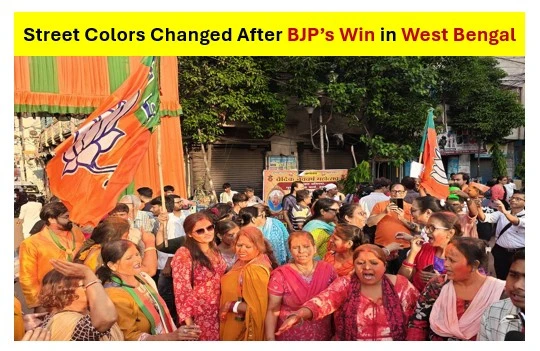
With the historic electoral win of the BJP in West Bengal, many streets, bridges, traffic railings, government buildings, and public areas throughout the state are being repainted from their blue and white colour to the new colours associated with the BJP (ex. yellow and white, saffron). This change has created a significant political debate, with supporters claiming it to be one instance of a new Bengal, while critics are alleging that this trend is simply defining new forms of political symbols from one party to another.
Will the Blue and White be Replaced with Yellow and White?
For over ten (10) years under former Chief Minister (Mamata Banerjee) the urban identity (of West Bengal) was dominated by the blue and white colours of the Trinamool Congress party. This is evidenced by the way all flyovers, lamp posts, and road dividers in Kolkata had a consistent colour scheme, as did all government offices and many tram depots. This blue and white colour scheme became synonymous with the political party (Trinamool Congress) that held power and was utilized for example to promote Bengal’s cultural and civic branding.
However, after the historic landslide victory of the BJP in the last Assembly elections held in 2026, reports show that painting crews and municipal workers in various districts of the state are starting to repaint public buildings in yellow and white and saffron colours. In many instances, the current yellow and white colour schemes are simply the old blue and white colour schemes with an entire new coat of paint being used to cover (up) the existing colours.
The Bharatiya Janata Party has defended their choice of colour for public infrastructure when stating that the prior colour scheme simply reflected the party’s ‘brand’ as opposed to stating that it conformed to the ‘neutral’ aesthetics of the public or all people living in West Bengal. The BJP has further declared that public infrastructure should reflect a ‘national identity’ and should not be reflective of just one particular political party or group that managed to win the last election.
also read: PM Modi meets Iran’s foreign minister Araghchi for the first time
Changed Inside/Out
Analysts of political issues have suggested that the colour change will have more significance than simply being a way to change or update the look of governmental properties in West Bengal and that this colour choice by the BJP has broader implications regarding their attempt to build a credibility factor in their efforts to build upon their success in becoming the governing party of West Bengal after being such a failure for such a long period of time.
With the BJP becoming the governing party of West Bengal after taking control of the state legislature, having their website and other means of gaining some foundation in the state does not have the previous government’s logo, ‘Biswa Bangla’ but instead has the national Ashoka emblem and is offering only that on the state’s portion of the internet and all other places of public use such as buildings, roads, and the like.
Political observers view these actions by the governing body of West Bengal as efforts to make noticeable shifts in the manner in which the outgoing government governed and return back to being aligned to the governing model set forth by central government agencies.
also read: China Admits Helping Pakistan During Operation Sindoor
Reaction to the Change
Many supporters of the BJP feel as though the fact that they are changing the paint colour of public places throughout West Bengal is a visible example of political change. Throughout the city of Kolkata and in several districts of West Bengal, party workers celebrated the election victory with saffron powder, drums, rallies, and cultural programmes.
Some in the community supporting the BJP (Bharatiya Janata Party) believe the state is entering a new era where only one party dominated politically for years on end. Some feel like the change in color schemes and logos that have occurred to date signifies a transitional period away from historical forms of governance and toward something very different.
BJP officials have stated consistently that their primary agenda will consist of restoring an acceptable level of law and order within the state, increasing the number of available public amenities and infrastructure, and attracting investments to the state by companies searching for new locations from which to do business.
also read: Vijay Orders Closure of 717 Liquor Outlets
Opposition Cries Political Vengeance
Trinamool Congress (TMC), the opposition party, has been very critical of these actions. According to TMC officials, taxpayer-funded public works projects should never be used as political spoils of war, and that rebranding public works with a new set a colors and symbols immediately upon taking office demonstrates a focus on “political vengeance” as opposed to administrative priorities.
Many within the public have expressed disdain that every subsequent elected government attempted to create their own visual identity when issuing tax dollars to build or maintain infrastructure. In addition many of them have voiced their feelings that since the state is experiencing economic hardship and high unemployment they believe spending taxpayer’s money to change the color on previously painted walls is inappropriate. (Example: Mamata Banerjee of TMC called for party members to stick together after losing in the referendum and pledged to rebuild the party.)
A Changing Political Landscape
Bengal’s streets are changing not only in terms of their paint, but also in their political representation. For decades, the BJP struggled to expand its base in West Bengal, making the 2026 electoral victory of the BJP one of the biggest political events in recent Indian history.
As the new government takes office in West Bengal, the new colours of Bengal’s streets have become a powerful visual representation of the transformation of the political landscape — a transformation that supporters of the BJP are celebrating, while opponents of the BJP view this transformation with concern. The question that remains for the people of West Bengal is whether or not these visual changes will lead to a more significant transformation of government and administrative reforms.
