


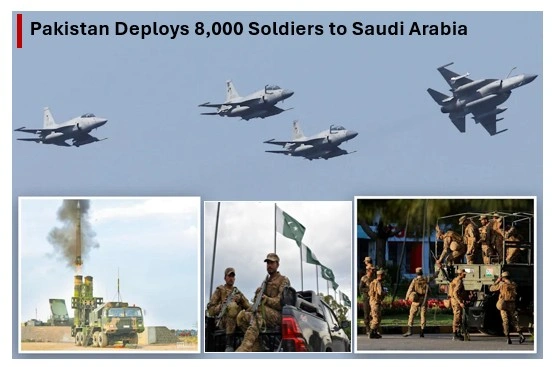
Under an agreement between the countries, Pakistan is sending about 8,000 military personnel jets, drones, and an advanced air defence system to Saudi Arabia, with high tensions prevailing throughout the Middle East as a result of the Iran situation and increasing security concerns throughout the Gulf Region.
Major Military Deployment Amid Regional Tensions
Sources close to the Pakistani government and military, say this deployment will involve a squadron of JF-17 fighter jets, some drone-support units, and a Chinese-manufactured HQ-9 system of integrated air defence. Pakistani personnel are also operating any military assets that are deployed in Saudi Arabia.
This development is significant as it’s one of the largest Pakistani military deployments outside of Pakistan in recent history and represents an increased military cooperation agreement between the governments of Pakistan and Saudi Arabia.
read also: Nuclear power plant in the United Arab Emirates atracked
Defence Agreement Related to Deployment
This current deployment is a result of what both the governments have called “a mutual defence agreement” that was signed between Pakistan and Saudi Arabia in 2025 and, which obligates both countries to provide military support for each other in the event of an attack on one another.
This defence agreement purportedly allows for significantly larger numbers of Pakistan military personnel to be deployed, if required, than currently exist, and, some estimates indicate the potential for up to 80,000 Pakistani military personnel to be deployed under this agreement.
While Pakistan has a long history of military cooperation with Saudi Arabia, analysts see this current deployment as different in scope and capability. International media sources reported that the soldiers are strongly combat-capable versus being within symbolic/advisory circles.
read also: Bangladesh seeks China’s support for Teesta River project
Strategic Value of the HQ-9 Air Defence System
One of the significant components of this deployment, the HQ-9, is a Chinese-made air defence system used for tracking/intercepting aircraft, drones and ballistic missiles—therefore adding to the air defence capabilities of Saudi Arabia in the face of repeated drone and missile attacks on oil infrastructure.
The Chinese-made air defence system will provide the Saudi Arabian military capability of responding to any future threats to their infrastructure by deploying defensive against drone or missile threats.
Military analysts indicate that the military deployment also strengthens China’s internal influence in the Gulf through both defence sales and military partnerships with Pakistan.
Balancing Pakistan’s Diplomatic and Military Role
The military deployment occurs in an environment where Pakistan is attempting to negotiate as a mediator within the context of the Iran conflict and reportedly has been at the front of diplomatic attempts to mediate between Iran and the US, thereby creating communication channels between the two nations.
Geopolitical analysts have raised concerns over Pakistan’s dual role of engaging in the dialogues desired by the region and its military growth in obtaining forces to support Saudi Arabia in its regional efforts to the detriment of its neutrality as a mediator.
Aspects of this balancing act are complicated by the close ties that Pakistan has with both Saudi Arabia and Iran. Saudi Arabia has historically been a financially supportive ally on multiple occasions to Pakistan, providing large amounts of financial support and direct investments during times of economic crisis. Iran, on the other hand remains a border state with Pakistan where there are both border and security considerations of significance to both countries.
Regional and Global Implications
The deployment of Pakistani forces in Saudi Arabia has garnered a considerable amount of global interest as a result of its implications at both regional and global spatial and chronological levels. The deployment of a large and capable combined unit of Pakistani troops, along with advanced military assets from Pakistan in Saudi Arabia, has the potential to change the security trajectory on a regional scale in respect to both affecting the potential for a larger regional conflict as well as the associated risks of that larger regional conflict occurring.
Analysts believe that the Pakistani deployment to Saudi Arabia provides Iran with a very strong signal that Saudi Arabia is enhancing its military preparedness in concert with military support from other countries. The deployment also sends a message to all Middle Eastern countries regarding Pakistan’s interest in increasing its strategic influence throughout that region.
While critics have cautioned that increased military involvement may draw Pakistan into regional hostilities, increasing its likelihood of being drawn into conflict with Iran; social media and global diplomatic forums are also debating how Pakistan’s involvement might affect its overall security, and its diplomatic position in South Asia and the Middle East.
No Official Confirmation So Far
There is currently no publicly available confirmation from either the Pakistani military or the Saudi government that troops have been deployed, nor has any deadline for this deployment been announced. Nevertheless, senior officials from several major global media outlets have confirmed from multiple sources within the Saudi government that the deployments are happening.
As tensions continue to be very high in the Middle East, experts are monitoring whether the defence relationship between Pakistan and Saudi Arabia will deepen or expand over the next few weeks.
