


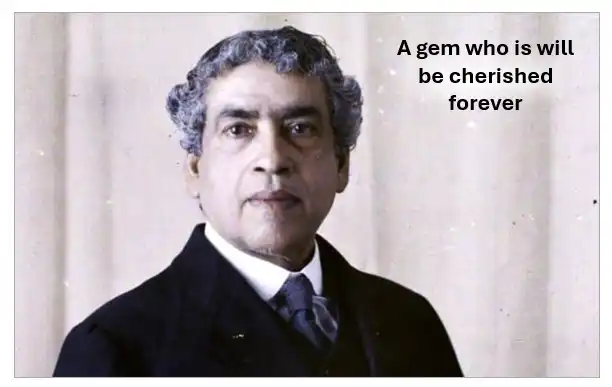
Jagadish Chandra Bose — Pioneer in radio science and plant physiology; worked across physics and biology.
Jagadish Chandra Bose is well-known as an Indian scientist who was a pioneer in radio and also contributed greatly to plant science.
In his work Bose showed scientists that plants have lives and feelings just like humans or any other living being has. He also contributed greatly to the development of wireless communication and transmission methods.
What makes him unique
From other scientists of his era, his intelligence, creativity, and dedication stand out. He also stands out from many other physicists and biologists for his amazing contributions.
The discoveries he made have benefited different scientists who work in electronics and plant biology till date.
Jagadish Chandra Bose was an incredible scientist who overcame prejudice and limited resources to accomplish positive results. His life serves as an example of what it means to have the traits of curiosity, perseverance, equality and service to all humankind. He will always be a symbol of Indian innovation, and inspire future generations.
Early Life
Bose was born on 30 November, 1858 in Mymensingh, Bengal Presidency (now in Bangladesh).
His father, Bhagawan Chandra Bose, was a government officer and a social reformer. His mother, Bama Sundari Devi, encouraged discipline and education.
you may also like:
Childhood and education
He played and studied with children from all social backgrounds. His life around nature influenced his interest in plants.
Bose studied at St. Xavier’s School and later at St. Xavier’s College in Kolkata. He then went to England and studied at the University of Cambridge.
Early struggles or inspirations
During his student life, Jagadish Chandra Bose had developed a deep interest in science despite situations that made him face racial discrimination.
His childhood was simple and close to nature. Jagadish Chandra Bose belonged to a respected family. His visionary and curious nature towards science influenced his bright future.
Personal Challenges
During the time of British control of India, Bose encountered multiple obstacles. Being an Indian educator meant that he received a lower salary than his white counterparts. He chose to protest his inferior pay by refusing to accept a salary for more than two years and would continue to refuse until he received equal pay.
Bose did not have access to adequate laboratories or proper scientific help while living in India, which made it very challenging for him to perform his research. Nonetheless, he persevered with his research despite the financial and social challenges he was facing. The amount of adversity he experienced before his greatness made his final accomplishments much more interesting.
Career / Main Journey
- Beginning of the Journey: When Bose returned to India in 1885, he was appointed as a professor of physics at Presidency College, Kolkata where he created an inspiring manner of teaching.
- Major Breakthroughs: During the 1890s, he performed experiments with radio waves and wireless communication as well as successfully demonstrating wireless signals to many European scientists well before they became well known for their contributions to the fields of radio and wireless technologies.
- Rise to Fame: Bose shifted his focus to plant science in the following years and created the “Crescograph” – an instrument used for measuring the growth of plants. Using the Crescograph, Bose demonstrated that plants respond to heat, light, sound, and pain.
- Important Contributions: Bose’s scientific work revolutionised the way physics and biology are connected. Throughout his career, Bose published a large number of research papers and gained worldwide respect for his work. In 1917, he established the Bose Institute in Kolkata, which aims to promote scientific research in India.
Major Achievements
- Invented the Crescograph to study plant growth.
- Conducted early research in wireless communication.
- Became one of the first Indian scientists to gain worldwide recognition.
- Founded the Bose Institute in 1917.
- Received a knighthood from the British government in 1917.
- Elected Fellow of the Royal Society in 1920.
Personality & Character
Jagadish Chandra Bose was intelligent, disciplined and humble; he had a genuine love for India and his fellow citizens. He also believed that science should be used for the benefit of mankind and not as a means to gain wealth (In other words, he did not try to make money through patents, as many inventors do).
One of his famous quotes is:
“The true laboratory is the mind, where behind illusions we uncover the laws of truth.”
Impact on Society
Bose was the first Indian to demonstrate that Indians could succeed in modern science during colonial rule, and he inspired many generations of Indian scientists. His work significantly changed the way plants were understood and opened up entirely new fields of study in biophysics.
Bose’s contributions to wireless communications were also critical to the development of future technologies. His work continues to be studied by students and researchers today.
Lesser-Known Facts
- Bose created science fiction stories in Bengali.
- He constructed numerous instruments for conducting scientific experiments using locally sourced materials.
- He chose not to patent numerous inventions because he felt that knowledge should be freely shared with others.
- Bose enjoyed nature and often spent long periods of time studying plants.
Final Years / Death
After retirement, Bose devoted most of his time to research and forming the Bose Institute. He passed away at the age of 78 on 23 November 1937 in Giridih, in India.
Legacy
His passing caused immense sorrow throughout India’s scientific community among scientists and students worldwide. His legacy of accomplishments and contributions continues to influence scientists till today.
Conclusion
Today Jagadish Chandra Bose is one of India’s most famous scientists. His legacy endures in the ongoing scientific study of the Bose Institute. There are schools, roads, and institutions named after him.
His story has been told in books, documentaries, and scholarly works. His contributions to plant science and wireless communication continue to be relevant in today’s society.
Final thoughts
Jagadish Chandra Bose was an outstanding scientist who faced adversity, discrimination, and lack of resources to achieve pioneering contributions to science. His discoveries in plant biology and wireless communications changed the course of science globally.
He exemplified the spirit of curiosity, perseverance through adversity, and service to humanity. He is regarded as a model of Indian scientific achievement and an inspiration for future generations.
