


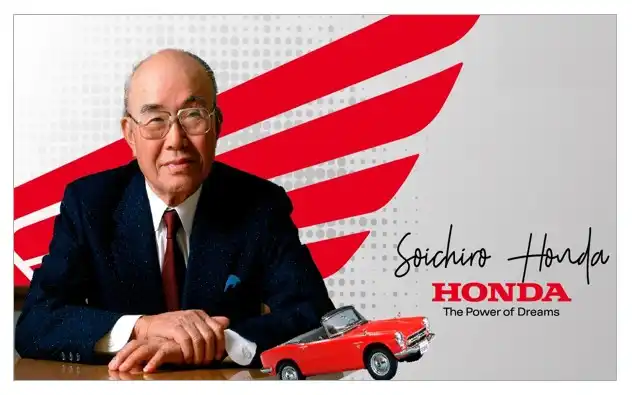
Soichiro Honda was a Japanese engineer, inventor and businessman who changed the motorcycle and automobile industries with his ideas. He is best remembered as the founder of Honda Motor Company, one of the most respected vehicle manufacturers worldwide.
What’s remarkable about Honda’s life story is that his success was built on persistence, not privilege. He was not born a rich man, nor was he a bright student in his school days. But his fascination with machines and ability to learn from his mistakes helped him build a company known for quality, engineering and innovation.
Early Life and Family
Soichiro Honda was born on 17 November 1906 in Komyo, a small village in Shizuoka Prefecture, Japan. Village life was simple and most families depended on manual work for their livelihood. Born into a household that valued discipline and hard work as essential values, Honda was raised.
His father, Gihei Honda, was a blacksmith who repaired bicycles. Mika Honda’s mother was a weaver. The young Honda’s family wasn’t financially strong, but he grew up surrounded by tools, mechanical parts and repair work. He was very much impressed by his father repairing bicycles.
also read: Shah Rukh Khan’s Student Days Resurface
Interest in Mechanics and Training
Honda’s association with formal education was weak, unlike many successful industrialists. He found learning in the classroom less exciting than practical work and often struggled academically. But he was not without useful skills, despite his lack of academic interest.
At the age of 15, Honda moved to Tokyo and began an apprenticeship at an automobile repair shop, Art Shokai. The experience was more valuable for him than the traditional schooling. From experiments he learned how engines functioned, how broken cars could be repaired, how mechanical systems could be improved.
The workshop also introduced him to race cars and sophisticated machinery. Honda was known to be willing to put in the hours and learn from experience. It was in these early years that he acquired the practical engineering mindset that would shape his later career.
also read: Akshaye Khanna’s Rs 167 crore net worth
First Failures and Hardships
Honda’s road to success was a little bumpy. He started a company called Tokai Seiki in the 1930s, which made piston rings for cars. He wanted to supply these parts to Toyota, but his first designs were not up to the mark. Toyota rejected the products and the setback could have killed his ambitions.
Honda didn’t give up, but took a deeper look at manufacturing methods and worked to refine his designs. After many trials he succeeded to make piston rings up to industrial standards.
His problems did not stop there. During the Second World War his factory was bombed and partly damaged. Later, his business operations were further devastated by earthquakes. Honda, however, went on to rebuild and search for new opportunities despite these hardships.
Establishment of Honda Motor Company
Japan had transportation problems after the war, because fuel and vehicles were expensive. Honda knew that common people needed inexpensive ways to get around. So he started putting little engines on bicycles and made simple motorized bicycles that were very popular.
In 1946 he founded the Honda Technical Research Institute to further develop these ideas. In 1948, two years later, he officially launched Honda Motor Company with his business partner, Takeo Fujisawa.
The company concentrated on producing motorcycles that were affordable, reliable and efficient. Honda’s engineering approach was different from many of its competitors in that it was always pushing for innovation and better performance.
The late 1950s were boom years for Honda motorcycles in Japan and abroad. Later, the company diversified into automobile manufacturing and gradually built a global reputation for reliable vehicles and fuel efficient engines.
Major Accomplishments
- Founding of Honda Motor Company, 1948
- Make affordable motorized bikes in Japan after the war
- Helping Honda become one of the leading motorcycle manufacturers in the world by the late 1950s
- A global automobile industry expansion of Honda
- Implementing new engineering practices that enhanced engine efficiency and reliability
- Receiving many patents related to mechanical and industrial innovation
Leadership Style and Personality
People who had worked with Honda described him as energetic, confident and highly independent. Unlike many traditional business leaders of his day, Honda encouraged experimentation within the company. He said workers should not be afraid to make mistakes when trying to improve products.
His famous quote that Success is 99 percent failure was the philosophy behind much of his life. Honda took setbacks in stride, viewing them as opportunities to learn and grow.
Industry and Society Impact
Soichiro Honda had a huge impact outside his own company. His work made motorcycles and cars available to more ordinary people throughout the world. Honda cars built a reputation for durability, fuel economy and engineering quality.
Another significant factor in Japan’s post World War II industrial growth was the success of Honda Motor Company. The company created jobs, boosted technological research and increased Japan’s status as a world manufacturing power.
Lesser Known Facts About
- He did not complete higher education
- As a child, he once faked family seals to get out of trouble at school
- He was a fan of motorsports and participated in racing
- In old age, he remained interested in flying and aviation.
- He and his business partner decided not to push their children into the family business
Later Years and Death
Soichiro Honda retired as president of Honda Motor Company in 1973, although he remained as an adviser. After his retirement, he was active in engineering circles and in charitable works related to the Honda Foundation.
Honda died on 5 August 1991 in Tokyo from liver failure at the age of eighty four. His death was widely mourned, for many considered him to be one of the most influential industrial leaders of the twentieth century.
Heritage
Today, Honda Motor Company continues the legacy of Soichiro Honda manufacturing motorcycles, cars, robots and aviation technology used around the world.
His story remains popular in business studies, biographies and leadership discussions because it is one of resilience, creativity and determination. And many still admire how he turned repeated failures into opportunities for innovation.
Conclusion
Soichiro Honda’s life was a remarkable odyssey from a small Japanese village to the world stage of engineering and industry. He built a company that changed transportation for millions of people through discipline, imagination and constant experimentation.
His accomplishments continue to inspire generations of engineers, entrepreneurs and innovators to come. Honda’s story shows us that failure is not the end of progress. It can be the foundation for future success in many cases.
