


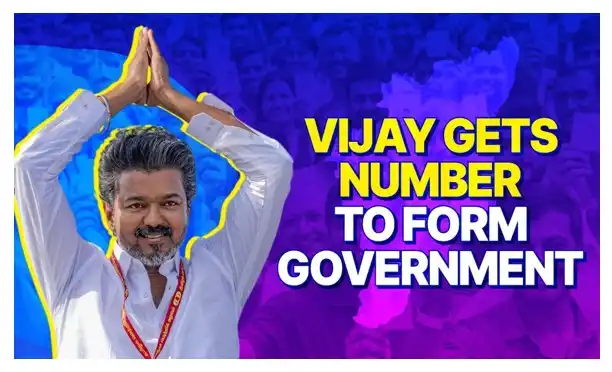
Vijay, who has transitioned from an actor to a politician, achieved a remarkable feat in Tamil Nadu by garnering the backing of 120 MLAs in a mere 92 hours to prepare for forming a new government. After extensive discussions, strategic outreach, and a great deal of political drama, the leader of the Tamilaga Vettri Kazhagam (TVK) successfully obtained enough support to move past the majority requirement in the 234-member Assembly.
This is a momentous occasion for Tamil Nadu since it concludes a time where the DMK and AIADMK ruled with absolute authority for many decades. Observers of politics in Tamil Nadu are astonished by how quickly Vijay has developed from a film star into a serious contender for the Chief Ministership, and the strength with which he has energized his supporters all across the Tamil Nadu.
TVK: The Largest Political Force
During the recent 2026 Tamil Nadu Assembly elections, TVK (Tamilaga Vettri Kazhagam) emerged as the largest political force in Tamil Nadu’s overall fractured mandate after winning between 107 and 108 seats based on how the counting would affect The Tamilaga Vettri Kazhagam to declare them a correct plurality based on how many seats Vijay won in the 2026 Tamil Nadu Assembly elections. However, the TVK did not achieve or exceed the majority of 118 seats needed to form a ruling government.
After winning a hard-fought political victory, the last four days were spent in a series of political negotiations that moved quickly at a high energy level, and therefore the level of excitement (politically) was quite intense. During the negotiations involving multiple rounds of meetings with other parties, independents, and small regional parties, TVK was able to obtain the numbers needed to form a government in Tamil Nadu from these political parties. Political suspense kept the people of Tamil Nadu on the edge of their seats, while it also motivated the other political party to continue making attempts to form a coalition.
read also: Suvendu Adhikari to become first BJP’s West Bengal CM
Smaller Parties Extend Crucial Support
The parties that were instrumental in forming a coalition supporting Vijay for the position of Chief Minister included the Viduthalai Chiruthaigal Katchi (VCK) and the Indian Union Muslim League (IUML), who both extended their unconditional support to him. Before Vijay made a bid for forming a new Tamil Nadu Government, he had also received backing from the Congress (C), Communist Party of India (CPI), and the Communist Party of India Marxist (CPI-M).
As per reports, all parties combined provided enough support to increase his total number of MLAs to 120, exceeding the necessary threshold required to allow Vijay to go ahead with forming the new state government. According to political analysts, coalition-building endeavours in this manner have not been accomplished in Tamil Nadu since the 2017 assembly elections.
All the support letters from the ally MLAs were then submitted to Rajendra Vishwanath Arlekar, the Governor of Tamil Nadu, at the Lok Bhavan in Chennai.
read also: Mamata Banerjee Refuses to Resign
Three Meetings with the Governor
Vijay’s attempt to form a new government was not without difficulties. Reports indicated that he was only able to provide the Governor with written evidence of support for his coalition of 116 MLAs at the previous meeting with the Governor. Vijay assured the Governor he would provide additional MLAs’ names from the VCK and IUML once he secured their support.
During the course of the four-day negotiations with the Raj Bhavan [Governor’s office], Vijay was negotiating with the Governor, while his party leaders conducted negotiations behind the scenes to secure the necessary number of coalition members. After receiving all confirmation letters from the coalition parties, the Governor formally invited Vijay to go ahead with forming a government.
In just over three days (92 hours) from uncertainly to massive support in the Tamil Nadu political arena, it demonstrated the evolving political strength of The Vaaniyin Koodam and its leader, Vijay, to negotiate ideologically with other political parties.
read also: Trump congratulates PM Modi on BJP’s win in WB elections
Swearing-In Ceremony Marks Historic Moment
Sunday marked a defining moment in the history of the state when Vijay was sworn-in as Chief Minister of Tamil Nadu at Jawaharlal Nehru Stadium in Chennai by some the most trusted and respected leaders from varying political backgrounds and their party workers, along with many thousands of supporters. Also sworn in were nine cabinet ministers.
The swearing-in ceremony was a defining metaphor signifying a major shift in the political landscape of Tamil Nadu. Many of Vijay’s fans call him Thalapathy and he became yet another cinematic icon to enter upon the legacy of cinema’s most famous residents of Tamil Nadu who rose to be an active participant and influencer in Indian politics. Many made direct comparisons to former Chief Minister M.G. Ramachandran based on his status as an actor.
Numerous other dignitaries attended the historic event, with nationwide leaders such as Congress Party’s Rahul Gandhi, indicating that the new coalition government has attracted many people interested/providing insight to new political leadership in the State of Tamil Nadu.
Challenges Ahead for the New Government
While there’s a celebratory atmosphere surrounding the establishment of a new Government, there are many immediate pressures facing the new administration. The first and most urgent task for Chief Minister, Vijay Kanth (VJ), is to establish his majority in the Assembly within the timeframe mandated by the Governor. There are also challenges in managing a coalition government with several different political parties who have differing views on policy issues, which could put pressure on the stability of the government.
Even so, supporters of VJ view this as the beginning of the next political era for Tamil Nadu. VJ’s ability to assemble the support of 120 Members of the Legislative Assembly (MLAs) in just 92 hours is already creating headlines and is considered to be one of the most significant political developments in 2026.
