


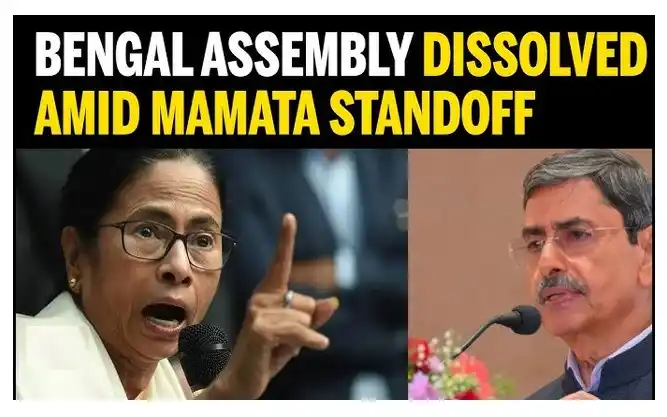
West Bengal’s governor C.V. Ananda Bose has taken an unprecedented action by dissolving the state’s Legislative Assembly because of Chief Minister Mamata Banerjee’s refusal to vacate her office and increased political turmoil in West Bengal. This drastic action has brought outrage from various parties, constitutional experts, and civil society, as well many are now questioning the balance of power between elected governments and constitutional authority.
For weeks there has been political instability in West Bengal due to the ruling coalition’s Numerous defections from the government and total collapse: Mamata Banerjee has refused to bow down and state that she still has the support of the citizens of West Bengal despite overwhelming pressures from the opposition parties to step down.
Governor Dismisses Government
The Raj Bhavan announced on Friday night that the Governor of West Bengal has dissolved the State Legislative Assembly because, pursuant to the Constitution of India, there is no longer any state government with the confidence to properly govern. The Governor cited the breakdown of appropriate law and order in West Bengal as the basis for this decision, together with overall concerns about the operation of the Constitution.
The Governor proposed to the Centre the need for administrative continuity until new elections are held. Observers noted this is a departure from the norm and is likely to face legal scrutiny immediately.
There is significant debate about whether or not the Governor acted in a constitutional manner. Some believe that the only way to ascertain majority support for elected representatives is through voting on the assembly floor; others believe that the extraordinary circumstances we currently find ourselves in warrant the Governor’s actions.
Mamata Banerjee called this measure–”democratic”
Mamata Banerjee publicly condemned the Governor onstage at an enormous rally in Kolkata, claiming that the Governor’s actions constitute “murder of democracy.” Her accusations implicated both the federal Government and the Governor as co-conspirators who had working together to unlawfully remove an elected body from office.
“The only removal of us as voters will come from us, the people of West Bengal. They are attempting to destroy democracy and destroy federalism,” said Banerjee, whose remarks served to generate enthusiasm among those participants at the rally.
Constitutional Crisis Deepens in West Bengal
Immediately after Banerjee addressed the crowd, senior TMC leaders stated their intention to request the Supreme Court to consider whether the Governor’s orders are constitutional and will be challenged. TMC leaders have offered evidence of opposition parties and their supporters working together to disrupt West Bengal before future elections at the national level.
The ruling party’s supporters conducted street demonstrations across numerous districts. Heavy security was provided in Kolkata and other sensitive areas to prevent any clashes.
Opposition Welcomes Dissolution
In response, the opposition welcomed the Governor’s decision to disband the Assembly, saying that the Banerjee government had lost both moral and political legitimacy.
According to the state BJP leaders, the Banerjee government’s corruption allegations, internal revolt, and poor governance made it unreasonable for that administration to remain in office any longer. “The people of Bengal deserve a stable, transparent government,” stated a senior BJP spokesperson.
The Congress party, while critical of the Governor’s timing, raised questions concerning the manner in which the ruling party handled the recent controversies. Still, several opposition leaders stressed that there should be new elections held as soon as possible to re-establish the democratic system.
Political analysts believe that the dissolution will change the political dynamic of the state dramatically, setting the stage for one of the most hotly contested elections in many years.
Constitutional Debate Intensifies
The recent dissolution of the West Bengal Assembly has sparked renewed discussions on the role played by Governors of Indian state governments in the context of India’s federal arrangement. Constitutional experts have stated that the Governor should independently administer state politics and remain above partisanship; this is especially important during times of elected government.
Opposition to the Governor’s intervention comes mainly from the view that he should have directed the Chief Minister himself to prove her party’s majority by way of a confidence vote or assembly floor test. Creating a precedent for bypassing this orderly procedure could create chaos between state and federal governments in future relationships.
Proponents of the Governor’s recent decision support his use of constitutional powers based on the continued instability of the government and an inability to maintain effective administration in West Bengal. All signs point toward this issue becoming a significant legal and political battle in the near future; some legal experts are suggesting that there is now a real likelihood that the Supreme Court will hear both merits and procedural arguments on petitions regarding the dissolution.
Public Sentiment Toward Assembly Dissolution
Overall, public sentiment in West Bengal is sharply divided. Pro-Mamata Banerjee groups in Kolkata held demonstrations to support their leader, while opposition parties celebrated the assembly’s dissolution as being a victory for democracy and a willingness to return to a proper democratic system of government.
Protests and road blockades caused disruption to businesses and transport services in some areas; others also announced precauatory closures of educational institutions due to fears of unrest due to the same reason.
The hashtags used to describe reactions to Banerjee’s announcement on social media carry a mixture of supportive and oppositional comments directed toward the former Chief Minister. Many users praised Banerjee’s choice to not leave office and view it as an example of standing up to dictatorship. Others feel that a new election is required in order to produce the necessary public mandate to create stability in governance in the terms of the elected representatives of our society.
What’s Next?
Now that the assembly is dissolved, attention turns to the Election Commission or possible court action related to the Governor’s decision. If the Supreme Court upholds the Governor’s decision, West Bengal could face new assembly elections within the next few months. If the Court intervenes, the political situation could potentially become troubled once again.
As of this writing, the state is under a state of political uncertainty. As these legal disputes will become more intense, and as the political tempers escalate with time in the state, West Bengal will be a key player in one of the most important constitutional crises to have ever taken place in India since independence.
