


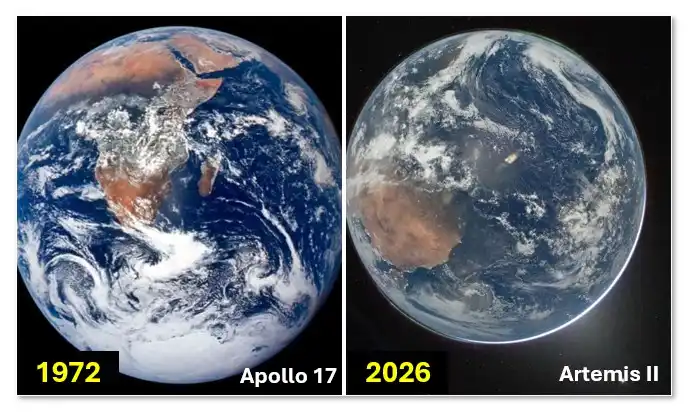
NASA has shared another spectacular view of the Planet Earth through a photo taken by the Artemis II spacecraft. The picture shows Earth against the blackness of space. Just like (the original) Blue Marble from Apollo 17 taken over 54 years ago (1972) marks humanity’s return to deep space for exploration.
A Modern Day Blue Marble – Echoing Legacy of Apollo 17
The (new) image depicts Earth firmly positioned in full color and suspended in space against the blackness of everything around it. Also similar to the “Original” Blue Marble photograph taken by astronauts during Apollo 17, this image shows our fragile atmosphere, dynamic cloud formations, and vast oceans.
NASA officials consider the photograph to be both a technical and emotional achievement. Although cameras have improved dramatically since the 1970s, the emotion is still present — how fragile and connected we are to Earth.
The original Blue Marble has been reproduced more than any other image and has come to represent the movement toward eco-consciousness and how we all share one planet together. The Artemis II photograph is expected to motivate the upcoming generation similarly.
The Artemis II Mission: A New Era Begins
Artemis II will be NASA’s first crewed flight in NASA’s Artemis program, with the mission to send humans to the Moon again and provide the foundation for future missions to Mars. The last flight of Artemis, Artemis I, did not get humans out there; however, Artemis II will have astronauts onboard, and they will travel to and come back from the Moon.
The purpose of Artemis II is to test life support systems, spacecraft performance and the crew’s ability to operate in deep space. The Orion spacecraft that will be used for Artemis II contains some of the latest imaging technology; some of which made this new image of Earth possible.
NASA also emphasized that creating such photographs is not only about art but also about public interest and documenting science.
read more: NASA Report Reveals Critical Failures Behind Nine Month Space Ordeal
Comparing Artemis II to Apollo 17
It is difficult not to compare Artemis II to Apollo 17 because 1972 was the last time that astronauts flew beyond low Earth orbit, which resulted in the creation of one of the most memorable images from space, the Blue Marble image of Earth from Apollo 17.
Apollo astronauts took still photos using film cameras; the images were developed after they returned to Earth. Artemis II will be taking high definition, digital images With near real time transfer of images back to Mission Control.
While technology has changed throughout time regarding images from space, the main experience that has been the same since humans have been able to see the Earth from space, is that astronauts continue to view the Earth as one big unified planet and will remember what they see for a very long time.
read more: NASA Selects Vast for Sixth Private Mission to Space
Scientific and Cultural Significance
NASA scientists believe that the images from space have multiple uses, such as to monitor weather patterns, cloud cover and how much light is being reflected back on to the earth’s surface. These measurements will be used in climate research and scientific research about the Earth.
Viewing different parts of the Earth from space has shown humanity that we are all part of the same planet and therefore, we are all responsible for protecting our planet and each other. Environmental groups and educators have already started to use the image of the Earth taken by Artemis II in their campaigns and classrooms to promote a sense of stewardship for our planet.
In addition to promoting stewardship of the Earth through cultural mediums, the image that Artemis II has made available has also taken on global significance as issues such as climate change and international tragedy/strife continue to cause division globally. No other type of imagery can create a feeling of unity among people like space images do.
read more: NASA Approves iPhones for Spaceflight
Role of Advanced Technology
The success of this image is a demonstration of the increased capabilities of image capture technology used in space. The Orion spacecraft has been outfitted with the most current technology in image capture and has the ability to produce images with a wide dynamic range in all lighting conditions that exist in the universe.
In contrast to the Apollo Missions where there were manual controls for the camera, the modern systems have the capability to automatically set the optimum exposure, focus and color balance for an image to be created and distributed. This results in extremely beautiful and at the same time very accurate scientific pictures.
With improvements in the transmission of digital data, we are also now able to share photographs with the general public almost immediately, thus increasing public knowledge and involvement with their governments.
Public Reaction and Global Impact
The announcement of the Artemis II Earth image has created a great deal of excitement within the social media and scientific communities. Many have drawn comparisons to the emotional response of the Apollo flights in the 1960s and 1970s, and others view it as indicative of an increase in interest in space exploration.
The photograph has received praise from many prominent scientists, teachers, and artists for its beauty and symbolism. Some experts believe that like the first Blue Marble contributed to the development of the environmental movement, the new image may contribute to the growth of a global consciousness.
NASA has encouraged the public to reflect on and share the image with others, in an effort to inspire further curiosity and exploration.
Looking Ahead: Beyond the Moon
Although the Artemis program has the goal of getting humans back to the Moon, it also serves as a critical source of knowledge and experience that NASA will rely upon as it builds the foundation that will allow humans to explore the surface of Mars and other bodies in our solar system. The lessons learned from the Artemis II and subsequent missions will strengthen the necessary infrastructure for sustainable exploration of the Lunar surface.
The Artemis III mission will allow astronauts to land on the Moon again, including the first woman and the next man. Artemis II’s panoramic view of Earth serves to reinforce how individuals and societies are united by deeper exploration of space, and act as a symbolic reminder of what is at stake when we explore.
Timeless Image
Although this will be 54 years after the Apollo 17 mission provided its iconic full view of Earth, Artemis II will do this once again for a new generation of explorers. The technology may have changed, but Earth’s fragility and beauty as a shared home to all humans, located in a huge expanse of universe, has not changed.
As the Artemis missions continue, it is likely that these moments will also become defining images of another major human leap forward and will be a constant reminder of the incredible history that was created with our travels so far and where we are headed in the future.
