


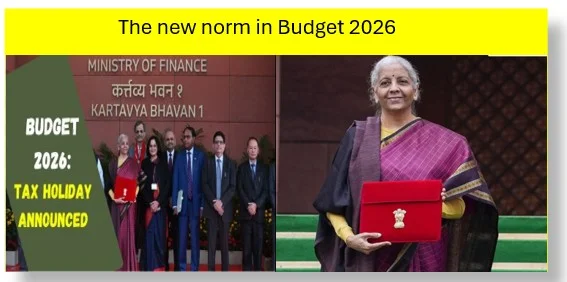
A Government Tax Holiday provides temporary reductions or complete elimination of all or part of the tax due to some taxpayers or business. The purpose of the Tax Holiday is to stimulate investment, promote economic growth within specific sectors, create jobs, and relieve early stage and capital-intensive business activities from the burden of both taxes in total and/or high taxes.
In general the Tax Holiday allows qualifying companies to either not pay taxes for a certain period of time and/or pay significantly reduced tax rates for a specific period of time.
The evolving definition of Tax Holiday within the context of Budget 2026 has developed from an isolated or niche tool used to provide specific benefits to selected taxpayers to now being recognized as a significant structural reform that can be used to attract long-term investments from around the globe to India.
- Indian Government Announces Tax Holiday of Two Decades in Union Budget 2026-27.
- In Union Budget 2026-27, Nirmala Sitharaman, Minister of Finance, announced a tax holiday until 2047 for selected foreign businesses.
- Foreign businesses that provide cloud services over the Internet for customers in any country using data center infrastructure will qualify for the Tax Holiday.
- The objective of this incentive is to position India as a leader in providing global digital infrastructure, cloud computing capabilities and AI based data services.
- The Government of India is moving towards competing with traditional data center locations by providing long-term tax certainty and an attractive regulatory environment.
How the Tax Holiday Works?
Here’s how the Incentive is structured:
1. Eligibility Requirements
Cloud service providers from other countries must utilize Indian data centers and offer services to Indian customers via an Indian reseller. This requires satisfactory compliance with all laws and regulations in India while also providing international clients an opportunity to partner with Indian businesses.
2. Safe Harbor Provisions
To promote the establishment of cloud service providers in India, companies with Indian-related connections will receive a safe harbor based on a margin of approximately 15% above their costs for taxation purposes. The purpose of this provision is to give businesses confidence regarding the accuracy of transfer pricing and taxes owed by the business.
Together, these two provisions help mitigate the effects of foreign capital into India while growing the local ecosystem.
Importance of the Provisions
India is Working to Attract Cloud and AI Investments from Around the World:
India holds a very small percentage of global data infrastructure relative to its digital footprint. The government signaled to hyperscale cloud service providers (such as Google, Microsoft, and Amazon) that it is ready to do long-term digital business in India by providing an extended tax holiday.
Industry analysts have characterized this tax holiday not only as a fiscal benefit but as a strategic move to establish India as a digital backbone for global operations, specifically for workloads requiring artificial intelligence and data-related services.
Complementary Moves in Budget 2026
The tax holiday for data centres is not the only long-term incentive:
- Gujarat’s GIFT City tax benefits lengthened to 20-year periods will help India better position itself for use as a global finance services provider.
- These changes are part of a larger effort to access global capital, build out India’s digital economy, and establish large, concentrated clusters around technology and finance.
Bottom Line
The budget 2026 tax holiday will mark a fundamental shift away from providing temporary/specialized fiscal benefits toward long-term structural incentives to ensure India’s ability to become a global centres for technology and data. By aligning tax benefits with investment in large infrastructure projects (particularly information and financial services) the government is attempting to unlock new sources of investment; create more jobs; and increase India’s involvement in the international digital economy over the next 20 years.
