


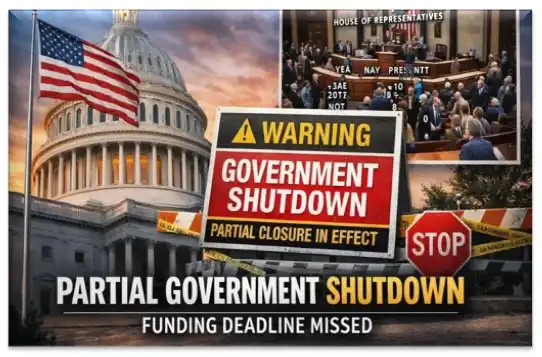
The United States federal government shut down after midnight on Jan. 31, 2026. The funding gap is the latest in a tempestuous start to the year, when a high-stakes game of chicken in Congress allowed lawmakers to blow past a deadline for approving an essential budget. The Senate was able to approve a major part of the funding package late Friday night, but the House had already gone home for the weekend, leaving many key departments — including Defense, State and Treasury — without current budgets.
This shutdown is being called “partial” because six of this year’s twelve annual appropriations bills were already signed into law earlier this month. But the six remaining bills, which fund most of the rest of federal operations, are now in limbo. The shutdown has left hundreds of thousands of federal workers facing furloughs and suspended non-essential services across the country.
Breaking Point: Immigration and DHS Funding
The main sticking point on the fiscal dispute was an intense battle over funding for the Department of Homeland Security (DHS). Tensions rose after a spate of tragedies in Minneapolis at the hands of federal immigration agents. Two protesters—Renée Good and Alex Pretti—were killed during “Operation Metro Surge”, and national strikes and political fallout ensued.
Senate Democrats, led by Minority Whip Dick Durbin, refused to sign off on the DHS funding measure unless it included major changes aimed at curbing Immigration and Customs Enforcement (ICE) and Customs and Border Protection (CBP).
“Instead of pursuing drug smugglers and human traffickers, the administration is using precious resources to harass peaceful demonstrators,” Durbin said in a social media post that encapsulated the Democrats’ argument.
In a desperate bit of eleventh-hour skulduggery to stave off an entire collapse, the Senate voted 71-29 to separate the disputed DHS bill from the broader spending package and let the other five bills go through. They also passed a two-week “stopgap” bill to fund DHS and buy time for further negotiations. But because the House did not reopen to ratify this new plan, the legal authority to spend money lapsed for all the agencies under unpassed bills.
Who is Affected? A Snapshot of the Shutdown
As this is a partial shutdown, workers don’t all feel the pain equally. Agencies that include the Department of Veterans Affairs and the Department of Agriculture continue to be fully funded. But for the remainder of government, the prospect of a “lapse in appropriations” is now coming into focus.
The Department of Defense (DOD)
It’s been an “awkward few days” at the Pentagon. Active-duty military personnel are supposed to report for duty as “essential,” but they will not be paid until a budget is passed. Also, more than 300,000 DOD civilian workers are looking at instant furlough. That’s particularly delicate because defense spending was expected to reach an all-time high of $1 trillion for the first time this fiscal year.
Federal Services and the Public
- National Parks and Museums: Most National Parks are still operating but don’t have to charge fees as their funding was appropriated in a previous bill.
- The IRS and Tax Season: As tax season gets underway, the I.R.S. is encountering significant disruptions. Non-essential employees have been dismissed, a move some predict could cause massive delays in issuing refunds, if the shutdown stretches on for more than a matter of days.
- Health and Education: The NIH and the Department of Education have stopped new grants, non-essential research activities.
Economic Risks and Historical Context
The closure is the second of President Donald Trump’s second term, coming after a 43-day crimp in late 2025 that set the record. Economists at Goldman Sachs have cautioned that though a short weekend shutdown has a “modest” effect on G.D.P., an extended standoff could siphon considerably from quarterly growth.
The cause of the chaos here is legally called the “Antideficiency Act.” Under that law, federal agencies quite literally don’t have legal authority to spend any money — not for paper clips, electricity or anything else — unless and until Congress has appropriated it. Agency heads have to decide how many of their staff are “excepted” (necessary for life and safety) and how many are on “furlough.”
And the human cost may be the most profound. Federal contractors, who receive no back pay at all, unlike civil servants, are often the most endangered. Small businesses who depend on federal contracts are already reporting worries about missing invoices and frozen projects.
The Path Forward: What Happens on Monday?
And with the ongoing shutdown, there is a feeling of optimism in D.C. that it will be “short-lived.” President Trump has indicated his support for the DHS funding side deal from the Senate and House leadership of a vote on Monday, February 2.
Were the House to pass the Senate package intact, the shutdown would be all but over within 48 hours. The proposal would restore funding for five large areas through Sept. 30, 2026, and grant lawmakers a two-week hard deadline to work out permanently the fate of the Department of Homeland Security.
