


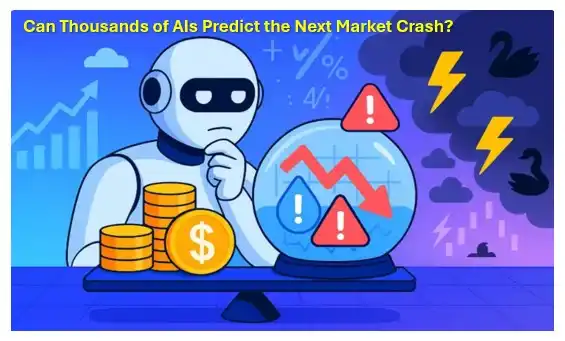
The last villain in the high-stakes game of world finance is the Black Swan, something anomalous, something catastrophic. Over the decades economists have struggled to contain it using spread sheets and stochastic calculus, often to no avail, as economics does not deal with human panic. However, an open-source project by the name of MiroFish is hoping the answer to the next market crash is not more math it is more people. Or thousands of them, digitalized versions of them.
By March 2026, MiroFish has gone viral in the world of technology with the founder, Chen Tianqiao of Shanda Group, making MiroFish aware of the product by putting 30 million RMB into it and the project is trending around the entire world on GitHub. It was invented in a mere ten days by a Chinese undergraduate student in an innovation called Vibe Coding, which signifies a huge departure in the way we may peep into our financial future.
Digital Sandbox: The Swarm Intelligence Street Faking
Classical AI models consider the market a physics problem: in case X occurs, Y has to follow. Markets are in fact social eco systems powered by swarm intelligence or collective behaviour of decentralized and self organizing systems. MiroFish tries to be one that recreates this through the construction of a “high-fidelity parallel digital world.”
When you feed MiroFish the “seed data” a news article on the Strait of Hormuz conflict, or a draft of a policy by a central bank, the engine does not simply read the data. It simulates the existence of up to 700,000 autonomous artificial intelligence agents.
read more:
- WhatsApp may launch a paid plan called WhatsApp Plus
- Jio Launches Voice-Only Prepaid Plans for Users
- Anthropic rejects latest Pentagon offer over AI safeguards
All the agents are distinctive online personas
- The Nervous Retailer: When a red candle appears the first thing he does is to panic-sell.
- The Contrarian Whiz: Buy the dip when everybody is running away.
- The Institutional Giant: Cool, calculating and subject to rigorous risk-taking procedures.
- The Memory: These agents also have long-term memory, similar to normal chatbots, however, they do not forget events they have experienced previously in the simulation, whether it is a trauma or a victory, and so their actions are based on these experiences.
The Human Factor: Is It Possible to Practice Tomorrow?
Mio Fishes is genius in the fact that its inventor, Guo Hangjiang, understood that the greatest weakness of financial modeling is the “Human Factor.” The models did not fail during the crash of 2008 or the pandemic dip of 2020, individuals did.
MiroFish is the method of determining the association among the entities, i.e. how a shipping delay in the Middle East actually impacts a textile factory in Surat and how a bankruptcy of the owner of the factory will influence the mood of the local bank, by GraphRAG (Graph-based Retrieval-Augmented Generation). It goes beyond the concept of big data to the concept of thick data, the human society intricacies and messiness.
