


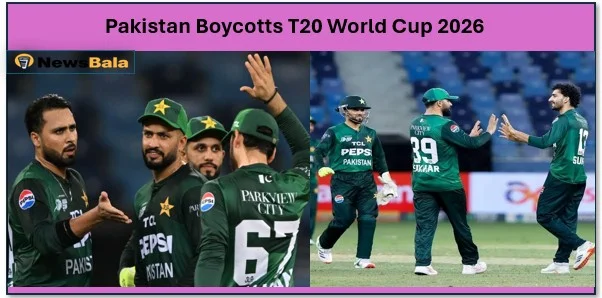
As international cricket grows in its global footprint, it’s expected that if Pakistan decides to stay away from ICC Men’s T20 Cricket World Cup 2026, it will cause shockwave in international cricket. Pakistan does not exist merely as another cricketing country in international cricket, but it is one of the most passionate cricketing nations with a huge fan following, with a cricketing history full of iconic cricketing moments, and their cricketing team excelling in international cricketing events, especially in ICC events like this Cricketing World Cup 2026, which will be held in T20 format.
Possible Reasons Behind a Boycott
It will also not happen in isolation, and hence, historically, the decision to enforce a boycott has been a result of factors like political tensions, diplomatic disputes, or unsolved security/logistics issues, etc. In light of the complicated relationship between cricket associations and the government in South Asian countries, it is also likely to influence the decision in a very crucial manner, visa disputes, unwillingness to tour a country, or hybrid hosting disputes, etc.
The lack of satisfaction with the ICC’s decisions may also serve as another factor. Pakistan cricket authorities have previously voiced their concerns regarding scheduling issues, issues with revenue sharing, and issues with hosting the tournament. The Pakistan Cricket Board (PCB) may feel they are being disregarded or are being treated unfairly. In this case, they can opt for a boycott, and this can serve as a strategy; however, this can also prove risky for them.
Impact on the Tournament
From a cricketing viewpoint, Pakistan’s absence would be a big loss to the tournament, simply because the T20 World Cup is grounded upon high-profile matches, of which the India vs Pakistan Clash is the biggest of them all, registering a record-breaking viewership/viewership attendance each time they face off against each other on TV screens.
Pakistan is also somebody you cannot write off in a format as short as the highly competitive format of T20. Their triumph in the 2009 T20 World Cup and their evacuation in other major ICC events prove their significance in a sporting contest.
Financial and Commercial Consequences
A boycott of the Pakistani team will, therefore, result in huge financial losses for the broadcasters, especially for South Asia and the Middle Eastern countries, given the immense popularity enjoyed by the team.
The advertisement rates for matches featuring the Pakistani team are the highest for cricket worldwide.
In such a situation, it would augur ill for the ICC, as its major source of generating revenue would be based on major tournaments. In addition, there would be an overwhelming chance of interference in or even providing concessions to encourage Pakistani participation in international cricket. Other cricket boards, even though smaller, would feel the impact of fewer earnings in terms of revenue sharing.
Consequences on Pakistan Cricket
Even if it is intended as a political and administrative statement, it will come with a price to Pakistani cricket. The cricketers will lose valuable experience on the biggest stage in world cricket’s biggest format of T20 cricket. The environment will not only impact their cricketing futures but also their market values and self-confidence, especially younger players who will miss a chance to compete on the world stage.
There is also a risk of isolation. Prolonged absence from ICC events can weaken a board’s influence within international cricket; in extreme cases, it might invite sanctions, strained relations with other boards, or reduced leverage in future negotiations.
Fan Reaction and Public Sentiment
The most emotional backlash may come from the fans. Cricket runs deep in the veins of Pakistan’s national identity, and ICC events bring together masses of people throughout the country. There would probably be frustration and disappointment if it had to be boycotted, in which fans are deprived of moments of pride and collective joy. Public pressure could mount quickly on the PCB and government to review such a decision.
The Likely ICC Response
If the ICC were faced with the prospect of a Pakistan boycott, frantic last-minute diplomacy would doubtless ensue. Emergency meetings, revised arrangements, or neutral-venue compromises could be explored. That said, ICC has traditionally moved towards inclusivity. It knows that, if a major team does not participate, it affects the already fragile credibility of its premier events.
Conclusion
A decision by Pakistan to boycott the T20 World Cup event in the year 2026 would therefore be far beyond the absence of a team in the fixture list. This would change the dynamics of the event, undermine its commercial appeal, and reinforce the pre-existing issues with cricket administration worldwide. Though the cricketers may be using this to gain leverage in the controversy, the long-term disadvantages would still be far beyond the benefits it may gain by doing this act. This is an event in which cricketers worldwide celebrate unity, competition, and excitement together with the team included in the event.
