


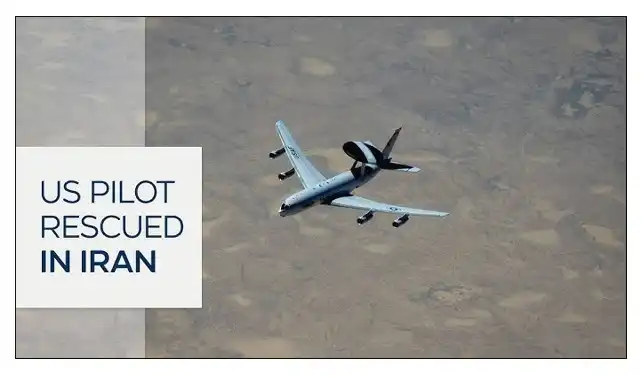
The United States conducted an extremely complex mission to recover 2 pilots from a downed U.S. F-15E jet in Iran. The mission was conducted by using a number of aircraft types that included advanced fighter aircraft, transport aircraft, and helicopters with drones–all operating deep inside hostile territory.
US Deploys Multiple Aircraft in High-Risk Iran Rescue Mission
The jets were hit while flying during the war in Iraq and left 2 pilots with their feet on the ground in Iran. One of the pilots was rescued within a few hours; however the other pilot – a wounded Weapons Systems Officer – was missing for nearly 48 hours before being rescued in Iran.
The operation started when an Iranian missile shot down a U.S. F-15E Strike Eagle (a 2 seat aircraft). This was a major event in the war and initiated a massive search and rescue operation.
Following the successful rescue of the first pilot, he was rescued shortly after ejecting. The second pilot landed in a mountainous area and had to avoid Iranian forces while waiting on rescue.
The U.S. said that the search for both airmen was a “nightmare for both U.S. and Iranian forces” due to the nature of the search.
read more: Gunfire reported near White House
Dozens of Aircraft Deployed for Rescue
After a large-scale rescue operation, the United States military launched an operation to save the stranded military officer, deploying with dozens of advanced weapon-equipped airplanes.
Major Aircraft Used:
- MC-130J Commando II– Aircraft used to covertly insert and extract personnel from special operations.
- MH-6 & AH-6 Little Bird– Helicopters used for close-in support and rapid ground troop movement.
- MQ-9 Reaper Drones– Drones used to provide intelligence and carry out precision strikes against a target.
- Additional Fighter Assists– Used for down range air support and protection of all aircraft on the ground.
The detailed coordination of helicopters, air operations, and ground troops consisting of a large contingent of Special Operations Forces allowed two different levels of aerial platform assistance to be used (helicopter) and fixed wing platforms (aircraft).
read more: Secret Damage Uncovered After Iran Drone Strike
Challenges of Transport Planes and Helicopters
The operations suffered many technical failures as well as attacked by the enemy. Reports have stated that two of the MC-130J transport aircraft had mechanical issues, preventing their use from this forward staging base from which they departed in Iran.
While attempting to retrieve the other crew member, the helicopters supporting the operation were attacked by enemy fire.
Nevertheless, US forces were able to adapt rapidly by using smaller aircraft and deploying them in multiple waves to continue the operation despite these challenges.
read more: Iran shoots down US F-35 fighter jet
US Destroys Its Own Aircraft
Here are some of the most notable actions taken by U.S. forces during this mission; they blew up several of their own aircraft while still on the ground.
The U.S. military destroyed “at least two” MC-130J planes, as well as many helicopters, to prevent classified equipment from getting into Iranian hands.
This shows how important it was for U.S. forces to protect classified equipment from enemies as well as to rescue personnel.
How Drones and Air Strikes Protected the Stranded Airman?
Unmanned aerial vehicles (UAVs) — namely the MQ-9 Reaper UAVs — played an essential role in providing protection for the stranded airman.
The UAVs conducted surveillance of Iranian forces and then attacked them when they tried to capture the pilot.
Furthermore, U.S. forces dropped bombs on roads and employed electronic jamming in order to disrupt the movement of Iranian military units. These efforts worked together to create a safe route for the rescue team to use.
How CIA Deception Strategy Helped the Mission?
Intelligence tactics are also considered as critical to the overall success of this mission. The CIA reportedly orchestrated a deception operation, whereby they told people that the airman had already been retrieved.
These deception tactics confused the Iranian military and directed their attention away from the actual location of the rescue, thus providing U.S. forces with a tactical advantage.
Final Extraction Under Fire
In spite of injuries, the second injured crew member managed to stay away from being captured for over thirty-six hours in very rugged country until he was finally found by US Special Forces on the top of a mountain and taken out via a high-risk extraction.
The extract was extremely dangerous; while extracting the second airman, there was intense battle between the US troops and Iran as they were escorting the second airman from the top of the mountain.
Despite the great risk and danger, both US airmen were successfully extracted from the enemy territory with no US casualties.
A Costly but Successful Operation
The operation cost a substantial amount of money; however, the operation ultimately succeeded; both crew members were brought back home safely.
It has been termed one of the most daring recovery missions ever attempted in the history of the military, clearly showing the policies and determination of the US government to recover its personnel from hostile areas globally.
The operation also demonstrates how important the roles of advanced aircrafts, unmanned aerial vehicles (UAVs), and intelligence must work together during modern conflicts, where success is achieved with not just fire power, but with precision, speed, and strategy.
