


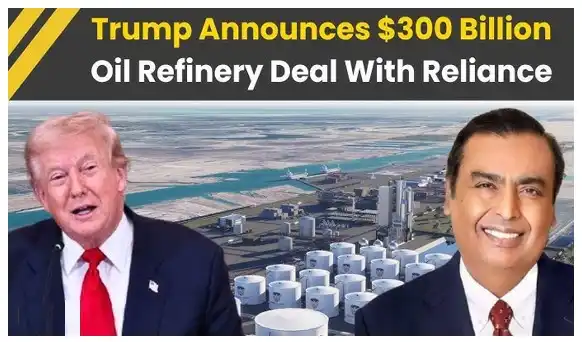
U.S. President Donald Trump has made a historic announcement in a decision that has rocked the global energy market with a $300 billion investment in a partnership with Reliance Industries, India to build the first of its kind oil refinery in America since the 1960s. The venture, to be fronted by a newly formed company named America first refining, will be located in the Port of Brownsville, Texas.
This is a deal that the White House is framing as the ultimate game of Energy Dominance, coming as it has in the midst of a skyrocketing conflict in West Asia, that has not only choked the world oil supply, but has also caused the prices to skyrocket.
Lack of rainfall Cessation in South Texas in 50 Years
The United States has been using a fleet of refineries that are aged and most of them were built in the 1970s. The production of the American shale has been a boom, but the facilities to refine that crude into something useful as fuel stayed stagnant until now.
The Port of Brownsville is a strategic location. Being a gulf coast deep-water center, it offers the ideal escape route to the world exports, and is not affected by the present maritime anarchy of the strait of Hormuz. The refinery will also be a pure technological wonder and will be able to refine 100 per cent American shale oil with very lower carbon emission levels as compared to other refineries.
also read: India-Canada signs 10 year agreement on Uranium supply
The Ambani Association: Why Reliance?
The inclusion of Reliance Industries by Mukesh Ambani is not an accident. Reliance owns the largest refining complex in Jamnagar in India, and the technical expertise needed to carry out the project of this colossal magnitude.
- Operational Excellence: The Jamnagar plant of Reliance is famous due to the so-called complex index- that enables the facility to take as many different types of crude grades as possible and process them in the most efficient way possible.
- Strategic Alignment: The Trump administration has been strengthening an already established “Energy Alliance by collaborating with a huge Indian conglomerate, avoiding the traditional and increasingly insecure Middle Eastern reliance.
- The Sales Pact: It is reported that Reliance has already signed a 20-year contract to buy and sell fuels manufactured by the Brownsville plant which will guarantee the refinery with a market to sell its products on the first day.
This monumental Investment, Trump added, was courtesy of our partners in India, and their largest privately held Energy Company, Reliance, which is a further indication of an emerging Indo-US strategic relationship.
also read: India GCC sign Joint Statement to begin FTA
Making It Personal: Jobs, Gas Prices, and a Town Transformed
It is more than a company transaction to the people of South Texas; it is a life line. Thousands of high paying jobs should be created in the region that has been grappling with underemployment.
Construction workers and pipefitters will then become chemical engineers and logistics experts, which makes the “Refinery Boom” sure to renew Brownsville. Even the local businesses, such as motels to diners, are already gearing up to handle an increase in demand, with thousands of workers flocking the area to work there when the ground breaking begins, which is set to happen in the second quarter of 2026.
also read: App-Based Services Are Changing How India Hires Domestic Help
Managing the Geopolitical Storm
The fact that the announcement was made at that time is an optic masterstroke. Since the Supreme Leader of Iran Ayatollah Ali Khamenei was killed in joint U.S.Israel attacks on February 28, and the so-called tanker war in the Gulf, the world has been looking to see an indication of stability in the energy supply.
The U.S. by announcing a massive domestic refinery is sending a message to the world and its adversaries that it no longer requires the Middle East to sustain its economy. This America first energy policy is based on:
- Domestic Production: The use of the shale reserves in the Permian Basin.
- Streamlined Permitting: Cutting Years of Regulatory Red Tape Dead Processing the Killer of such projects.
- Partnerships with the private sector: Customers can use foreign capital and experience to develop infrastructure in America.
