


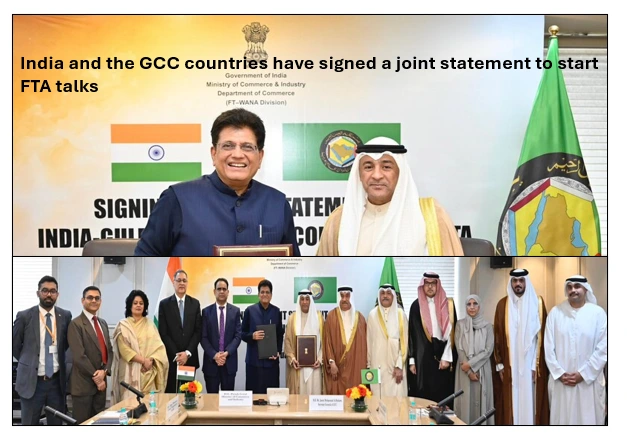
In a major departure in the economic environment of “extended neighbourhood,” India and the Gulf Cooperation Council (GCC) have formally launched negotiations for comprehensive Free Trade Agreement (FTA). The signing of a Frame Work Agreement was completed on February 24, 2026 when Union Minister of Commerce and Industry Piyush Goyal and GCC Secretary General Jasem Mohamed Albudaiwi signed a Joint Statement in New Delhi.
And this is not merely a diplomatic nicety: It signals the relaunching of a geopolitical aspiration that has been sitting dormant for nearly 20 years. By signing this statement, both sides have agreed to a “comprehensive and mutually beneficial” trade agreement to eliminate barriers, increase investment, and ensure supply chains across one of the world’s most important
A New Investment Strategy in Uncertain Times
The announcement comes at least as strategically timed as the agreement. As geopolitical volatility and fraying alliances cast a pall on global trade, New Delhi and the Gulf capitals are doubling down on what has long been known as their “living bridge.”
Minister Goyal further stated that, the Joint Statement signed on 30 March “is a significant milestone” in the context of Terms of Reference (ToR) signed earlier this month on 5 February. He said the bond — one based on centuries of cultural and social closeness — was now in need of a strong legal foundation to address digital economy in the 21st century.
Economic Weight of the Partnership
The numbers supporting this negotiation are staggering. The GCC of Saudi Arabia, the UAE, Qatar, Kuwait, Oman and Bahrain is already India’s largest trading partner bloc.
Key Trade Statistics (FY 2024-25):
- Total Bilateral Trade: $178.56 billion
- India’s Exports to GCC $56.87 billion (engineering goods, rice, textiles and gems).
- GCC imports from India: $121.68 billion (mostly crude oil, LNG and petrochemicals)
- Investment: As of late 2025, cumulative FDI from the GCC into India has exceeded $31.14 billion.
The GCC is the 9th largest economy globally with a GDP of $2.3 trillion and population decillion of 61.5 million. It would mean preferential access through an FTA for India to this wealthy consumer base as well as securing its energy future. For the GCC, it provides a portal into India’s $4 trillion-plus economy as well as its fast-expanding tech and manufacturing sectors.
Read also: New Zealand First Country To Get Duty Concessions
Beyond Oil: The FTA’s Emerging New Pillars
Though energy is the backbone of India-GCC relations, 2026 negotiations are aimed to diversify partnership.. The agenda for the talks, as established in the Joint Statement, includes a range of contemporary frontiers:
- Food Security: Making good use of India’s agricultural strength as a steady food basket for the Gulf region post global supply disruptions.
- Trade in Services: Facilitating the movement of professionals across multiple sectors—from IT to doctors and engineers—deepening the “living bridge” of close to 10 million Indians living in the Gulf.
- MSME Cooperation: An agreement to create a sector-specific framework that would make it easier for small and medium-sized enterprises from each side to become part of each other’s value chains.
2004-2026: The Long Road to “Yes”
The road to this FTA has been far from fast. Initial discussions date to 2004, and rounds of negotiations were held in 2006 and 2008. These efforts, however, eventually stalled as the GCC put all collective trade negotiations on hold to focus instead on deepening internal integration.
In 2026, the breakthrough is built on patient years of “mini-lateralism.” India’s successful operation of the Comprehensive Economic Partnership Agreement (CEPA) established with the UAE in 2022 and the recent trade (pact with Oman at late 2025 paved the proof.) These bilateral wins set the stage for the bloc-wide negotiations that began this week.
Read also: Global Media Highlights India-US Trade Deal
What Happens Next?
The Joint Statement is the “starting gun” for negotiating teams. The Secretary General Albudaiwi already announced the readiness of the GCC to host the first official round (1st) of negotiations at its headquarters in Riyadh during H2 2026.
With an already-existing ToR and expressed political will on both sides, observers expect negotiations to be expedited. And if signed, the India-GCC FTA would be among the biggest trade deals of the decade, which may reshape trade routes and investments between South Asia and the Middle East.
