


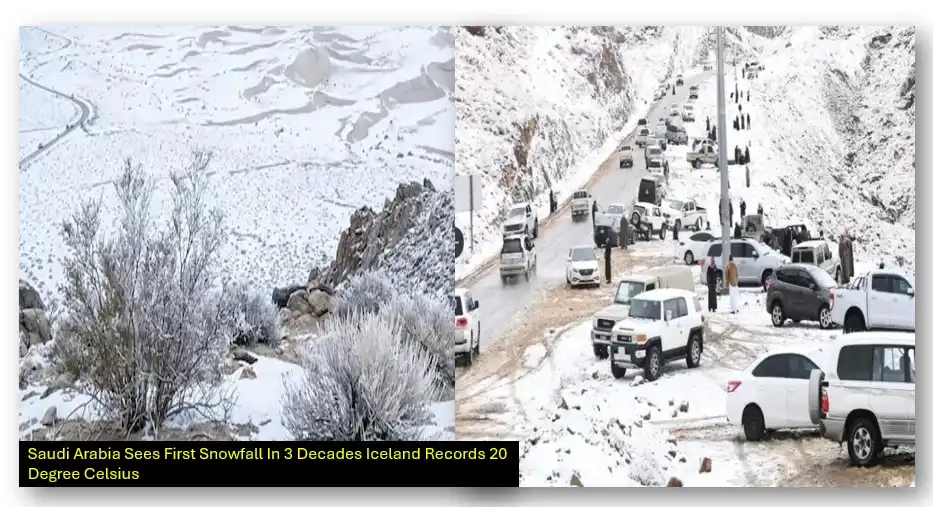
The last weeks of 2025 have brought a string of meteorological shockers: Scenes that could have been pulled from the script of a high-budget disaster flick, but purport to be weather.com. And in a world of growing climate volatility, the familiar line between “hot” and “cold” countries is increasingly being redrawn with dramatic consequences.
For the ironic of nature, as the deserts of Arabian peninsula were covered under snowfall after 30 years; those in and around ice had reached 20 degree centigrade points- example would be Iceland!
White Deserts: Saudi Arabia’s Historical `Winter Wonderland´
Northern Saudi (*Specifically for the residents of northern saudi, north to region Tabuk and Al-Jawf) Experiencing a sight that many people had only read about or watched on TV, these Sightings were experienced in December 2025. Gentle, rolling sand dunes that are freshly roasted by a sun that reaches over 50°C in the summer were instead covered with a clean layer of white snow.
Although the high-altitude summits of Jabal Al-Lawz get covered in a light frost some mornings, not in memory has it been so extreme an event. According to the local meteorologists, in almost three decades (since the early 1990s), the Kingdom has not experienced such widespread and heavy snowfall.
read more:
- Afghanistan Hit by Early-Morning Earthquake
- 9 must-visit cities for dazzling New Year’s Eve fireworks
Snow in the Sand? What Could Be Happening?
The rare atmospheric collision spawned the spectacle:
- The Siberian High: A huge mass of cold air that was pushed down from the Arctic, extending much deeper into the Arabian Peninsula than is typical.
- Moisture Transport: At the same time, a low from the Arabian Sea made inroads with high humidity levels.
- The Outcome: Where these two systems collided over the northern highlands, the rain changed to heavy snow; surreal photographs of camels plodding through white drifts circulated.
Tropical Arctic? Iceland’s Record-Breaking Christmas Heat
But as Saudi Arabia shivered, the North Atlantic was experiencing an even more puzzling abnormality. 19.8°C was measured at a number of weather stations in eastern Iceland on Christmas Eve and Christmas Day 2025.
To put that in context, the normal temperature for Iceland in December is about zero (0°C)C.The January average for London is 4(4°C) – The weather resembles a summer day rather than a winter night on the fringes of the Arctic Circle. In Seyðisfjörður, a town, residents were said to have come out without winter coats, as the island experienced one of its warmest Christmases ever recorded.
The ‘Heat Dome’ Effect
Scientists say this “winter heatwave” was caused by an intense high-pressure system that acted like a vacuum, sucking unusually warm and moist air from the subtropics directly up to the Arctic. That shunted aside the polar winds that would ordinarily have arrived, and left the island in a temporary bubble of warmth that has surpassed records that had stood for decades.
The ‘Warming Paradox’: Is This How Climate Will Change?
These twin phenomena are not merely “weird weather”; they are symptoms of a phenomenon that climate scientists call the Warming Paradox.
And when it does, that wall around the pole can weaken; That’s what’s happening now because due to global warming the planet is heating up and as a result the Jet Stream (the high-altitude wind current which keep cold air at poles and warm near equator) becomes “highly wavy.” It no longer spins in a tight circle, it moves in erratic waves deep. That would allow chilly Arctic air to “leak” southward, but also let tropical warmth “surge” northward.
Conclusion: Adapting to the Unpredictable
Events in Saudi Arabia and Iceland are painful counters to the “new normal” — which is no, or less predictable, normal. We not only enter an era in which desert nations must plan for snow clearance and arctic nations contemplate the melting of their glaciers from heat midwinter.
These abnormalities highlight the importance of worldwide climate resiliency. We are no longer reading from the script we wrote for nature over the past millennium; we are writing it in real time.
