


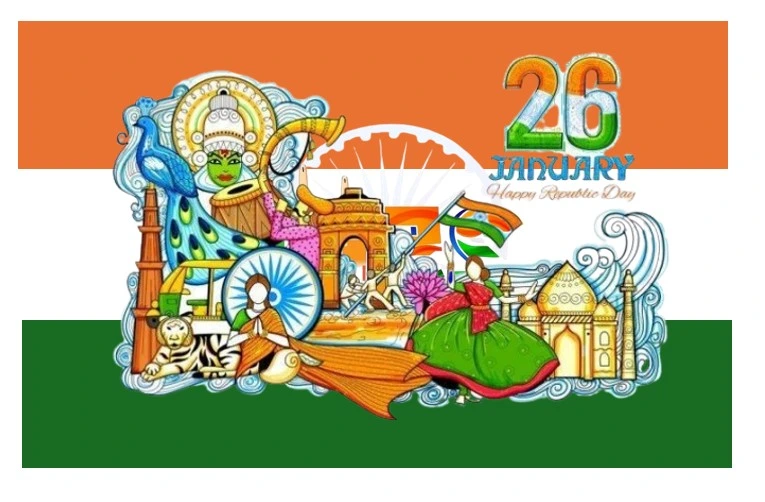
As India prepares for its 77th Republic Day on Jan. 26, 2026, the air in Kartavya Path crackles with a different sort of electricity. The annual parade is always a display of military precision and cultural vibrancy but the celebrations this year have a special historical significance. The theme “150 Years of Vande Mataram” is more than a ceremonial choice; it is an attempt to restore the modern Indian identity with the very soul of its independence movement.
The selection of the national song as the lodestar for the 2026 parade bridges that 19th-century ambition and a 21st-century national superstition: today’s self-reliant global power. In commemorating the sesquicentennial of this composition by Bankim Chandra Chattopadhyay, India is making a powerful statement about the enduring nature of its civilizational value.
The Song of the New Birth: 150 Years Upon the Planetary Life GUIDATA
Vande Mataram was written in 1875, after all, not as a set of verses but a revolutionary spark. At the 2026 commemorations, a “moving archive” on wheels is being staged by the Ministry of Culture. Through this visual journey, we show how a simple song turned from being a literary piece in the novel Anandamath into a battle cry that sent shivers down the spine of the British Raj.
Why Does This Legacy Matters Today?
- Spiritual vision: The song according to the Seer of Indian freedom was “a spiritual force which could not be resisted by any power on earth.” And in 2026, as India charts treacherous global geopolitics, the theme serves as a reminder to its citizens: Strength begins with internal cohesion.
- Artistic Resistance: An emphasis on the portrayal by Vishnupant Pagnis in the parade. During the colonial era, Pagnis reordered the verses to evade British censorship, a tale of “creative defiance” that resonates with government efforts to inspire today’s youth.
- “Mother” Concept: The portrayal of the nation as Sujalam, Suphalam gives an inner and emotional meaning to the theme; this has relevance in today’s world where sustainable development is a universal goal.
The Mixing of Heritage and ‘Atmanirbharta’: Swaraj to Self-Reliance
The most conspicuous feature of the 2026 parade is the coupling of the Vande Mataram theme with “Samriddhi ka Mantra – Atmanirbhar Bharat”. This is not simply a cute superimposition; it’s a story arc. The authorities are conveying that the freedom (Swaraj) dreamt by people who hummed Vande Mataram in the jails of the British is only possible if we become self-reliant in technology and military might.
“If Vande Mataram gave us the breath of freedom in the 20th century, Atmanirbharta gives us the spine of sovereignty in the 21st,” Defence Secretary Rajesh Kumar Singh said during a curtain-raiser event.
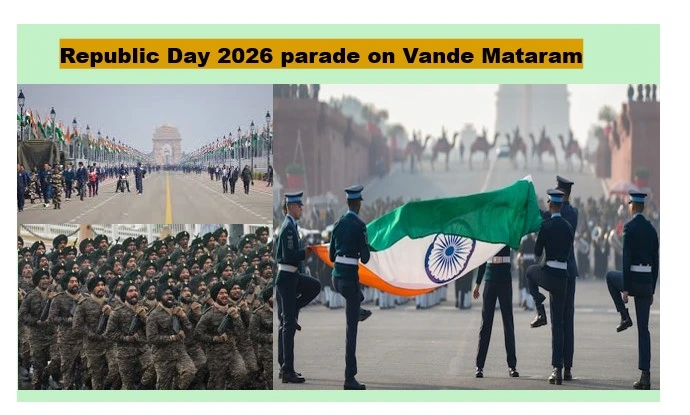
That’s on display in the hardware rolling down Kartavya Path. It is for the first time that an “Battle Array” format with indigenous platforms like Shaktibaan regiment and Drone Power is being displayed to reflect its warrior ethos/ chastised capability of the Army. It is a powerful image, these state-of-the-art, “Made in India” weapons systems dancing to the tune of a 150-year-old national song: an ancient civilization skillfully steering its way through the high-tech future.
Hosts of the World: The EU and Europe at the heart of India’s Republic
The 2026 festivities are also a major diplomatic jamboree. This is the first time two senior European Union leaders—President of the European Council Antonio Costa and President of the European Commission Ursula von der Leyen are participating as Chief Guests.
The backdrop of the Vande Mataram theme from among these international leaders is important. It’s not a postcolonial ntereoring but an “civilizational state,” she says. The EU contingent with Indian regiments highlights a partnership based on common democratic values, especially when the India is branding itself as ‘Vishwa Bandhu’ (Global Friend).
A Digital and Cultural Renaissance
To make sure the theme is projected throughout the country, this Republic Day has brought in technology like never before:
Augmented History On the parade route, “view-cutters” will showcase rare 1923 paintings by Tejendra Kumar Mitra that depict the verses of the song and are interspersed with physical stories along with visual stories.
- Gen-Z Touch: A major attraction will be the performance by 2,500 talented artistes with a new version of Vande Mataram created by Oscar winning music director M.M. Keeravani and narrated by Anupam Kher. This version is made to appeal to the younger generations, so that a song continues as a “living expression” rather than an exhibit in a museum.
- All-India Band Performances: Attached bands of the Military and CAPF are playing the song in ancestral house of Bankim Chandra Chattopadhyay at Naihati, West Bengal, connecting capital celebrations with birth place of song.
Conclusion: Remaining Worthy of Freedom
The significance of the 2026 Vande Mataram theme is, in the end a call to action. It’s not just backward looking, to the last 150 years; it looks at “the responsibilities of the present.” Its repertory comprising the song that animated its freedom struggle, the Republic Day parade insists on reminding every Indian to deserve that hard-fought-for liberty.
As the humongous “vande mataram” banner stretches across Kartavya Path, to the sound of a 21-gun salute, it is worth noting: India’s development does not come from GDP or missile ranges alone, but from that indomitable spirit of a nation that identifies itself as a Mother—nurturing and unyielding; now and forever.
