


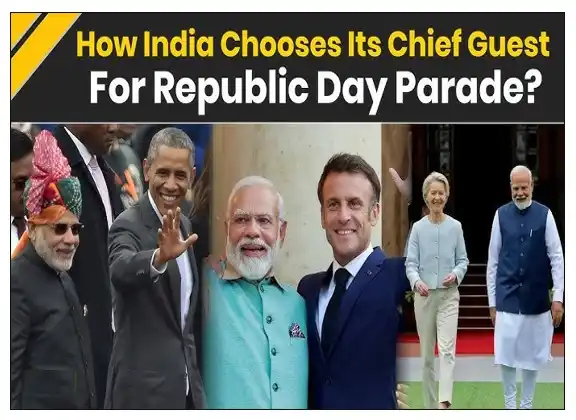
India marks Republic Day each year on January 26th with a spectacular parade that represents India’s constitutional values, cultural diversity, and military capabilities.
One of the most important aspects of the Republic Day celebrations is the choice of a Chief Guest, who is usually a foreign head of state or head of government. The person who serves as Chief Guest has a deep connection to diplomacy, strategy, and symbolism, rather than being simply ceremonial.
The chief guests invited to attend the Republic Day celebrations by India represent one of the highest levels of diplomatic recognition that a country can confer upon another. As well as sitting alongside the President of India during the celebrations and participating in some of the most important ceremonial elements, the invitation itself conveys an opportunity for strengthening relationships, demonstrating a level of ongoing partnership between nations, or, as appropriate, providing a message of policy strategy to the worldwide community.
Unlike routine state visits to and from countries, the invitation of a foreign leader to join India on Republic Day is usually offered by India during the course of the calendar year and reflects India’s most important foreign policy objectives for that year.
Institutional Process Behind the Selection
The Ministry of External Affairs (MEA) is primarily in charge of the selection process, albeit in collaboration with the Prime Minister’s Office (PMO). The MEA stands in communication with Indian embassies posted abroad, security agencies, and other relevant ministries throughout the consultation process to provide input in developing the shortlist of prospective candidates.
From time to time, the MEA prepares a shortlist of candidates long before (months or even around a year beforehand), however, once they establish mutual agreement internally, they make discreet diplomatic contacts with the candidate to indicate interest, and also to verify the candidate’s suitability, to then ultimately send an official invitation to the selected individual.
Another consideration in determining the appropriateness of a candidate is whether or not that candidate aligns with India’s Foreign Policy Goals. In the event that India wants to build stronger relationships with a country or region, it is likely that India will invite the leader from that country or region as the Chief Guest. Examples include:
- The invitation to leaders from ASEAN Member Nations reinforces the Act East Policy.
- The invitation to leaders from African Nations represents the concept of South-South Cooperation.
- The invitation to leaders from Western Nations often indicates a desire for heightened Strategic or Economic engagement by India with that nation.
- As such, the Chief Guest reflects the government of India’s desire to build strategic relationships through Diplomatic Capital.
Strategic and Geopolitical Considerations
India’s decision-making process is influenced by a number of factors, including geopolitical considerations.
In evaluating its decision to extend an invitation, India considers:
• Global Influence: India’s role in the world.
• Position on International Issues of Concern to India, for Example…: India has a vested interest in key issues such as Terrorism and Regional Stability.
• Existing Defense, Energy or Trade Partnerships.
In some cases, the invitation is used as an indirect diplomatic signal. The invitation can serve to reaffirm India’s alliances, provide balance among competing powers, or reinforce India’s Independent Foreign Policy objectives.
Another critical consideration in the invitation process is reciprocity. If a foreign government has recently recognized Indian leadership or supported India in a Forum, then extending an invitation to that government may be seen as a sign of goodwill.
Similarly, if an Indian Prime Minister has been recently to a country and signed major agreements with that country, then extending an invitation is a way to build on and continue that momentum and have the two countries establish a long-term relationship between them.
Regional Balance and Representation
India’s objective is to achieve geographical equity during the years. As part of this process, steps taken to ensure that a particular area does not consistently appear on the guest list. Over the years, South Asia, Africa, Europe, East Asia and North/South America will all have been part of the invitation process.
By inviting guests from all over the world India demonstrates to others that India is not simply a regional power but rather an inclusive power on the world stage.
Considerations Regarding Domestic and Security
The suitability of a guest in India is investigated before determining that an invitation will be extended to him/her. Those leaders who are involved in significant public disagreements, have experienced unrest or turmoil at home and have issues with India are typically eliminated from consideration.
The security agencies in India will evaluate each guest to determine the risks associated with the invitation and to determine how to mitigate these risks if the invitation is accepted.
Logistical and Practical Challenges
While a leader may appear to be a diplomatically perfect fit for an invitation extended by India, the practicality of scheduling and the availability of the leader will greatly affect the acceptance of the invitation. In addition to being available around the date of January 26 or Republic Day, the leader will need to have the time necessary to participate in several days of events during the visit, including official meetings, banquets and cultural activities.
Many of the invitations sent to world leaders by India have been declined due to scheduling conflicts and therefore, India is sometimes left with no choice but to invite an alternate candidate.
Symbolism Beyond Diplomacy
The effectiveness of a selection may often be determined from a historical or cultural perspective. Therefore, it is common to invite multiple leaders from nations that have had similar colonial experiences, embrace common democratic ideals, or possess a strong sense of civilizational identity in order to strengthen the cultural bonds and narratives of the countries involved. An example of this is to invite a head of state to a major anniversary of the establishment of diplomatic relations, as this indicates a sustained and enduring relationship between the two nations.
To summarize, selecting the Chief Guest at India’s Republic Day is the result of careful consideration driven by a strong sense of symbolism, strategy and practicality. The selection represents India’s priority in terms of foreign policy, regional interests and global ambitions at that time. It is far more than a mere ceremonial function; it represents India’s view of itself in relation to other nations and the type of leaders they wish to share the world stage with!
